
Note
Go to the end to download the full example code or to run this example in your browser via JupyterLite.
Zerocash: notes, nullifiers and private payments (2014)#
Bitcoin’s ledger shows who paid whom and how much. Ben-Sasson, Chiesa, Garman, Green, Miers, Tromer and Virza hid all three. A coin is a note, and the ledger stores only its commitment, in a Merkle tree. Spending a note publishes its nullifier \(\mathrm{nf} = H(\mathit{sk}, \rho)\), a commitment to the payee’s new note, and a zk-SNARK of the statement
The ledger records the nullifier to stop double spending, but cannot tell which commitment it belongs to. Zcash launched on this design in 2016.
import matplotlib.pyplot as plt

import blockchainkit as bk
Alice pays Bob, privately#
key = bk.proofs.spend_setup(3, bk.proofs.Groth16Trapdoor(5, 6, 7, 8, 9))
pool = bk.proofs.ShieldedPool(3, key.verifying_key)
alice, bob = 1111, 2222
coin = bk.proofs.Note(bk.proofs.owner_key(alice), 100, rho=1, randomness=77)
pool.mint(coin)  # Depositing reveals the amount, not the owner.
pool.mint(bk.proofs.Note(bk.proofs.owner_key(3333), 50, rho=9, randomness=5))  # Someone else's.

payment = bk.proofs.Note(bk.proofs.owner_key(bob), 70, rho=2, randomness=88)
spend = bk.proofs.prove_spend(key, pool, alice, coin, 0, payment, public_value=30, seed=1)
pool.spend(spend)
print("the ledger sees commitments", [c % 10**6 for c in pool.commitments], "...")
print("and one nullifier", spend.nullifier, "linked to none of them")
assert pool.supply == 120 and spend.nullifier not in pool.commitments
the ledger sees commitments [889954, 96551, 656852] ...
and one nullifier 1445271407 linked to none of them
Double spends, theft and inflation fail#
try:
    pool.spend(spend)
except ValueError as error:
    print("replaying the spend:", error)
for label, secret, new_note, public in (
    ("Mallory spends Bob's note", 4444, bk.proofs.Note(bk.proofs.owner_key(4444), 70, 3, 1), 0),
    (
        "Bob mints a 'negative' note",
        bob,
        bk.proofs.Note(bk.proofs.owner_key(bob), bk.proofs.FIELD_PRIME - 1000, 3, 1),
        1070,
    ),
):
    try:
        bk.proofs.prove_spend(key, pool, secret, payment, 2, new_note, public)
        raise AssertionError("a false statement was proved")
    except ValueError:
        print(label + ": no proof exists")
replaying the spend: double spend: the nullifier was already revealed
Mallory spends Bob's note: no proof exists
Bob mints a 'negative' note: no proof exists
What the circuit costs#
Each MiMC hash is 48 constraints; the Merkle path adds one hash per level.
depths = range(1, 9)
dummy = bk.proofs.Note(0, 0, 0, 0)
sizes = [
    bk.proofs.spend_circuit(d, 0, dummy, [0] * d, 0, dummy, 0).r1cs().num_constraints
    for d in depths
]
print("constraints by tree depth:", sizes)
assert sizes[1] - sizes[0] == 48 + 2

fig, ax = plt.subplots(figsize=(7, 4.5))
ax.bar(depths, sizes, color="#2563eb")
ax.set(xlabel="Merkle tree depth (log2 of the number of notes)", ylabel="R1CS constraints")
ax.set_title("The spend statement grows by one hash per level")
fig.tight_layout()

plt.show()
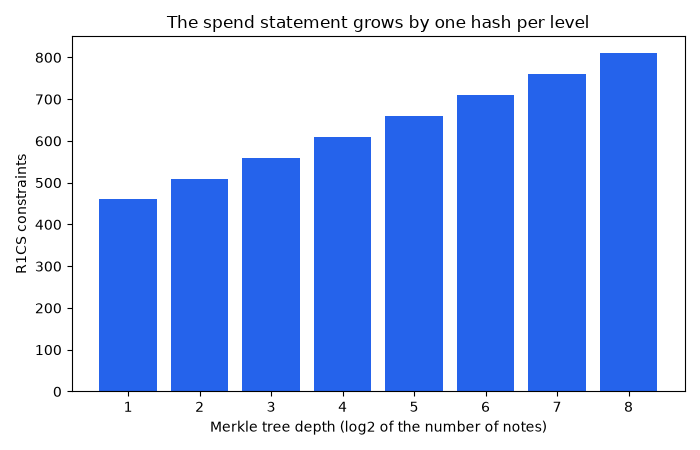
constraints by tree depth: [460, 510, 560, 610, 660, 710, 760, 810]
Exercise#
Bob’s “negative” note balances modulo p. Build its spend circuit with
spend_circuit and find which constraint the witness violates. Without
that constraint, how many coins would the spend create?
A worked solution is in Exercises: proof systems.
Total running time of the script: (0 minutes 0.294 seconds)
