Note
Go to the end to download the full example code or to run this example in your browser via JupyterLite.
Decker and Wattenhofer’s duplex micropayment channels (2015)#
A Spilman channel pays one way and is spent once its capacity has gone to
the payee. Decker and Wattenhofer pair two of them, one in each direction,
and reset the pair when one side runs dry, re-funding both from the
current balances. Without penalties, the newest pair must beat every older
one to the chain, and an invalidation tree of relative lock times sees to
that: at every level, each replacement lowers the lock time by
\(\delta\), so where two branches part, the newer one is valid first
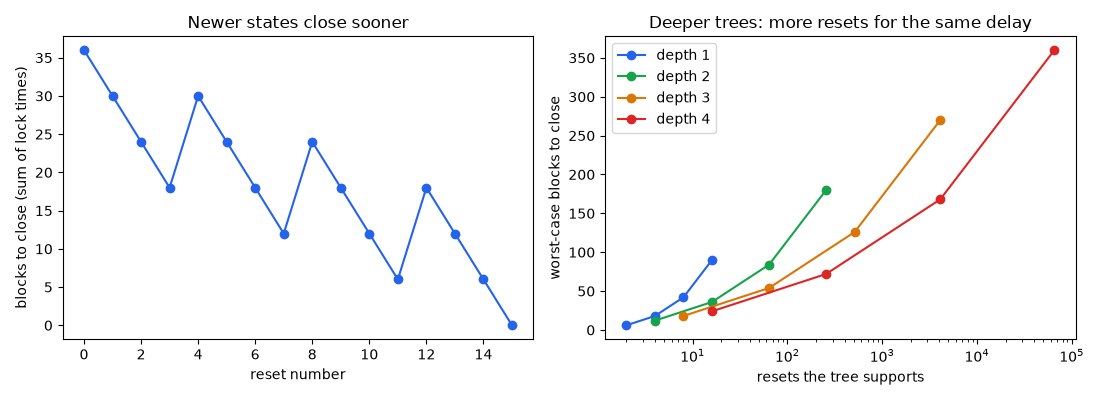
and spends the shared parent. A tree of depth d with s lock-time
values per level holds s^d resets, and closing waits for up to
blocks.
from random import Random

import matplotlib.pyplot as plt

import blockchainkit as bk
The newest branch always wins#
depth, steps, delta = 2, 4, 6
locks = [
    bk.channels.invalidation_locktimes(s, depth=depth, steps=steps, delta=delta)
    for s in range(steps**depth)
]
print("state 5 lock times:", locks[5], " state 6:", locks[6])
rng = Random(3)
for _ in range(100):
    published = rng.sample(range(steps**depth), 3)
    winner = bk.channels.first_confirmed(published, depth=depth, steps=steps, delta=delta)
    assert winner == max(published)
state 5 lock times: (12, 12) state 6: (12, 6)
Ping-pong payments until the tree is used up#
channel = bk.channels.DuplexChannel(
    ("alice", "bob"), (50, 50), depth=depth, steps=steps, delta=delta
)
payments = 0
try:
    while True:
        channel.pay("alice", 40)
        channel.pay("bob", 40)
        payments += 2
except ValueError as error:
    print(f"after {payments} payments and {channel.resets} resets: {error}")
assert channel.resets == steps**depth - 1
after 32 payments and 15 resets: the invalidation tree is exhausted; close the channel
Capacity against closing delay#
More levels give exponentially more resets, but closing waits for the lock times of every level.
shapes = [(d, s) for d in (1, 2, 3, 4) for s in (2, 4, 8, 16)]
for d, s in shapes:
    worst = sum(bk.channels.invalidation_locktimes(0, depth=d, steps=s, delta=delta))
    assert worst == d * (s - 1) * delta

fig, (left, right) = plt.subplots(1, 2, figsize=(11, 4))
left.plot(range(steps**depth), [sum(lock) for lock in locks], "o-", color="#2563eb")
left.set(xlabel="reset number", ylabel="blocks to close (sum of lock times)")
left.set_title("Newer states close sooner")
for d, color in zip((1, 2, 3, 4), ("#2563eb", "#16a34a", "#d97706", "#dc2626"), strict=True):
    points = [(s**d, d * (s - 1) * delta) for dd, s in shapes if dd == d]
    right.plot(*zip(*points, strict=True), "o-", color=color, label=f"depth {d}")
right.set_xscale("log")
right.set(xlabel="resets the tree supports", ylabel="worst-case blocks to close")
right.set_title("Deeper trees: more resets for the same delay")
right.legend()
fig.tight_layout()

plt.show()
Exercise#
With delta = 6 blocks, which shape of tree supports a million resets
while closing within a day (144 blocks)? Compare with Lightning, whose
number of updates is not limited by its delay at all.
A worked solution is in Exercises: channels.
Total running time of the script: (0 minutes 0.195 seconds)
