Note
Go to the end to download the full example code or to run this example in your browser via JupyterLite.
Poon and Dryja’s Lightning Network: revocation and penalties (2016)#
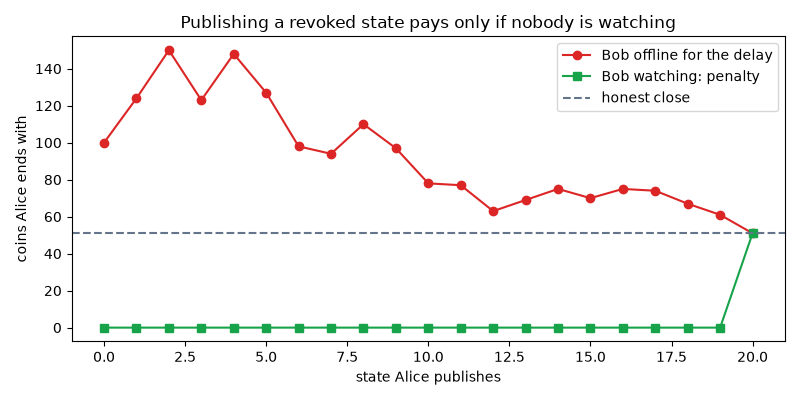
Lightning ranks a channel’s states by punishment rather than by time locks, so a channel can be updated any number of times. Each party holds its own commitment transaction, signed by the other. It pays the counterparty at once, but its holder only after a delay, during which anyone with the revocation key can take the holder’s output instead. Moving to a new state, each party reveals the secret behind its old commitment’s revocation key. Publishing a revoked commitment then forfeits the whole channel to a counterparty that is watching.
The revocation key adds the holder’s per-commitment point to the counterparty’s base point, so it is usable only once both secrets are known:
The secrets are a hash chain used backwards, so the counterparty stores only the latest one and hashes it to recover every older one.
from random import Random

import matplotlib.pyplot as plt

import blockchainkit as bk
Twenty payments back and forth#
def busy_channel(seed):
    rng = Random(seed)
    channel = bk.channels.LightningChannel(("alice", "bob"), (7, 5), (100, 100), delay=144)
    history = [dict(channel.balances)]
    for _ in range(20):
        sender = rng.choice(channel.parties)
        channel.pay(sender, rng.randint(1, min(30, channel.balances[sender])))
        history.append(dict(channel.balances))
    return channel, history


channel, history = busy_channel(5)
best_old = max(range(20), key=lambda s: history[s]["alice"])
print(f"Alice's best revoked state: {best_old}, with {history[best_old]['alice']} coins")
Alice's best revoked state: 2, with 150 coins
Alice publishes it: the penalty when Bob is watching#
channel.publish("alice", state=best_old, height=1_000)
penalty = channel.penalize(height=1_010)
print("penalty:", dict(penalty.payouts))
assert penalty.payouts["alice"] == 0 and penalty.payouts["bob"] == 200

# Bob stored one secret, and hashes it to rebuild the secret of any revoked state.
assert all(channel.derive_secret("alice", s) is not None for s in range(20))
assert channel.derive_secret("alice", 20) is None  # The current state is not revoked.
penalty: {'alice': 0, 'bob': 200}
If Bob sleeps through the delay, the theft succeeds#
alice_if_watched, alice_if_asleep = [], []
for state in range(21):
    alice_if_watched.append(0 if state < 20 else history[20]["alice"])
    alice_if_asleep.append(history[state]["alice"])
channel, _ = busy_channel(5)  # The same channel, rebuilt.
channel.publish("alice", state=best_old, height=1_000)
try:
    channel.sweep(height=1_100)
except ValueError as error:
    print("too early for Alice:", error)
theft = channel.sweep(height=1_144)
assert theft.payouts["alice"] == history[best_old]["alice"]

fig, ax = plt.subplots(figsize=(8, 4))
states = range(21)
ax.plot(states, alice_if_asleep, "o-", color="#dc2626", label="Bob offline for the delay")
ax.plot(states, alice_if_watched, "s-", color="#16a34a", label="Bob watching: penalty")
ax.axhline(history[20]["alice"], color="#64748b", linestyle="--", label="honest close")
ax.set(xlabel="state Alice publishes", ylabel="coins Alice ends with")
ax.set_title("Publishing a revoked state pays only if nobody is watching")
ax.legend()
fig.tight_layout()

plt.show()
too early for Alice: the holder's output is locked: OP_CHECKLOCKTIMEVERIFY: the lock time has not been reached
Exercise#
The penalty must be published within delay blocks of the revoked
commitment. Using sweep()
and penalize(),
find the last height at which Bob can still punish Alice, and explain
why a shorter delay is riskier for Bob.
A worked solution is in Exercises: channels.
Total running time of the script: (0 minutes 1.318 seconds)
