
Note
Go to the end to download the full example code or to run this example in your browser via JupyterLite.
Sprites and general state channels (Miller et al., 2017)#
With contracts, a channel can be a judge rather than a set of transactions. An adjudicator contract holds both deposits; the parties sign successive versions of any state; and at the end one of them submits the latest. If it submits an old version, the other has a dispute period to submit a newer one, and the contract pays out the highest version it saw.
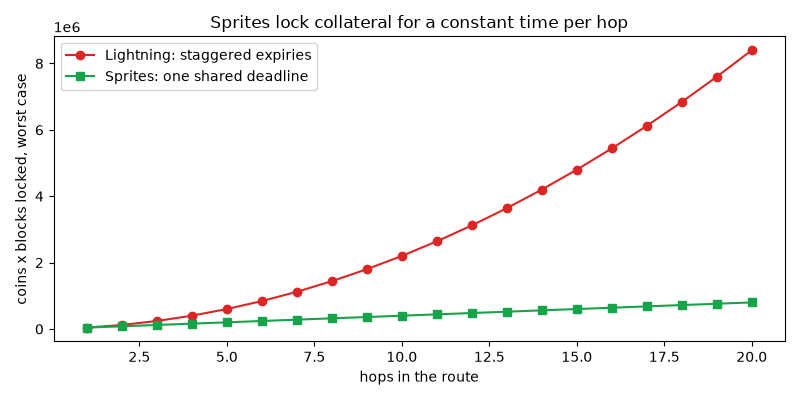
Sprites also shortened how long a multi-hop payment locks collateral. In Lightning each hop’s expiry exceeds the next one’s by \(\Delta\), so over \(n\) hops the first hop’s coins are locked for about \(n\Delta\). In Sprites every hop asks one preimage manager contract whether the preimage was published by a common deadline, so every hop expires at the same time:
import matplotlib.pyplot as plt

import blockchainkit as bk
from blockchainkit.contracts import World
from blockchainkit.crypto import public_key, sha256
A dispute settled by the adjudicator#
world = World()
world.fund("alice", 100)
keys = [public_key(7), public_key(5)]
channel = world.deploy(
    "alice", bk.channels.StateChannel, keys, ["alice", "bob"], [100, 0], 20, value=100
)


def signed(version, balances):
    return [bk.channels.sign_state(k, channel, version, balances) for k in (7, 5)]


states = {v: [100 - 10 * v, 10 * v] for v in range(8)}  # Alice pays Bob 10 per version.
stale = world.transact("alice", channel, "submit", 2, states[2], signed(2, states[2]))
assert stale.success  # Alice submits version 2, when version 7 exists.
world.advance(5)
assert world.transact("bob", channel, "submit", 7, states[7], signed(7, states[7])).success
world.advance(15)
assert world.transact("bob", channel, "settle").success
print("payouts:", world.balance("alice"), world.balance("bob"))
assert (world.balance("alice"), world.balance("bob")) == (30, 70)
payouts: 30 70
One preimage manager for every hop#
manager = world.deploy("deployer", bk.channels.PreimageManager)
deadline = world.block_number + 10
world.advance(3)
world.transact("carol", manager, "publish", b"invoice 42")  # The recipient publishes.
assert world.view(manager, "published_by", sha256(b"invoice 42"), deadline)
Collateral locked as the path grows#
delta, amount = 40, 1_000
hops = range(1, 21)
lightning, sprites = [], []
for n in hops:
    amounts = [amount] * n
    staggered = bk.channels.htlc_expiries(n, delta=delta)
    shared = bk.channels.sprites_expiries(n, delta=delta)
    lightning.append(bk.channels.collateral_time(amounts, staggered))
    sprites.append(bk.channels.collateral_time(amounts, shared))
assert lightning[-1] / sprites[-1] == (20 + 1) / 2  # (n + 1) / 2 times as much.

fig, ax = plt.subplots(figsize=(8, 4))
ax.plot(hops, lightning, "o-", color="#dc2626", label="Lightning: staggered expiries")
ax.plot(hops, sprites, "s-", color="#16a34a", label="Sprites: one shared deadline")
ax.set(xlabel="hops in the route", ylabel="coins x blocks locked, worst case")
ax.set_title("Sprites lock collateral for a constant time per hop")
ax.legend()
fig.tight_layout()

plt.show()
Exercise#
Bob must answer within the dispute period. Using
StateChannel, find
the last block at which his newer state is still accepted after Alice’s
stale submission, and explain what a longer period costs an honest party
who wants to close.
Total running time of the script: (0 minutes 0.103 seconds)
