Note
Go to the end to download the full example code or to run this example in your browser via JupyterLite.
eltoo: channel updates without penalties (Decker, Russell and Osuntokun, 2018)#
Lightning’s penalty punishes mistakes as hard as theft: restore an old backup, publish it, and lose the channel. eltoo replaces punishment with replacement. Every state is an update transaction, which can spend the funding output or any earlier update, and a settlement, which pays that state’s balances after a delay. An old update on chain is simply overwritten by a newer one, and only the last update ever settles.
Updates can attach to any earlier update because they are signed with
SIGHASH_NOINPUT, which leaves the spent output out of the signature;
and only later updates can attach, because each update output demands a
lock time above its own state number:
import matplotlib.pyplot as plt

import blockchainkit as bk
Twelve updates, and a stale publication#
channel = bk.channels.EltooChannel(("alice", "bob"), (7, 5), (100, 100), delay=144)
for state in range(12):
    channel.pay("alice" if state % 3 else "bob", 10)
print("latest balances:", channel.balances)

channel.publish(state=4, height=1_000)  # Alice publishes an old state...
try:
    channel.publish(state=2, height=1_001)  # ...and cannot go further back.
except ValueError as error:
    print("state 2 rejected:", error)
channel.publish(height=1_002)  # Bob overwrites it with the latest.
settlement = channel.settle(height=1_002 + 144)
assert dict(settlement.payouts) == channel.balances and settlement.state == 12
latest balances: {'alice': 60, 'bob': 140}
state 2 rejected: update 2 cannot replace the one on chain: OP_CHECKLOCKTIMEVERIFY: the lock time has not been reached
The cost of publishing an old state, by mistake or on purpose#
Compare Lightning, where a watching counterparty takes everything, with eltoo, where the stale state is replaced and costs nothing but fees.
lightning = bk.channels.LightningChannel(("alice", "bob"), (7, 5), (100, 100), delay=144)
for state in range(12):
    lightning.pay("alice" if state % 3 else "bob", 10)
honest = lightning.balances["alice"]
lightning.publish("alice", state=4, height=1_000)
lost = honest - lightning.penalize(height=1_001).payouts["alice"]
print(f"stale state 4: Alice loses {lost} in Lightning, 0 in eltoo")
assert lost == honest

fig, ax = plt.subplots(figsize=(7, 4))
ax.bar(["Lightning", "eltoo"], [lost, 0], color=["#dc2626", "#16a34a"])
ax.set(ylabel="coins Alice loses", title="Publishing an old state: penalty or replacement")
fig.tight_layout()

plt.show()
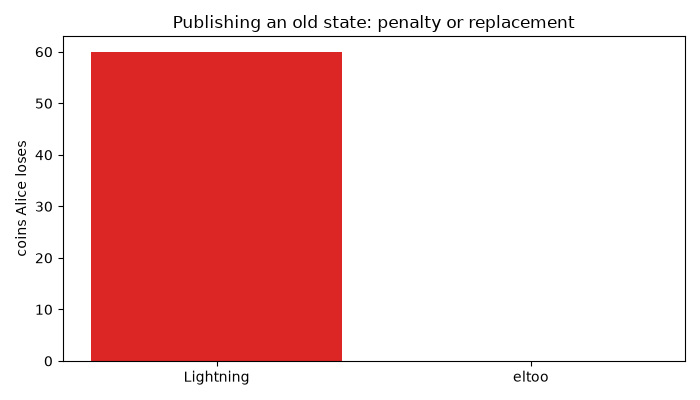
stale state 4: Alice loses 60 in Lightning, 0 in eltoo
Exercise#
In eltoo each party keeps only the latest update and settlement. What must a Lightning party keep to be able to punish every revoked state, and how does the hash chain of per-commitment secrets keep that small?
Total running time of the script: (0 minutes 0.884 seconds)
