
Note
Go to the end to download the full example code or to run this example in your browser via JupyterLite.
King’s symbolic execution: every path of a fee schedule (1976)#
James King proposed running a program on symbols instead of numbers. Every variable holds an expression over the inputs, and each branch on such an expression forks the run in two. Each path then carries a path condition, the conjunction of the decisions it took:
Any input satisfying the path condition drives a concrete run down exactly that path, so solving the condition of a path that fails an assertion produces a bug-triggering input, without guessing.
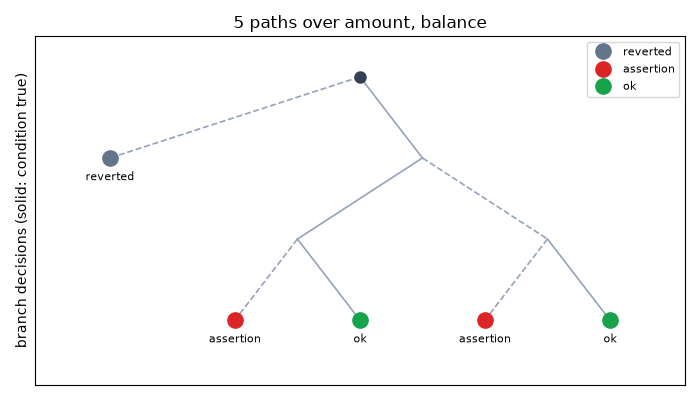
The program charges a fee that depends on the amount. Its check only
requires amount <= balance, forgetting the fee. Symbolic execution
finds five paths, and solving the two that fail the assertion yields inputs
that leave a negative balance.
import matplotlib.pyplot as plt

import blockchainkit as bk
from blockchainkit.contracts.visualizers import plot_symbolic_paths
Explore every path#
program = """
require(amount <= balance)
if amount > 100:
    fee = 2
else:
    fee = 1
balance = balance - amount - fee
assert balance >= 0
"""
result = bk.contracts.symbolic_execute(program)
print(result.outcomes)
for path in result.paths:
    condition = " and ".join(bk.contracts.to_source(c) for c in path.conditions)
    print(f"{path.outcome:9s} if {condition}")
assert result.outcomes == {"reverted": 1, "assertion": 2, "ok": 2}
{'reverted': 1, 'assertion': 2, 'ok': 2}
reverted  if not amount <= balance
assertion if amount <= balance and amount > 100 and not balance - amount - 2 >= 0
ok        if amount <= balance and amount > 100 and balance - amount - 2 >= 0
assertion if amount <= balance and not amount > 100 and not balance - amount - 1 >= 0
ok        if amount <= balance and not amount > 100 and balance - amount - 1 >= 0
Solve the failing paths#
The solver tries boundary values: 0, 1, 2, and every constant in the condition with its neighbors.
for path in result.paths:
    if path.outcome == "assertion":
        witness = bk.contracts.solve(path.conditions)
        outcome, final = bk.contracts.run_program(program, witness)
        print(witness, "->", outcome, "balance", final["balance"])
        assert outcome == "assertion" and final["balance"] < 0

fixed = program.replace("amount <= balance", "amount + 2 <= balance")
fixed_paths = bk.contracts.symbolic_execute(fixed).paths
assert all(
    bk.contracts.solve(path.conditions) is None
    for path in fixed_paths
    if path.outcome == "assertion"
)

fig, ax = plt.subplots(figsize=(7, 4))
plot_symbolic_paths(result, ax=ax)
fig.tight_layout()

plt.show()
{'amount': 101, 'balance': 101} -> assertion balance -2
{'amount': 0, 'balance': 0} -> assertion balance -1
Exercise#
Add a third fee tier (amount > 1000 pays 5). How many paths does
symbolic execution find now, and how many does a program with n
independent if statements have in the worst case?
Total running time of the script: (0 minutes 0.029 seconds)
