
Note
Go to the end to download the full example code or to run this example in your browser via JupyterLite.
Meyer’s design by contract: an escrow with checked clauses (1986)#
Bertrand Meyer’s Eiffel treats every routine as a contract. The caller must
establish the precondition; the routine then guarantees the
postcondition; and every public routine preserves the class
invariant. Checked at run time, a violated clause names the culprit: a
failed precondition is the caller’s bug, a failed postcondition or
invariant the supplier’s. In Hoare’s notation, a routine r must satisfy
Solidity’s require and assert are the same idea, and a violated
clause reverts the transaction. The escrow below holds deposits for
several accounts; its invariant ties the recorded deposits to the ether
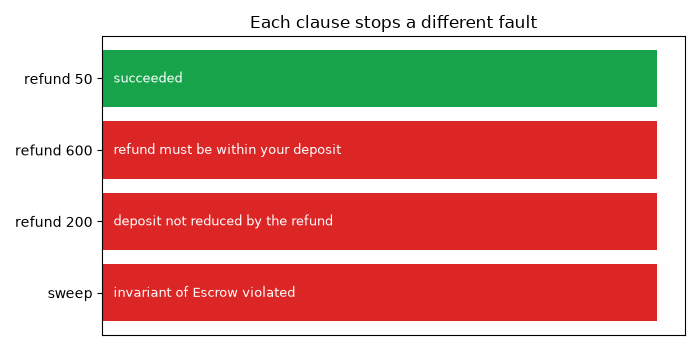
it actually holds. A refund with a rounding bug is stopped by its
postcondition, and a sweep that forgets to update the books is stopped by
the invariant, each before any state changes.
import matplotlib.pyplot as plt

import blockchainkit as bk
from blockchainkit.contracts import Contract, ensures, requires
An escrow with a precondition, a postcondition and an invariant#
class Escrow(Contract):
    layout = ("deposits", "total", "fee")

    def receive(self):
        self.write("deposits", self.sender, self.read("deposits", self.sender) + self.value)
        self.write("total", self.read("total") + self.value)

    @requires(
        lambda self, amount: 0 < amount <= self.read("deposits", self.sender),
        "refund must be within your deposit",
    )
    @ensures(
        lambda self, old, result, amount: (
            self.read("deposits", self.sender) == old("deposits", self.sender) - amount
        ),
        "deposit not reduced by the refund",
    )
    def refund(self, amount):
        fee = amount // 100  # A bug: the fee is charged to the depositor's record twice.
        self.write("deposits", self.sender, self.read("deposits", self.sender) - amount - fee)
        self.write("total", self.read("total") - amount)
        self.call(self.sender, None, value=amount)

    def sweep(self, to):
        self.call(to, None, value=self.ether_balance())  # Forgets to update the books.

    def invariant(self):
        return self.read("total") == self.ether_balance() == sum(self.entries("deposits").values())


world = bk.contracts.World()
for account in ("alice", "bob"):
    world.fund(account, 1_000)
escrow = world.deploy("operator", Escrow)
world.transact("alice", escrow, value=500)
world.transact("bob", escrow, value=300)

attempts = {
    "refund 50": world.transact("alice", escrow, "refund", 50),
    "refund 600": world.transact("alice", escrow, "refund", 600),
    "refund 200": world.transact("alice", escrow, "refund", 200),
    "sweep": world.transact("mallory", escrow, "sweep", "mallory"),
}
for name, receipt in attempts.items():
    print(f"{name:10s} ->", "ok" if receipt.success else receipt.error)
assert attempts["refund 50"].success
assert attempts["refund 600"].error == "refund must be within your deposit"
assert attempts["refund 200"].error == "deposit not reduced by the refund"
assert attempts["sweep"].error == "invariant of Escrow violated"
assert world.balance(escrow) == 750 and world.balance("mallory") == 0

fig, ax = plt.subplots(figsize=(7, 3.5))
names = list(attempts)
ax.barh(
    names,
    [1] * len(names),
    color=["#16a34a" if r.success else "#dc2626" for r in attempts.values()],
)
for row, receipt in enumerate(attempts.values()):
    ax.text(
        0.02,
        row,
        "succeeded" if receipt.success else receipt.error,
        va="center",
        color="white",
        fontsize=9,
    )
ax.set(xticks=[], title="Each clause stops a different fault")
ax.invert_yaxis()
fig.tight_layout()

plt.show()
refund 50  -> ok
refund 600 -> refund must be within your deposit
refund 200 -> deposit not reduced by the refund
sweep      -> invariant of Escrow violated
Exercise#
A refund of 50 passed although the code is buggy. For which amounts does the postcondition catch the fee bug, and why does that make run-time checking weaker than proof?
Total running time of the script: (0 minutes 0.033 seconds)
