
Note
Go to the end to download the full example code or to run this example in your browser via JupyterLite.
Oyente: symbolic execution finds the BeautyChain overflow in bytecode (2016)#
Oyente, by Luu, Chu, Olickel, Saxena and Hobor, ran symbolic execution on deployed EVM bytecode, with the Z3 solver deciding which paths were feasible. Run over 19,366 contracts on the main network, it flagged about 8,800 as vulnerable, including the DAO. Working on bytecode means checking what actually runs, not what the source was meant to say.
Here the same idea runs over the stack machine of blockchainkit.vm.
Storage slot k starts as the symbol s<k> and the argument as
value; arithmetic wraps modulo \(2^{256}\). The bug is stated as
a condition on a finished path: a recipient’s balance grows while the
sender’s does not shrink,
On the BeautyChain-style batch_transfer, the solver finds
\(\mathrm{value} = 2^{255}\), the value of the April 2018 attack; with
the SafeMath check no input satisfies the condition.
import matplotlib.pyplot as plt

import blockchainkit as bk
from blockchainkit.constants import WORD_MODULUS
from blockchainkit.contracts.visualizers import plot_symbolic_paths
Explore the bytecode#
bug = "slot1 >= s1 and slot2 > s2"
reports = {}
for checked in (False, True):
    program = bk.vm.batch_transfer(1, [2, 3], checked=checked)
    result = bk.contracts.symbolic_bytecode(program, arguments=("value",))
    witnesses = []
    for path in result.paths:
        if path.outcome == "stop":
            query = (*path.conditions, bk.contracts.expression(bug, **path.state))
            witness = bk.contracts.solve(query, modulus=WORD_MODULUS)
            if witness is not None:
                witnesses.append(witness)
    reports[checked] = (result, witnesses)
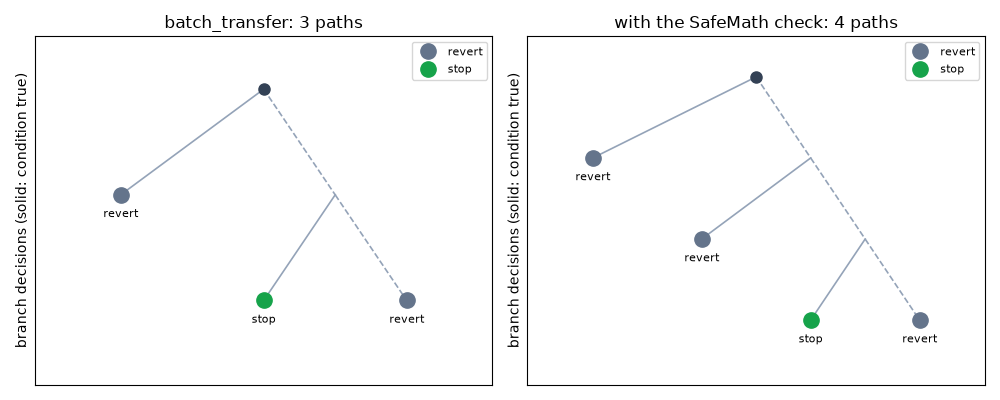
    print(f"checked={checked}: {result.outcomes}, bug inputs {witnesses}")

attack = reports[False][1][0]
assert attack["value"] == 2**255 and not reports[True][1]
checked=False: {'revert': 2, 'stop': 1}, bug inputs [{'s1': 0, 's2': 0, 'value': 57896044618658097711785492504343953926634992332820282019728792003956564819968}]
checked=True: {'revert': 3, 'stop': 1}, bug inputs []
Confirm the witness concretely#
storage = {1: attack["s1"], 2: attack["s2"], 3: 0}
run = bk.vm.execute(bk.vm.batch_transfer(1, [2, 3]), arguments=(attack["value"],), storage=storage)
print(dict(run.storage))
assert run.storage[2] == run.storage[3] == 2**255 and run.storage[1] == 0

fig, (left, right) = plt.subplots(1, 2, figsize=(10, 4))
plot_symbolic_paths(reports[False][0], ax=left)
left.set_title("batch_transfer: 3 paths")
plot_symbolic_paths(reports[True][0], ax=right)
right.set_title("with the SafeMath check: 4 paths")
fig.tight_layout()

plt.show()
{1: 0, 2: 57896044618658097711785492504343953926634992332820282019728792003956564819968, 3: 57896044618658097711785492504343953926634992332820282019728792003956564819968}
Exercise#
With three recipients the overflowing value is no longer
\(2^{255}\), and the default candidates miss it. Find a value that
makes 3 * value wrap to a small number, and pass it to solve
through candidates. A worked solution is in Exercises: contracts.
Total running time of the script: (0 minutes 0.043 seconds)
