
Note
Go to the end to download the full example code or to run this example in your browser via JupyterLite.
Schelling’s focal points: coordinating without communicating (1960)#
Two people must meet in a city on the same day, without having agreed where or when. Any place and time is a good answer if both choose it, so game theory alone predicts nothing. Schelling found that most people choose the same one anyway, because it stands out: noon, at the main station. Such a focal point lets players coordinate because each expects the others to pick it.
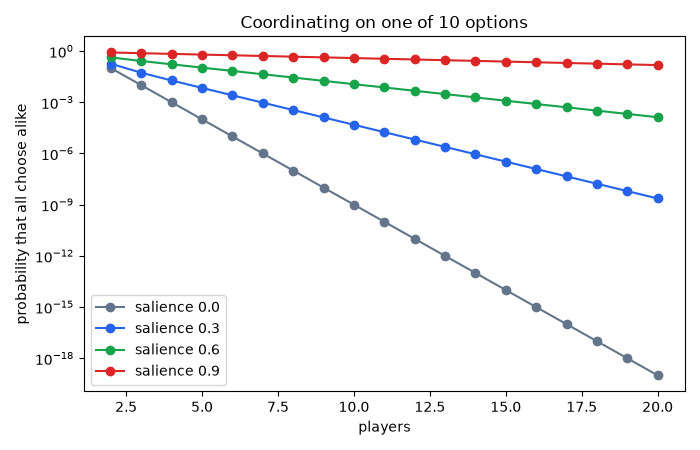
Suppose each of \(k\) players picks the focal option with probability \(s\), its salience, and otherwise picks any of \(n\) options at random. All of them coincide with probability
Without salience, coordination collapses as players are added; with even a moderately salient answer it does not. Blockchain oracles and voting games rely on the truth being such an answer.
import matplotlib.pyplot as plt

import blockchainkit as bk
Chance against salience#
options = 10
for salience in (0.0, 0.5):
    measured = bk.economics.play_coordination(5, options, salience, rounds=20_000, seed=1)
    exact = bk.economics.coordination_probability(5, options, salience)
    print(f"salience {salience}: five players meet {measured:.2%} of the time (exact {exact:.2%})")
    assert abs(measured - exact) < 0.01

assert bk.economics.coordination_probability(5, options, 0.0) < 1e-3
assert bk.economics.coordination_probability(5, options, 0.5) > 0.03

fig, ax = plt.subplots(figsize=(7, 4.5))
players = range(2, 21)
for salience, color in ((0.0, "#64748b"), (0.3, "#2563eb"), (0.6, "#16a34a"), (0.9, "#dc2626")):
    chances = [bk.economics.coordination_probability(k, options, salience) for k in players]
    ax.semilogy(players, chances, "o-", color=color, label=f"salience {salience}")
ax.set(
    xlabel="players",
    ylabel="probability that all choose alike",
    title=f"Coordinating on one of {options} options",
)
ax.legend()
fig.tight_layout()

plt.show()
salience 0.0: five players meet 0.01% of the time (exact 0.01%)
salience 0.5: five players meet 5.25% of the time (exact 5.03%)
Exercise#
With 20 players and 10 options, what salience gives an even chance that everyone coincides? Why does a large group need a much more obvious focal point than a pair? A worked solution is in Exercises: economics.
Total running time of the script: (0 minutes 0.158 seconds)
