
Note
Go to the end to download the full example code or to run this example in your browser via JupyterLite.
SchellingCoin: a decentralized oracle (2014)#
A contract cannot read the price of ether in dollars; someone must report it. Buterin’s SchellingCoin asks many reporters, each with a deposit, publishes the median, and rewards those between the lower and upper quartile, while the others lose their deposit. Each reporter cannot know what the others will say, so it reports what it expects them to report: the truth, the focal point.
Below a quarter of the reports, liars lose their deposits and the median does not move. Above a quarter, a cartel that agrees on one value is inside the quartiles and is paid like everyone else; above half, it sets the answer; above three quarters, the honest reporters lose their deposits:
from random import Random

import matplotlib.pyplot as plt

import blockchainkit as bk
Honest reporters, then a growing cartel#
rng = Random(4)
TRUE_PRICE = 2_000
honest_reports = [round(rng.gauss(TRUE_PRICE, 3), -1) for _ in range(40)]  # Rounded to 10.

answers, honest_payout, cartel_payout = [], [], []
cartel_sizes = range(0, 41, 4)
for cartel in cartel_sizes:
    reports = {f"honest{i}": value for i, value in enumerate(honest_reports[cartel:])}
    reports |= {f"cartel{i}": 2_500 for i in range(cartel)}
    result = bk.economics.schelling_round(reports, reward=1, deposit=5)
    answers.append(result.answer)
    honest = [result.payouts[name] for name in reports if name.startswith("honest")]
    cartel_gains = [result.payouts[name] for name in reports if name.startswith("cartel")]
    honest_payout.append(sum(honest) / len(honest) if honest else float("nan"))
    cartel_payout.append(sum(cartel_gains) / len(cartel_gains) if cartel_gains else float("nan"))

at = cartel_sizes.index
assert cartel_payout[at(8)] == -5 and answers[at(8)] == TRUE_PRICE  # 20%: liars pay.
assert cartel_payout[at(12)] == 1 and answers[at(16)] == TRUE_PRICE  # 30-40%: liars are paid.
assert answers[at(24)] == 2_500  # 60%: the cartel sets the price.
assert honest_payout[at(32)] == -5  # 80%: honest reporters lose their deposits.
print("published price with a 40% cartel:", answers[at(16)])

fig, (left, right) = plt.subplots(1, 2, figsize=(11, 4.2))
fractions = [c / 40 for c in cartel_sizes]
left.plot(fractions, answers, "o-", color="#2563eb")
left.axhline(TRUE_PRICE, color="#16a34a", linestyle="--", label="true price")
left.set(xlabel="fraction of reporters in the cartel", ylabel="published median")
left.set_title("The median holds until a majority lies")
left.legend()
right.plot(fractions, honest_payout, "o-", color="#16a34a", label="honest reporter")
right.plot(fractions, cartel_payout, "s-", color="#dc2626", label="cartel member")
right.set(xlabel="fraction of reporters in the cartel", ylabel="average payout")
right.set_title("Who keeps their deposit")
right.legend()
fig.tight_layout()

plt.show()
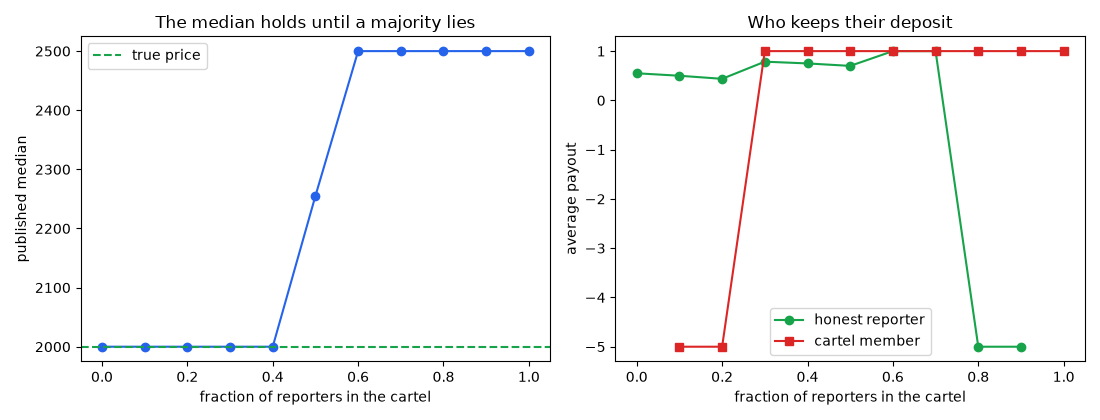
published price with a 40% cartel: 2000.0
Exercise#
In the “P + epsilon” attack, an attacker promises to pay every voter who reports 2,500 its deposit plus a small bonus, but only if the vote fails. Using this payout rule, explain why reporting 2,500 becomes a dominant strategy, and why the attacker pays nothing if everyone believes it.
Total running time of the script: (0 minutes 0.081 seconds)
