
Note
Go to the end to download the full example code or to run this example in your browser via JupyterLite.
Proposer-builder separation and MEV-Boost (2022)#
Extracting the value of transaction ordering takes searchers, private order flow and fast infrastructure. A validator that has them earns more per unit of stake than one that does not, and so attracts more stake: MEV pushes proof of stake toward a few large operators. Proposer-builder separation splits the roles. Specialized builders assemble blocks and bid for the slot; the proposer, any validator, signs the best bid.
If builders bid their values \(v_b = f + \sigma_b M\) for fees \(f\), MEV \(M\) and skill \(\sigma_b\), the proposer receives at least the second-highest value,
so with competitive builders a solo validator earns nearly as much per slot as a sophisticated one. Flashbots’ MEV-Boost, launched with Ethereum’s move to proof of stake in September 2022, runs this auction outside the protocol, through relays the proposer must trust.
import matplotlib.pyplot as plt
import numpy as np

import blockchainkit as bk
A sophisticated operator and two solo stakers#
stakes = {"operator": 64, "solo A": 32, "solo B": 32}
options = {"sophisticated": {"operator"}, "slots": 20_000, "fees": 0.05, "mev": 0.05}
runs = {}
for label, separated, builders in (
    ("no PBS", False, {}),
    ("PBS, two strong builders", True, {"b1": 1.0, "b2": 0.95}),
    ("PBS, one strong builder", True, {"b1": 1.0, "b2": 0.3}),
):
    runs[label] = bk.economics.simulate_pbs(
        stakes, separated=separated, builders=builders, seed=9, **options
    )
    per_stake = {v: runs[label].revenue_per_stake(v) * 32 for v in stakes}
    print(label, {v: round(r, 1) for v, r in per_stake.items()})

alone = runs["no PBS"]
assert alone.revenue_per_stake("operator") > 1.7 * alone.revenue_per_stake("solo A")
boosted = runs["PBS, two strong builders"]
assert boosted.revenue_per_stake("operator") < 1.1 * boosted.revenue_per_stake("solo A")

fig, (left, right) = plt.subplots(1, 2, figsize=(12, 4.5))
xs = np.arange(len(stakes))
for i, (label, run) in enumerate(runs.items()):
    left.bar(
        xs + (i - 1) * 0.27,
        [run.revenue_per_stake(v) * 32 for v in stakes],
        0.27,
        label=label,
    )
left.set_xticks(xs, list(stakes))
left.set(ylabel="revenue per 32 staked")
left.set_title("Builder competition equalizes validators")
left.legend(fontsize=8)
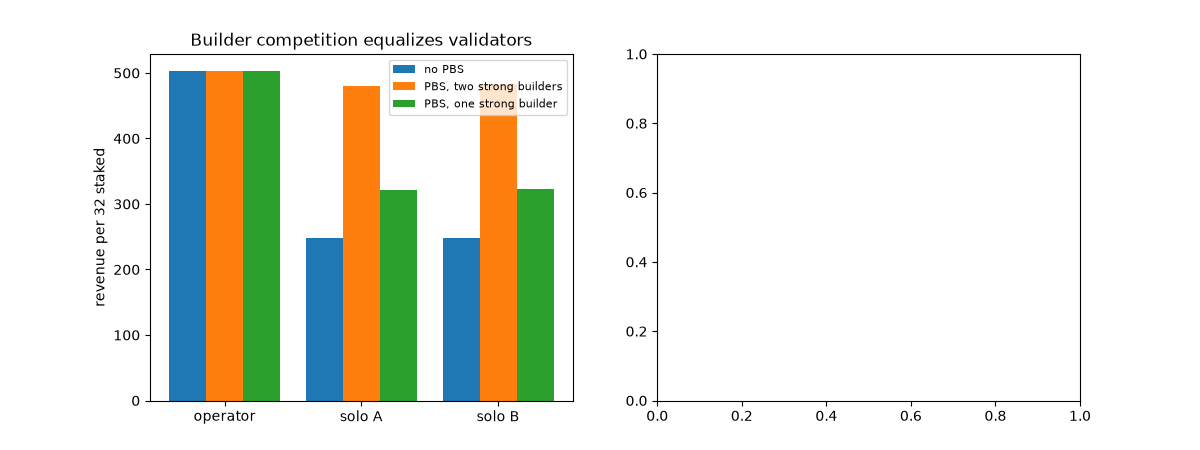
no PBS {'operator': 503.8, 'solo A': 247.5, 'solo B': 248.1}
PBS, two strong builders {'operator': 503.8, 'solo A': 480.0, 'solo B': 483.5}
PBS, one strong builder {'operator': 503.8, 'solo A': 320.9, 'solo B': 322.4}
How much competition is enough?#
skills = np.linspace(0, 1, 11)
ratio = []
for skill in skills:
    run = bk.economics.simulate_pbs(
        stakes, builders={"b1": 1.0, "b2": float(skill)}, seed=9, **options
    )
    ratio.append(run.revenue_per_stake("solo A") / run.revenue_per_stake("operator"))
right.plot(skills, ratio, "o-", color="#2563eb")
right.axhline(1, color="black", linestyle=":")
right.set(xlabel="second builder's skill", ylabel="solo revenue / operator revenue")
right.set_title("Solo stakers get what the runner-up builder would pay")
fig.tight_layout()
assert ratio[0] < ratio[-1] and ratio[-1] > 0.95

plt.show()
Exercise#
The proposer receives the second-highest value, but the winning builder keeps the gap between its value and that price. With one builder of skill 1 and one of skill 0.5, what fraction of the MEV does the winning builder keep, and why might it pay to integrate a builder with a large validator?
Total running time of the script: (0 minutes 0.436 seconds)
