
Note
Go to the end to download the full example code or to run this example in your browser via JupyterLite.
Sandwich attacks on decentralized exchanges (Zhou et al. 2021)#
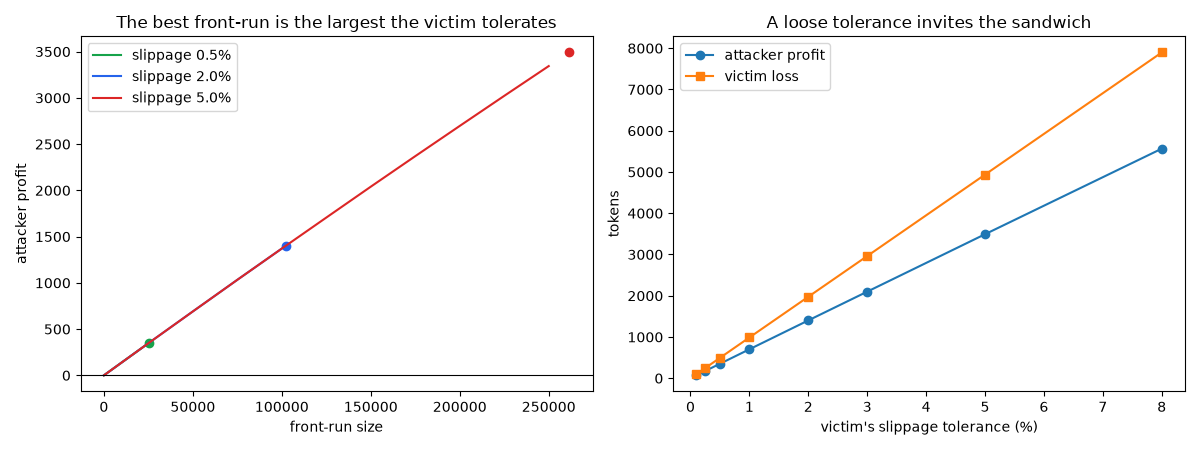
A swap on a constant-product pool waits in the public mempool before it is mined. An attacker who sees it can sandwich it: buy just before it, which raises the price the victim pays, and sell just after, at the price the victim’s own purchase pushed up. The victim’s slippage limit, the least output it accepts, is all that stops the attacker: the victim’s swap reverts below it, so the attacker picks the most profitable front-run \(a\) among those that keep
For a large trade, that is the largest one allowed. Zhou et al. derived this optimal attack, showed how a looser tolerance hands more of the trade to the attacker, and measured sandwiches on Uniswap.
import matplotlib.pyplot as plt

import blockchainkit as bk
One sandwich#
RESERVES = (10_000_000, 10_000_000)
VICTIM = 100_000
attack = bk.economics.sandwich_attack(*RESERVES, VICTIM, slippage_bps=200)
print(
    f"front-run {attack.front_run:,}; victim gets {attack.victim_out:,} "
    f"instead of {attack.victim_out_alone:,}; attacker profit {attack.profit:,}"
)
assert attack.profit > 0 and attack.victim_loss > attack.profit  # Fees take the difference.

# The pool contract agrees with the formula.
world = bk.contracts.World()
tok = world.deploy("lp", bk.contracts.ERC20, 10**9, name="TOK")
usd = world.deploy("lp", bk.contracts.ERC20, 10**9, name="USD")
pool = world.deploy("lp", bk.economics.ConstantProductPool, usd, tok, name="pool")
for who in ("lp", "victim", "attacker"):
    if who != "lp":
        world.transact("lp", usd, "transfer", who, 10**7)
    for token in (tok, usd):
        world.transact(who, token, "approve", pool, 10**9)
world.transact("lp", pool, "add_liquidity", *RESERVES)
minimum = attack.victim_out_alone * 9_800 // 10_000
bought = world.transact("attacker", pool, "swap", usd, attack.front_run, 0).result
victim = world.transact("victim", pool, "swap", usd, VICTIM, minimum)
sold = world.transact("attacker", pool, "swap", tok, bought, 0).result
assert victim.result == attack.victim_out and sold - attack.front_run == attack.profit
greedy = bk.economics.sandwich_profit(*RESERVES, VICTIM, attack.front_run + 10_000)
assert greedy.victim_out < minimum  # Any larger, and the victim's swap would revert.
front-run 102,223; victim gets 96,740 instead of 98,715; attacker profit 1,402
Profit against the front-run, and against the tolerance#
fig, (left, right) = plt.subplots(1, 2, figsize=(12, 4.5))
sizes = range(0, 1_500_001, 25_000)
for slippage, color in ((50, "#16a34a"), (200, "#2563eb"), (500, "#dc2626")):
    best = bk.economics.sandwich_attack(*RESERVES, VICTIM, slippage_bps=slippage)
    floor = best.victim_out_alone * (10_000 - slippage) // 10_000
    feasible = [
        a for a in sizes if bk.economics.sandwich_profit(*RESERVES, VICTIM, a).victim_out >= floor
    ]
    left.plot(
        feasible,
        [bk.economics.sandwich_profit(*RESERVES, VICTIM, a).profit for a in feasible],
        color=color,
        label=f"slippage {slippage / 100}%",
    )
    left.plot(best.front_run, best.profit, "o", color=color)
left.axhline(0, color="black", linewidth=0.8)
left.set(xlabel="front-run size", ylabel="attacker profit")
left.set_title("The best front-run is the largest the victim tolerates")
left.legend()

tolerances = [10, 25, 50, 100, 200, 300, 500, 800]
results = [bk.economics.sandwich_attack(*RESERVES, VICTIM, slippage_bps=s) for s in tolerances]
right.plot(
    [s / 100 for s in tolerances], [r.profit for r in results], "o-", label="attacker profit"
)
right.plot(
    [s / 100 for s in tolerances], [r.victim_loss for r in results], "s-", label="victim loss"
)
right.set(xlabel="victim's slippage tolerance (%)", ylabel="tokens")
right.set_title("A loose tolerance invites the sandwich")
right.legend()
fig.tight_layout()
# The victim moves the price by about 2%, more than the attacker's two fees of 0.3%,
# so even a tight tolerance leaves a profit; a loose one multiplies it.
assert results[0].profit > 0 and all(
    a.profit < b.profit for a, b in zip(results, results[1:], strict=False)
)

plt.show()
Exercise#
The victim could split its trade into ten swaps of 10,000. Assuming each is sandwiched with the same tolerance, does the attacker earn more or less in total? What about the 0.3% fee the attacker pays twice? A worked solution is in Exercises: economics.
Total running time of the script: (0 minutes 0.080 seconds)
