
Note
Go to the end to download the full example code or to run this example in your browser via JupyterLite.
Approval (“ice”) phishing on ERC-20 allowances (2022)#
An ERC-20 approve lets a spender move the owner’s tokens later without
asking again. Exchanges ask once for an unlimited allowance, so users learn
to sign approvals without reading them. In February 2022 Microsoft named
ice phishing the attack that exploits this: a fake airdrop or mint page
asks the victim to approve the attacker’s contract, and the attacker
empties the wallet whenever it likes. Nothing is stolen from the keys; the
signature the victim reads in the wallet is the whole attack:
token.approve(0x9a1f...c3d7, type(uint256).max); // "Claim your airdrop"
What a wallet stands to lose is the sum, over its tokens, of
and revoking, approving 0, brings a spender’s share back to nothing.
import matplotlib.pyplot as plt

import blockchainkit as bk
One signature on a fake airdrop page#
world = bk.contracts.World()
usdc = world.deploy("issuer", bk.contracts.ERC20, 10**6, name="USDC")
dai = world.deploy("issuer", bk.contracts.ERC20, 10**6, name="DAI")
world.transact("issuer", usdc, "transfer", "victim", 5_000)
world.transact("issuer", dai, "transfer", "victim", 3_000)
drainer = world.deploy("attacker", bk.fraud.Drainer, name="AirdropClaim")
receipts = [
    world.transact("victim", usdc, "approve", "dex", bk.fraud.UNLIMITED),  # A real exchange.
    world.transact("victim", usdc, "approve", drainer, bk.fraud.UNLIMITED),  # The phish.
    world.transact("victim", dai, "approve", drainer, 1_000),
]
approvals = bk.fraud.open_approvals(receipts, "victim")
exposed = bk.fraud.allowance_exposure(world, "victim", approvals)
print("standing approvals:", len(approvals), "| at risk:", exposed)
assert exposed == 6_000
standing approvals: 3 | at risk: 6000
Months later: one revoked, one forgotten#
world.advance(blocks=200_000)
receipts.append(world.transact("victim", dai, "approve", drainer, 0))
remaining = bk.fraud.open_approvals(receipts, "victim")
print("after revoking DAI:", bk.fraud.allowance_exposure(world, "victim", remaining), "at risk")
swept = [world.transact("attacker", drainer, "sweep", t, "victim").result for t in (usdc, dai)]
print("swept USDC, DAI:", swept)
assert swept == [5_000, 0]

fig, ax = plt.subplots(figsize=(7, 3.5))
labels = ["USDC (approved, forgotten)", "DAI (approved, revoked)"]
ax.barh(labels, [5_000, 3_000], color="#cbd5e1", label="held")
ax.barh(labels, swept, color="#dc2626", label="taken by the drainer")
ax.set(xlabel="tokens", title="An allowance outlives the page that asked for it")
ax.legend()
fig.tight_layout()

plt.show()
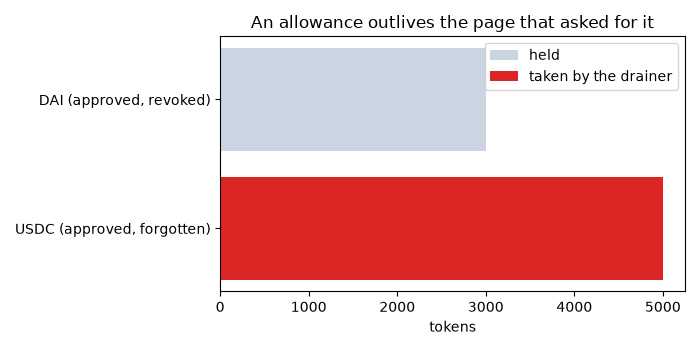
after revoking DAI: 5000 at risk
swept USDC, DAI: [5000, 0]
Exercise#
EIP-2612 replaces the approve transaction with a signed permit
message that anyone can submit. Why does this make ice phishing easier to
carry out and harder to notice?
Total running time of the script: (0 minutes 0.029 seconds)
