
Note
Go to the end to download the full example code or to run this example in your browser via JupyterLite.
Address poisoning with look-alike addresses (2022-2023)#
An Ethereum address is 40 hexadecimal digits, and wallets show only the first and last few. From late 2022, poisoners watched for payments, ground out an address matching the payee’s ends, and sent the payer a worthless transfer from it, so that the look-alike appeared in the payer’s history right next to the real one. The next payment copied from the history went to the poisoner; in May 2024 one victim sent 68 million dollars this way. Tsuchiya, Dong, Soska and Christin measured millions of such attempts. Matching \(k\) digits takes about
tries, a few seconds of computing for the eight digits a hurried user checks, and a detector needs only to compare new senders against the addresses the victim has paid.
import matplotlib.pyplot as plt

import blockchainkit as bk
The cost of a look-alike#
payee = bk.fraud.candidate_address(2023, 0)
digits, costs = [], []
for k in range(1, 5):
    prefix, suffix = (k + 1) // 2, k // 2
    found = [
        bk.fraud.grind_lookalike(payee, prefix=prefix, suffix=suffix, seed=s).trials
        for s in range(12 if k < 4 else 3)
    ]
    digits.append(k)
    costs.append(sum(found) / len(found))
    print(f"{k} digits: about {costs[-1]:,.0f} trials (16^{k} = {16**k:,})")
assert costs == sorted(costs)

fig, ax = plt.subplots(figsize=(6, 4))
ax.semilogy(digits, costs, "o", color="#dc2626", label="measured")
ax.semilogy(digits, [16**k for k in digits], color="black", label="16^k")
ax.set(xlabel="hex digits matched", ylabel="trials", xticks=digits)
ax.set_title("Each digit checked multiplies the work by 16")
ax.legend()
fig.tight_layout()
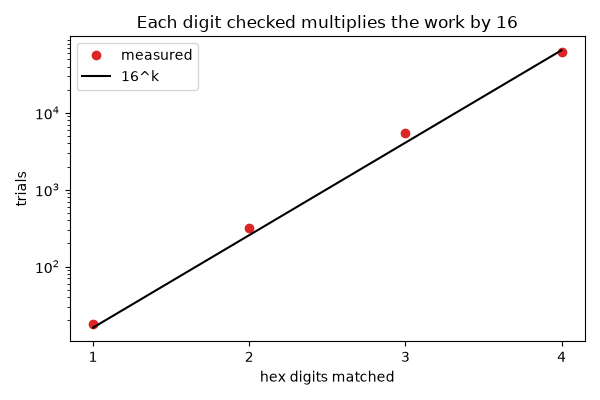
1 digits: about 18 trials (16^1 = 16)
2 digits: about 318 trials (16^2 = 256)
3 digits: about 5,402 trials (16^3 = 4,096)
4 digits: about 62,121 trials (16^4 = 65,536)
Poisoning a history, and spotting it#
fake = bk.fraud.grind_lookalike(payee, prefix=2, suffix=2, seed=7).address
history = [
    bk.fraud.Flow("victim", payee, 25_000, 0),
    bk.fraud.Flow(fake, "victim", 0, 1),  # The poisoner's zero-value transfer.
]
print("payee:", payee)
print("fake: ", fake)
latest = history[-1].sender  # The address a hurried user copies.
assert bk.fraud.looks_alike(latest, payee, prefix=2, suffix=2)
suspects = bk.fraud.poisoning_suspects(history, "victim", prefix=2, suffix=2)
print("suspects:", suspects)
assert suspects == (fake,)

plt.show()
payee: 0x7ae9ac40a05f19d12331ae1d17d88c878fc2b531
fake:  0x7a2a49df20c31827a7251eff85a5e4ca91f55e31
suspects: ('0x7a2a49df20c31827a7251eff85a5e4ca91f55e31',)
Exercise#
A wallet shows six characters at each end. How long does a poisoner computing ten million addresses a second need to match all twelve? A worked solution is in Exercises: fraud.
Total running time of the script: (0 minutes 2.018 seconds)
