
Note
Go to the end to download the full example code or to run this example in your browser via JupyterLite.
CoinJoin: many payers, one transaction (2013)#
Gregory Maxwell observed that the inputs of a Bitcoin transaction need not belong to one person. In a CoinJoin, several users each contribute an input and name an output; each checks the joint transaction and signs only its own input. If the mixed outputs all have one denomination \(d\), an observer cannot tell whose is whose, and the common-input heuristic now merges strangers.
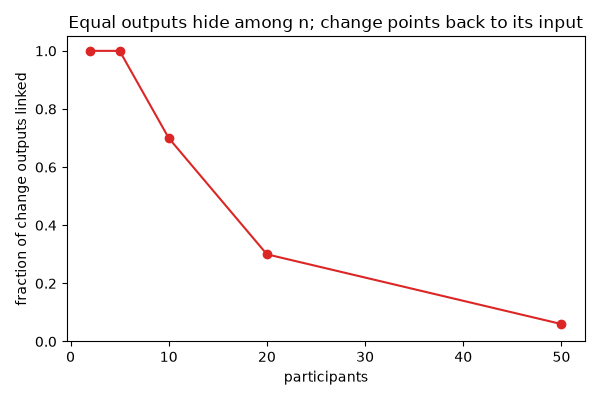
Change is the weak point. Each change output is an input minus \(d\),
which usually points straight back at its input. Only the equal outputs are anonymous: \(n\) of them hide each participant among \(n\).
from random import Random

import matplotlib.pyplot as plt

import blockchainkit as bk
One round#
participants = [("ann", "a1", 10), ("bob", "b1", 13), ("cat", "c1", 17), ("dan", "d1", 10)]
round_ = bk.privacy.coinjoin(participants, 10, seed=1)
for address, amount in round_.transaction.outputs:
    print(f"{address}  {amount:>3}")
print("anonymity set of the 10-coin outputs:", round_.anonymity_set)
links = bk.privacy.link_change(round_.transaction, 10)
assert all(round_.owners[c] == round_.owners[i] for c, i in links.items())
print("change linked to its input:", {round_.owners[c] for c in links})

clusters = bk.privacy.cluster_addresses([round_.transaction])
score = bk.privacy.score_clusters(clusters, round_.owners)
assert score.false_merges == 1
print("the input heuristic merges", len(clusters[0]), "addresses of 4 users into one cluster")
b42728bfaea822ae    3
5007614821705756   10
84a78c39bf93a468   10
a9a04e1352d51aff   10
17663be6439ae9c6    7
9f853c0b158c51b3   10
anonymity set of the 10-coin outputs: 4
change linked to its input: {'bob', 'cat'}
the input heuristic merges 4 addresses of 4 users into one cluster
Larger rounds#
Inputs between 10 and 30 coins, denomination 10.
rng = Random(4)
sizes = [2, 5, 10, 20, 50]
anonymous, linked = [], []
for n in sizes:
    people = [(f"u{i}", f"in{i}", rng.randrange(10, 31)) for i in range(n)]
    r = bk.privacy.coinjoin(people, 10, seed=n)
    anonymous.append(r.anonymity_set)
    linked.append(len(bk.privacy.link_change(r.transaction, 10)) / n)
# A change output that happens to equal the denomination joins the set too.
assert all(a >= n for a, n in zip(anonymous, sizes, strict=True))

fig, ax = plt.subplots(figsize=(6, 4))
ax.plot(sizes, linked, marker="o", color="#dc2626")
ax.set(xlabel="participants", ylabel="fraction of change outputs linked", ylim=(0, 1.05))
ax.set_title("Equal outputs hide among n; change points back to its input")
fig.tight_layout()

plt.show()
Exercise#
In a round of three with inputs 15, 15 and 25 and denomination 10, which
change outputs can link_change()
link? What does that suggest about choosing inputs?
A worked solution is in Exercises: privacy.
Total running time of the script: (0 minutes 0.055 seconds)
