Note
Go to the end to download the full example code or to run this example in your browser via JupyterLite.
Tornado Cash: a mixer contract with zero-knowledge withdrawals (2019)#
Tornado Cash put Zerocash’s notes and nullifiers into an Ethereum contract. Each deposit is a fixed amount with the commitment to a secret note, appended to a Merkle tree. A withdrawal, from any address, reveals the note’s nullifier and a zk-SNARK that the note is a leaf under a recent root. The contract pays once per nullifier and never learns which leaf.
The proof protects the link; behaviour can give it away. A withdrawal’s anonymity set is the deposits that could be its source,
and it collapses to one when someone withdraws to the address it deposited from. The US Treasury sanctioned the contracts in August 2022.
import dataclasses
from random import Random

import matplotlib.pyplot as plt

import blockchainkit as bk
from blockchainkit.privacy.visualizers import plot_anonymity_sets
from blockchainkit.proofs import Groth16Trapdoor, Note, note_commitment, owner_key, spend_setup
Deposits and a withdrawal#
key = spend_setup(3, Groth16Trapdoor(5, 6, 7, 8, 9))
world = bk.contracts.World()
mixer = world.deploy("deployer", bk.privacy.Mixer, 100, 3, key.verifying_key, name="mixer")
notes = []
for i in range(5):
    world.fund(f"user{i}", 1_000)
    note = Note(owner_key(700 + i), 100, rho=i + 1, randomness=4_000 + i)
    notes.append(note)
    assert world.transact(f"user{i}", mixer, "deposit", note_commitment(note), value=100).success
deposits = world.view(mixer, "deposits")
withdrawal = bk.privacy.prove_withdrawal(key, deposits, 3, 702, notes[2], "fresh-address")

# A front-runner copies the proof but names itself: the proof is bound to the recipient.
stolen = dataclasses.replace(withdrawal, recipient="front-runner")
print("redirected:", world.transact("front-runner", mixer, "withdraw", stolen).error)
receipt = world.transact("relayer", mixer, "withdraw", withdrawal)
assert receipt.success and world.balance("fresh-address") == 100
print("paid:", world.balance("fresh-address"), "| mixer holds:", world.balance(mixer))
print("replayed:", world.transact("relayer", mixer, "withdraw", withdrawal).error)
redirected: invalid proof
paid: 100 | mixer holds: 400
replayed: the note was already withdrawn
Anonymity sets over a day of use#
Forty users; a few careless ones withdraw to their own address.
rng = Random(3)
deposit_log, withdrawal_log = [], []
for i in range(40):
    block = rng.randrange(0, 200)
    deposit_log.append((f"user{i}", block))
    out = f"user{i}" if rng.random() < 0.15 else f"fresh{i}"
    withdrawal_log.append((out, block + rng.randrange(1, 60)))
withdrawal_log.sort(key=lambda entry: entry[1])
report = bk.privacy.mixer_report(deposit_log, withdrawal_log)
print(f"{len(report.address_links)} withdrawals linked by address reuse")
assert report.address_links and min(report.anonymity_sets) >= 1

fig, ax = plt.subplots(figsize=(7, 4))
plot_anonymity_sets(report.anonymity_sets, ax=ax)
for _, j in report.address_links:
    ax.scatter(j + 1, 1, color="#dc2626", marker="x")
ax.set_title("Anonymity sets, and withdrawals given away by address reuse (x)")
fig.tight_layout()

plt.show()
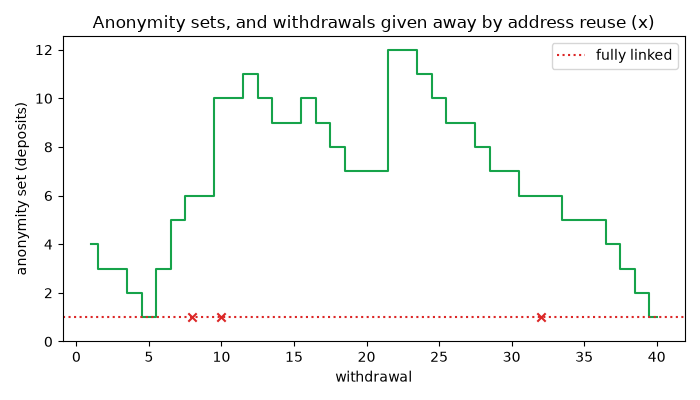
3 withdrawals linked by address reuse
Exercise#
The first withdrawal after a mixer is deployed has an anonymity set of however many deposits came before it. Why did Tornado’s guides tell users to wait before withdrawing, and what does waiting cost? A worked solution is in Exercises: privacy.
Total running time of the script: (0 minutes 0.436 seconds)
