
Note
Go to the end to download the full example code or to run this example in your browser via JupyterLite.
PLONK: permutation arguments and a universal setup (2019)#
Gabizon, Williamson and Ciobotaru wrote circuits as uniform gates, \(q_L a + q_R b + q_O c + q_M ab + q_C = 0\), and enforced that wires sharing a variable carry the same value with a permutation argument. With random \(\beta, \gamma\), the grand product
equals 1 whp only if the values are constant on every cycle of the wiring permutation \(\sigma\). The prover commits to the running product \(z(X)\) with KZG, and everything reduces to one quotient polynomial checked at a random point. Its setup is universal: one powers-of-tau string serves every circuit up to a size, with no ceremony per circuit.
import matplotlib.pyplot as plt

import blockchainkit as bk
from blockchainkit.proofs.visualizers import plot_copy_constraints
One setup, two circuits#
srs = bk.proofs.trusted_setup(200, secret=24680)
circuit = bk.proofs.PlonkCircuit()
x = circuit.variable(3)
circuit.assert_constant(circuit.add(circuit.mul(circuit.mul(x, x), x), x), 30)  # x**3 + x = 30
key = bk.proofs.plonk_setup(circuit, srs)
proof = bk.proofs.plonk_prove(key, srs, circuit.wire_values())
assert bk.proofs.plonk_verify(key, srs, proof)

power = bk.proofs.PlonkCircuit()
v = power.variable(2)
for _ in range(40):
    v = power.mul(v, power.variable(2))
power.assert_constant(v, 2**41 % bk.proofs.FIELD_PRIME)
power_key = bk.proofs.plonk_setup(power, srs)
assert bk.proofs.plonk_verify(
    power_key, srs, bk.proofs.plonk_prove(power_key, srs, power.wire_values())
)
print(f"the same string served circuits of {key.n} and {power_key.n} rows")
the same string served circuits of 4 and 64 rows
Breaking a copy constraint#
Change the first gate to 2 * 2 = 4: the gate still holds, but x is now 2 there and 3 elsewhere. Only the permutation argument notices.
rows = [list(row) for row in circuit.wire_values()]
rows[0] = [2, 2, 4]
honest = bk.proofs.permutation_product(key, circuit.wire_values(), beta=11, gamma=13)
broken = bk.proofs.permutation_product(key, rows, beta=11, gamma=13)
print("grand product, honest:", honest[-1], "| broken copy:", broken[-1])
assert honest[-1] == 1 and broken[-1] != 1
try:
    bk.proofs.plonk_prove(key, srs, rows)
except ValueError as error:
    print("the prover cannot continue:", error)

fig, ax = plt.subplots(figsize=(5, 4.5))
plot_copy_constraints(key, ax=ax)
fig.tight_layout()

plt.show()
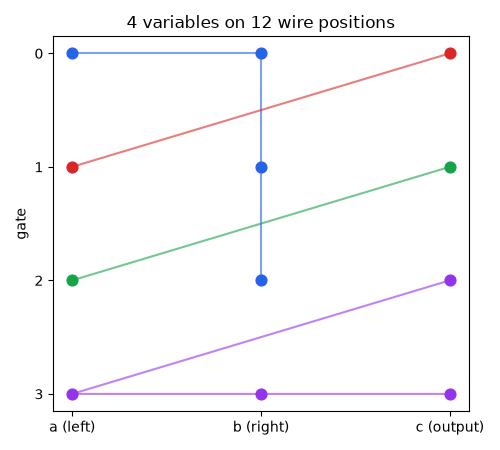
grand product, honest: 1 | broken copy: 1729665758
the prover cannot continue: a copy constraint is not satisfied
Exercise#
A PLONK proof here is 5 points, 14 field elements and 2 more points,
whatever the circuit. Measure len(proof.evaluations) for both circuits
above, and count how many gates the second circuit needed.
Total running time of the script: (0 minutes 0.107 seconds)
