
Note
Go to the end to download the full example code or to run this example in your browser via JupyterLite.
STARKs: transparent proofs of computation from hashes (2018)#
Ben-Sasson, Bentov, Horesh and Riabzev built scalable, transparent arguments of knowledge: no trusted setup, nothing but a hash function, and proofs that grow polylogarithmically with the computation. Write the computation as an execution trace, here the Fibonacci sequence \(a_{i+2} = a_{i+1} + a_i\), interpolate it as a polynomial \(f\) over a subgroup \(\langle g\rangle\), and turn each rule into a divisibility:
are polynomials exactly when the trace follows the rule and ends at the claimed value. The prover commits to \(f\) on a larger domain and proves with FRI that a random combination of the quotients has low degree. StarkNet and many zkVMs use this design.
import matplotlib.pyplot as plt

import blockchainkit as bk
from blockchainkit.proofs.visualizers import plot_proof_sizes
Proving the 1024th Fibonacci number modulo p#
steps = 1024
result = bk.proofs.fibonacci_trace(steps)[-1]
proof = bk.proofs.stark_prove(steps)
assert bk.proofs.stark_verify(proof, steps=steps, result=result)
print(f"a_{steps - 1} = {result}; proof of {proof.size:,} bytes")

false = bk.proofs.stark_prove(steps, claimed=result + 1)
assert not bk.proofs.stark_verify(false, steps=steps, result=result + 1)
print("a false result fails: its boundary quotient is not a polynomial, and FRI notices")
a_1023 = 95215208; proof of 130,664 bytes
a false result fails: its boundary quotient is not a polynomial, and FRI notices
Proof size against computation length#
The proof grows like log**2 of the trace, the trace itself linearly. For the tiny traces here the proof is still the larger, by a shrinking factor; extrapolated, the lines cross near 2**15 steps, and real STARKs prove billions.
points = []
for log_t in range(4, 12):
    t = 2**log_t
    p = bk.proofs.stark_prove(t)
    assert bk.proofs.stark_verify(p, steps=t, result=bk.proofs.fibonacci_trace(t)[-1])
    points.append((t, p.size))
print("trace length and proof bytes:", points)
assert points[-1][1] < 4 * points[0][1]

ax = plot_proof_sizes(
    {"the trace itself (8 bytes a step)": [(t, 8 * t) for t, _ in points], "STARK": points},
    xlabel="steps of computation",
)
ax.set_title("STARK proofs grow with log**2 of the computation")
plt.show()
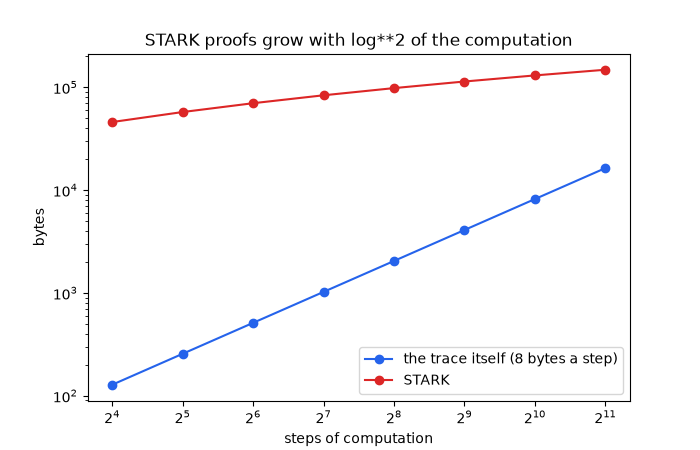
trace length and proof bytes: [(16, 45992), (32, 57544), (64, 70120), (128, 83720), (256, 98344), (512, 113992), (1024, 130664), (2048, 148360)]
Exercise#
The low-degree extension lives on a coset 31 * <w> that avoids the
trace domain <g>. Why? Evaluate the boundary quotient (f(x) - 1)/(x - 1)
on the subgroup <w> itself and see which point breaks it.
Total running time of the script: (0 minutes 0.729 seconds)
