
Note
Go to the end to download the full example code or to run this example in your browser via JupyterLite.
Halo: recursive proof composition without a trusted setup (2019)#
A proof that a previous proof verified, applied at every block, would let anyone check a whole chain from one short proof. That needs verification cheap enough to run inside a proof. Inner-product arguments have no trusted setup, but verifying one costs a multi-exponentiation as long as the committed vector. Bowe, Grigg and Hopwood noticed that the expensive part is a commitment to the polynomial
which anyone can evaluate in \(O(\log n)\) from the round challenges \(c_j\). So the verifier defers it: it keeps the claim as an accumulator, merges accumulators by opening a random combination at a random point (which is another cheap check with its own deferred claim), and pays the \(O(n)\) cost once, at the end. Zcash’s Orchard (2022) and Mina rest on this idea.
import math

import matplotlib.pyplot as plt

import blockchainkit as bk
A chain of 12 steps, each verified cheaply#
n = 64
gens = bk.proofs.ipa_generators(n)
accumulator = None
for step in range(12):
    poly = [(step + 1) * i + 7 for i in range(n)]
    opening = bk.proofs.ipa_open(poly, 100 + step, gens)
    claim = bk.proofs.ipa_defer(bk.proofs.ipa_commit(poly, gens), opening, gens)
    assert claim is not None  # The cheap checks passed; G_final is still unchecked.
    group = [claim] if accumulator is None else [accumulator, claim]
    accumulator = bk.proofs.verify_accumulation(group, bk.proofs.accumulate(group, gens), gens)
    assert accumulator is not None
assert bk.proofs.decide(accumulator, gens)
print("12 openings verified with one final O(n) check")
12 openings verified with one final O(n) check
A bad claim survives the cheap checks but not the end#
fake = bk.proofs.HaloAccumulator(claim.challenges, claim.g_final * 4 % bk.crypto.TEACHING_GROUP.p)
merged = bk.proofs.verify_accumulation([fake], bk.proofs.accumulate([fake], gens), gens)
assert merged is None or not bk.proofs.decide(merged, gens)
print("a tampered accumulator is rejected by the final decision")
a tampered accumulator is rejected by the final decision
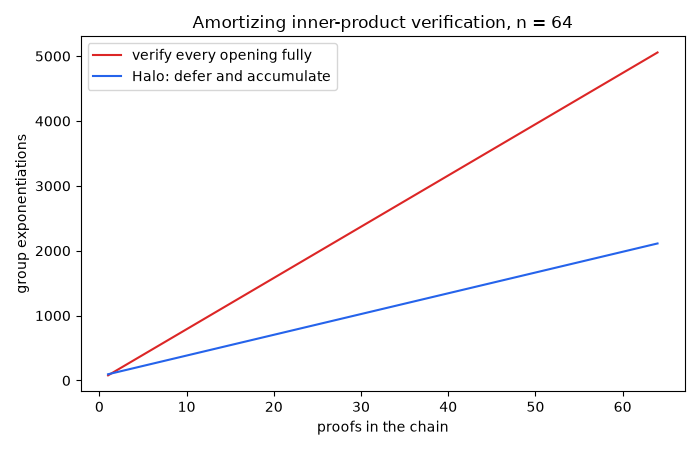
Group exponentiations: verify everything, or defer#
A full check costs about n + 2 log2 n + 3 exponentiations; a deferred check and one accumulation step about 2 (2 log2 n + 3) + 2, and the decision n once.
rounds = int(math.log2(n))
steps = range(1, 65)
full = [s * (n + 2 * rounds + 3) for s in steps]
deferred = [s * (2 * (2 * rounds + 3) + 2) + n for s in steps]
fig, ax = plt.subplots(figsize=(7, 4.5))
ax.plot(steps, full, color="#dc2626", label="verify every opening fully")
ax.plot(steps, deferred, color="#2563eb", label="Halo: defer and accumulate")
ax.set(xlabel="proofs in the chain", ylabel="group exponentiations")
ax.set_title(f"Amortizing inner-product verification, n = {n}")
ax.legend()
fig.tight_layout()

plt.show()
Exercise#
Check that challenge_polynomial(c, x) equals the inner product of the
coefficient vector s, built from the challenges, with (1, x, x**2, …): the
fact that lets the verifier skip computing G_final.
Total running time of the script: (0 minutes 0.103 seconds)
