Note
Go to the end to download the full example code or to run this example in your browser via JupyterLite.
One payment from signature to reorganization and reinclusion#
This capstone follows one payment through every subpackage: Alice signs it, peers gossip it into their pending queues (mempools), a miner includes it in a block, a competing branch with more work displaces that block, and the payment is included again. Life of a payment tells the same story step by step.
Bob’s balance goes from 0 to 25, back to 0 when the competing branch wins, and to 25 again after reinclusion. Queueing a payment never changes a balance, and the signature stays valid throughout. The scenario is deliberately small: one pending payment per peer, no fees, and a shared in-memory registry that resolves announced hashes, with parents sent before children.
import matplotlib.pyplot as plt

import blockchainkit as bk
Sign and validate before queueing#
alice_key = 7
alice_public = bk.crypto.public_key(alice_key)
alice = bk.structures.address(alice_public)
bob = bk.structures.address(bk.crypto.public_key(11))
initial = bk.structures.Ledger({alice: 100})
genesis = bk.consensus.mine(bk.structures.Block(difficulty=4)).block
peers = {name: bk.structures.Blockchain(genesis, initial) for name in ("west", "east")}
queues = {name: {} for name in peers}
payment = bk.structures.Transaction(alice_public, bob, 25, 0).signed(alice_key, signing_nonce=17)
assert payment.is_valid()
# apply returns a new snapshot. Discarding it checks validity without spending.
assert initial.apply([payment]).balances[bob] == 25
assert initial.balances.get(bob, 0) == 0
registry = {payment.txid: payment}
events = []


def record(stage):
    events.append(
        [
            stage,
            *[peers[n].state.balances.get(bob, 0) for n in peers],
            *[len(queues[n]) for n in peers],
        ]
    )


def receive(delivery):
    item = registry[delivery.payload]
    peer = peers[delivery.recipient]
    if isinstance(item, bk.structures.Transaction):
        peer.state.apply([item])
        queues[delivery.recipient][item.txid] = item
    else:
        peer.add(item)
        # Reconcile our one-payment queue against the new canonical state.
        # After a reorganization an old payment may become eligible again.
        try:
            peer.state.apply([payment])
        except ValueError:
            queues[delivery.recipient].pop(payment.txid, None)
        else:
            queues[delivery.recipient][payment.txid] = payment


network = bk.network.SimulatedNetwork(peers, on_receive=receive)
network.connect("west", "east", latency=(2, 2))
network.broadcast("west", payment.txid)
record("Queued at west")
assert len(queues["west"]) == 1 and not queues["east"]
network.run()
record("Payment propagated")
assert all(len(queue) == 1 for queue in queues.values())
assert all(peer.state.balances.get(bob, 0) == 0 for peer in peers.values())
Partition and mine competing histories#
network.disconnect("west", "east")
paid = bk.consensus.mine(
    bk.structures.Block(genesis.hash, tuple(queues["west"].values()), 1, 3, 4)
).block
alternate = bk.consensus.mine(bk.structures.Block(genesis.hash, (), 1, 4, 4)).block
extension = bk.consensus.mine(bk.structures.Block(alternate.hash, (), 2, 5, 4)).block
for block, sender in [(paid, "west"), (alternate, "east"), (extension, "east")]:
    registry[block.hash] = block
    network.broadcast(sender, block.hash)
record("Partition: west includes payment")
assert peers["west"].state.balances[bob] == 25
assert not queues["west"] and len(queues["east"]) == 1
Reconnect, synchronize, and restore a displaced payment#
network.connect("west", "east")
network.broadcast("east", alternate.hash)
network.run()
network.broadcast("east", extension.hash)
network.run()
record("Longer fork wins; payment pending")
assert peers["west"].tip == peers["east"].tip == extension
assert all(peer.state.balances.get(bob, 0) == 0 for peer in peers.values())
assert all(payment.txid in queue for queue in queues.values())
proof = bk.structures.MerkleTree([payment.to_bytes()]).proof(0)
assert bk.structures.verify_proof(payment.to_bytes(), proof, paid.merkle_root)
assert payment.is_valid()
Reinclude once; reject replay#
reincluded = bk.consensus.mine(
    bk.structures.Block(extension.hash, tuple(queues["west"].values()), 3, 6, 4)
).block
registry[reincluded.hash] = reincluded
network.broadcast("west", reincluded.hash)
network.run()
record("Reincluded on winning history")
assert all(peer.state.balances[bob] == 25 for peer in peers.values())
assert all(not queue for queue in queues.values())
for peer in peers.values():
    try:
        peer.state.apply([payment])
    except ValueError as error:
        assert "nonce" in str(error)
    else:
        raise AssertionError("replay must be rejected")
Read the lifecycle as a balance and queue trace#
fig, (ax, table_ax) = plt.subplots(2, 1, figsize=(11, 7), height_ratios=[1, 1.2])
for column, peer in [(1, "west"), (2, "east")]:
    ax.step(range(len(events)), [row[column] for row in events], where="post", label=peer)
ax.set(xticks=range(len(events)), xlabel="Stage number (table order)", ylabel="Bob's balance")
ax.legend()
table_ax.axis("off")
table = table_ax.table(
    cellText=events,
    colLabels=["Stage", "West balance", "East balance", "West queue", "East queue"],
    colWidths=[0.48, 0.13, 0.13, 0.13, 0.13],
    loc="center",
)
table.auto_set_font_size(False)
table.set_fontsize(9)
table.scale(1, 2)
fig.suptitle("Signed does not mean pending; included does not mean final")
fig.tight_layout()
for event in events:
    print(event)

plt.show()
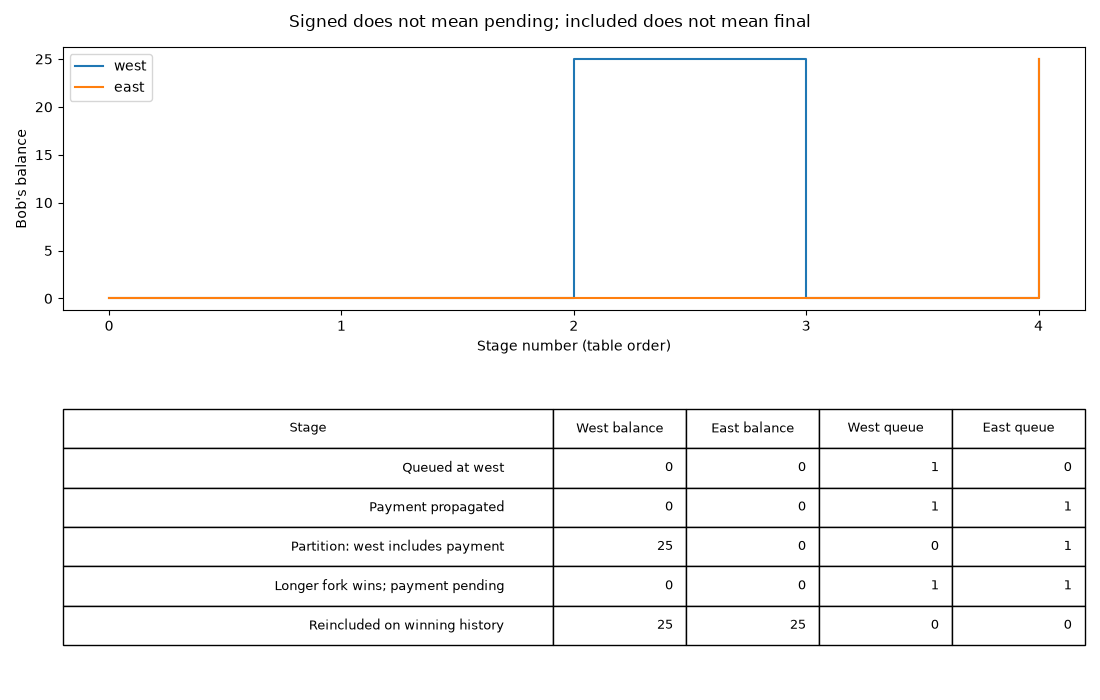
['Queued at west', 0, 0, 1, 0]
['Payment propagated', 0, 0, 1, 1]
['Partition: west includes payment', 25, 0, 0, 1]
['Longer fork wins; payment pending', 0, 0, 1, 1]
['Reincluded on winning history', 25, 25, 0, 0]
Exercise#
Replace an empty competing block with a conflicting payment that spends all of Alice’s funds. Predict whether the original payment returns to the queue. Explain why the single-payment queue is insufficient for dependent payments with consecutive account nonces.
A worked solution is in Exercises: ledgers and data structures.
Total running time of the script: (0 minutes 0.206 seconds)
