
Note
Go to the end to download the full example code or to run this example in your browser via JupyterLite.
Threshold ECDSA (Gennaro and Goldfeder, 2018)#
A multisig script shows its policy on chain and needs a signature per signer. A threshold signature is one ordinary signature under one key, made by any t of n parties holding Shamir shares of a private key that no one ever assembles. Schnorr responses add, but ECDSA’s
multiplies secrets. Rosario Gennaro and Steven Goldfeder’s protocol converts products of secrets held by two parties into sums with a multiplicative-to-additive (MtA) conversion, one for every ordered pair of signers and each of two products, \(k\gamma\) and \(kx\). Here a 2-of-3 key is generated jointly and used to sign. The MtA step is an ideal function; the real protocol runs it under Paillier encryption.
from itertools import combinations

import matplotlib.pyplot as plt

import blockchainkit as bk
A jointly generated 2-of-3 key#
keys = bk.wallets.threshold_keygen(2, 3, seed=2018)
print("joint key address:", bk.wallets.p2pkh_address(keys.public))
for index, _ in keys.shares:
    assert bk.wallets.verify_key_share(keys, index)
print("every share matches the dealers' Feldman commitments")

message = b"pay bob 5 BTC"
for signers in combinations((1, 2, 3), 2):
    signing = bk.wallets.threshold_sign(message, keys, signers, seed=sum(signers))
    valid = bk.wallets.ecdsa_verify(message, signing.signature, keys.public)
    print(f"signers {signers}: r = {hex(signing.signature.r)[:12]}..., valid {valid}")
    assert valid

try:
    bk.wallets.threshold_sign(message, keys, [2])
except ValueError as exc:
    print("one signer:", exc)
joint key address: 1GDvqoYSTqkBLJfFDM1Ecvd2YtUjUAzq5x
every share matches the dealers' Feldman commitments
signers (1, 2): r = 0xbe6dbf6df9..., valid True
signers (1, 3): r = 0x8d111bb4c2..., valid True
signers (2, 3): r = 0x91a247ac58..., valid True
one signer: need at least 2 signers
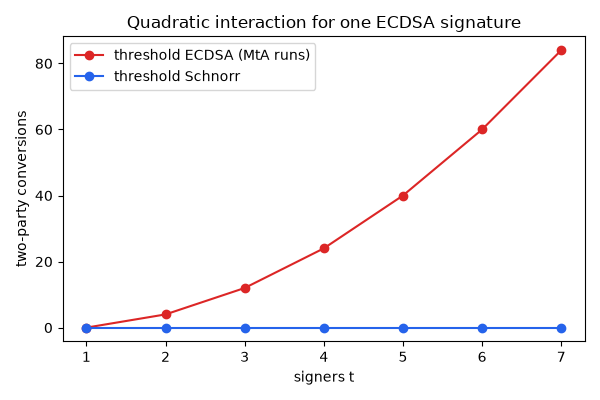
The work ECDSA’s nonlinearity costs#
A Schnorr threshold signature needs no conversions; ECDSA needs 2 t (t - 1).
thresholds = list(range(1, 8))
conversions = []
for t in thresholds:
    big = bk.wallets.threshold_keygen(t, t, seed=t)
    signing = bk.wallets.threshold_sign(b"m", big, range(1, t + 1), seed=t)
    assert bk.wallets.ecdsa_verify(b"m", signing.signature, big.public)
    conversions.append(signing.conversions)
assert conversions == [2 * t * (t - 1) for t in thresholds]

fig, ax = plt.subplots(figsize=(6, 4))
ax.plot(thresholds, conversions, "o-", color="#dc2626", label="threshold ECDSA (MtA runs)")
ax.plot(thresholds, [0] * len(thresholds), "o-", color="#2563eb", label="threshold Schnorr")
ax.set(xlabel="signers t", ylabel="two-party conversions")
ax.set_title("Quadratic interaction for one ECDSA signature")
ax.legend()
fig.tight_layout()
plt.show()
Exercise#
Recover the joint private key from two shares with Lagrange coefficients,
and check it against keys.public. Why does the protocol never do this?
A worked solution is in Exercises: wallets.
Total running time of the script: (0 minutes 1.277 seconds)
