
Note
Go to the end to download the full example code or to run this example in your browser via JupyterLite.
Hierarchical deterministic wallets (BIP32, 2012)#
Early Bitcoin wallets drew each key at random, so a backup went stale with the next payment. Pieter Wuille’s BIP32 derives a tree of keys from one seed. An extended key is a key k and a chain code c, and child i is
Since \(k_i G = I_L G + K\), an extended public key derives every normal child’s public key: a shop’s server can make a new address for each order and hold no private key. The other side of that coin is that the extended public key and any one normal child’s private key give away the parent’s, which is why accounts are derived with hardened indices (i >= 2**31), whose data is the private key instead.
import matplotlib.pyplot as plt

import blockchainkit as bk
BIP32’s first test vector#
master = bk.wallets.master_key(bytes(range(16)))
print("m      ", bk.wallets.serialize_extended_key(master))
account = bk.wallets.derive_path(master, "m/0'")
print("m/0'   ", bk.wallets.serialize_extended_key(bk.wallets.neuter(account)))
assert bk.wallets.serialize_extended_key(master).startswith("xprv9s21ZrQH143K3QTDL4LXw2F7HEK")
m       xprv9s21ZrQH143K3QTDL4LXw2F7HEK3wJUD2nW2nRk4stbPy6cq3jPPqjiChkVvvNKmPGJxWUtg6LnF5kejMRNNU3TGtRBeJgk33yuGBxrMPHi
m/0'    xpub68Gmy5EdvgibQVfPdqkBBCHxA5htiqg55crXYuXoQRKfDBFA1WEjWgP6LHhwBZeNK1VTsfTFUHCdrfp1bgwQ9xv5ski8PX9rL2dZXvgGDnw
A shop with only the extended public key#
xpub = bk.wallets.neuter(account)
addresses = []
for order in range(5):
    from_public = bk.wallets.derive_public(xpub, order)
    from_private = bk.wallets.derive_private(account, order)
    assert from_public.public == from_private.public
    addresses.append(bk.wallets.p2pkh_address(from_public.public))
    print(f"order {order}: {addresses[-1]}")
order 0: 1LZaBnH11M2yN5ZNiK67yUbaspfX6XKmRr
order 1: 1JQheacLPdM5ySCkrZkV66G2ApAXe1mqLj
order 2: 1MF1zYw5uEQiESDYq88vdEde6bLjah6tiu
order 3: 1BWVwxpt9vbU1AZPEJmhDF2n5LK8asFGg8
order 4: 1C4SsQwJ9rt2sEhaS5sz4QHWCiyF5YewKE
One leaked child key, and the whole account falls#
leaked = bk.wallets.derive_private(account, 3).private
recovered = bk.wallets.recover_parent_private(xpub, leaked, 3)
assert recovered == account.private
print("account key recovered from the xpub and child 3's key")
stolen = bk.wallets.derive_private(
    bk.wallets.ExtendedKey(
        account.chain_code, account.public, recovered, 1, account.index, account.parent_fingerprint
    ),
    4,
)
assert stolen.private == bk.wallets.derive_private(account, 4).private

# The master stays safe: m/0' is hardened, so its key does not reveal m's.
try:
    bk.wallets.recover_parent_private(bk.wallets.neuter(master), recovered, account.index)
except ValueError as exc:
    print("master:", exc)

fig, ax = plt.subplots(figsize=(7, 4))
ax.axis("off")
ax.text(0.5, 0.9, "m", ha="center", fontsize=12)
ax.text(0.5, 0.55, "m/0'  (hardened)", ha="center", fontsize=11)
ax.annotate("", (0.5, 0.6), (0.5, 0.86), arrowprops={"arrowstyle": "->"})
for i in range(5):
    x = 0.1 + 0.2 * i
    color = "#dc2626" if i == 3 else "#2563eb"
    ax.annotate("", (x, 0.2), (0.5, 0.5), arrowprops={"arrowstyle": "->", "color": color})
    ax.text(x, 0.1, f"m/0'/{i}", ha="center", color=color)
ax.text(
    0.5,
    -0.05,
    "xpub + the private key of m/0'/3 reveal m/0' and every child",
    ha="center",
    color="#dc2626",
)
ax.set_title("BIP32: one leaked child of a public parent leaks the parent")
fig.tight_layout()
plt.show()
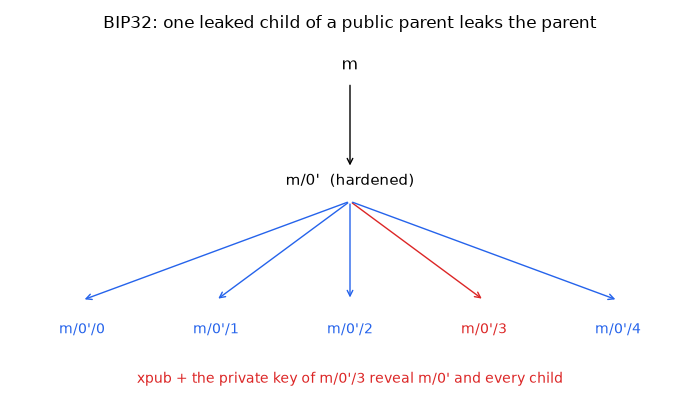
account key recovered from the xpub and child 3's key
master: a hardened child does not reveal its parent
Exercise#
Repeat the attack with a hardened child, m/0'/3'. What stops it?
A worked solution is in Exercises: wallets.
Total running time of the script: (0 minutes 0.139 seconds)
