
Note
Go to the end to download the full example code or to run this example in your browser via JupyterLite.
Multi-account derivation paths (BIP44, 2014)#
BIP32 allows any tree of keys, so one wallet program could not restore another’s from the same seed. Marek Palatinus and Pavol Rusnak fixed five levels,
and a rule for finding used keys: scan each account’s receiving chain until 20 addresses in a row are unused (the gap limit), and stop at the first account with none. A wallet that hands out more than 20 unpaid addresses in a row hides later payments from any other wallet restoring the seed. Here a seed is restored with several gap limits.
import matplotlib.pyplot as plt

import blockchainkit as bk
The paths of a wallet#
master = bk.wallets.master_key(bytes(range(16)))
print(bk.wallets.bip44_path(0, 0, 0, 0), "first Bitcoin receiving address")
print(bk.wallets.bip44_path(60, 0, 0, 0), "first Ether address")
print(bk.wallets.parse_path("m/44'/0'/0'/0/5"))


def address(account, index):
    path = bk.wallets.bip44_path(0, account, 0, index)
    return bk.wallets.p2pkh_address(bk.wallets.derive_path(master, path).public)


# A user paid to addresses 0-3 and 9 of account 0, and to address 0 of account 1.
used = {address(0, i) for i in (0, 1, 2, 3, 9)} | {address(1, 0)}
m/44'/0'/0'/0/0 first Bitcoin receiving address
m/44'/60'/0'/0/0 first Ether address
(2147483692, 2147483648, 2147483648, 0, 5)
Restoring with different gap limits#
limits = [2, 4, 5, 6, 8]
found = []
for gap in limits:
    scan = bk.wallets.discover_accounts(master, used, gap_limit=gap)
    found.append(len(scan.found))
    print(
        f"gap limit {gap}: {scan.accounts} accounts, {len(scan.found)} of 6 addresses,"
        f" {scan.derived} derived"
    )
assert found[0] < 6 and found[-1] == 6

fig, ax = plt.subplots(figsize=(6, 4))
ax.step(limits, found, where="post", color="#2563eb")
ax.plot(limits, found, "o", color="#2563eb")
ax.axhline(6, color="#64748b", linestyle="--", label="addresses used")
ax.set(xlabel="gap limit", ylabel="used addresses found", ylim=(0, 6.5))
ax.set_title("A gap longer than the limit hides the coins")
ax.legend(loc="lower right")
fig.tight_layout()
plt.show()
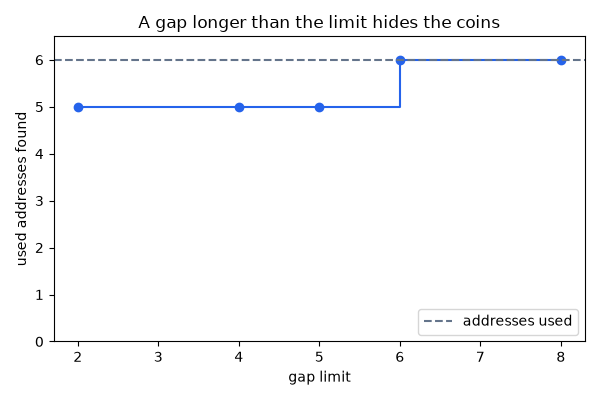
gap limit 2: 2 accounts, 5 of 6 addresses, 11 derived
gap limit 4: 2 accounts, 5 of 6 addresses, 17 derived
gap limit 5: 2 accounts, 5 of 6 addresses, 20 derived
gap limit 6: 2 accounts, 6 of 6 addresses, 29 derived
gap limit 8: 2 accounts, 6 of 6 addresses, 35 derived
Exercise#
The user also pays to address 30 of account 0. What is the smallest gap limit that finds it? A worked solution is in Exercises: wallets.
Total running time of the script: (0 minutes 1.291 seconds)
