
Note
Go to the end to download the full example code or to run this example in your browser via JupyterLite.
scrypt and memory-hard key derivation (2009)#
PBKDF2 makes each guess slow but needs almost no memory, so custom chips run millions of guesses in parallel. Colin Percival’s scrypt makes each guess need a large table as well. Its core, ROMix, fills a table of N blocks and then reads it at N data-dependent addresses,
An attacker may keep only every k-th entry and recompute the rest, but then spends about (k + 1)/2 times as long in the second loop: memory times time stays near constant, so the chip area and time of an attack grow together. Here the trade-off is measured.
import hashlib

import matplotlib.pyplot as plt

import blockchainkit as bk
from blockchainkit.wallets.visualizers import plot_memory_tradeoff
scrypt as specified#
ours = bk.wallets.scrypt(b"password", b"NaCl", 64, 2, 1, 32)
assert ours == hashlib.scrypt(b"password", salt=b"NaCl", n=64, r=2, p=1, dklen=32)
print("scrypt(N=64, r=2):", ours.hex())
scrypt(N=64, r=2): bfdb7f756bcbf7bc0b1cc882d58fc202bb6635406880f18094158824044eca77
Forgetting part of the table#
block = bk.wallets.pbkdf2(b"password", b"NaCl", 1, 128)
n = 256
reference, _ = bk.wallets.romix(block, n)
costs = []
for k in (1, 2, 4, 8, 16, 32, 64, 128, 256):
    out, cost = bk.wallets.romix(block, n, keep_every=k)
    assert out == reference
    costs.append(cost)
    print(
        f"keep every {k:3}: {cost.memory:6,} bytes, {cost.block_mixes:6,} BlockMix calls,"
        f" product {cost.memory * cost.block_mixes:,}"
    )

# Filling the table costs N calls at any k, so the product falls from 2N
# to about N/2 per byte-block: a factor of 4 at most, never a free lunch.
products = [c.memory * c.block_mixes for c in costs]
assert max(products) / min(products) < 4.5

ax = plot_memory_tradeoff(costs)
plt.show()
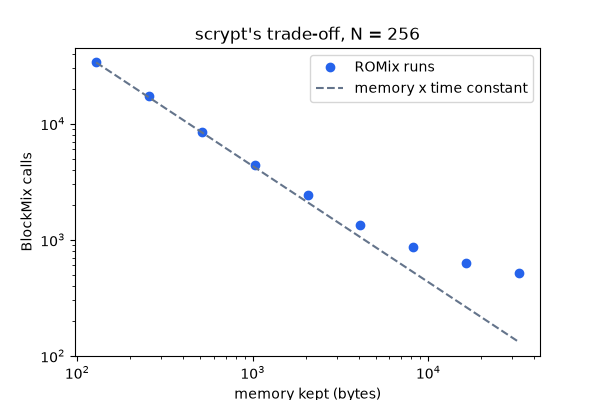
keep every   1: 32,768 bytes,    512 BlockMix calls, product 16,777,216
keep every   2: 16,384 bytes,    632 BlockMix calls, product 10,354,688
keep every   4:  8,192 bytes,    858 BlockMix calls, product 7,028,736
keep every   8:  4,096 bytes,  1,330 BlockMix calls, product 5,447,680
keep every  16:  2,048 bytes,  2,410 BlockMix calls, product 4,935,680
keep every  32:  1,024 bytes,  4,410 BlockMix calls, product 4,515,840
keep every  64:    512 bytes,  8,410 BlockMix calls, product 4,305,920
keep every 128:    256 bytes, 17,306 BlockMix calls, product 4,430,336
keep every 256:    128 bytes, 33,946 BlockMix calls, product 4,345,088
Exercise#
Keeping every k-th entry should cost about \(N + N(k + 1)/2\) BlockMix calls. Check this against the measured counts. A worked solution is in Exercises: wallets.
Total running time of the script: (0 minutes 4.008 seconds)
