
Note
Go to the end to download the full example code or to run this example in your browser via JupyterLite.
Vickrey’s second-price auction: truthful bidding (1961)#
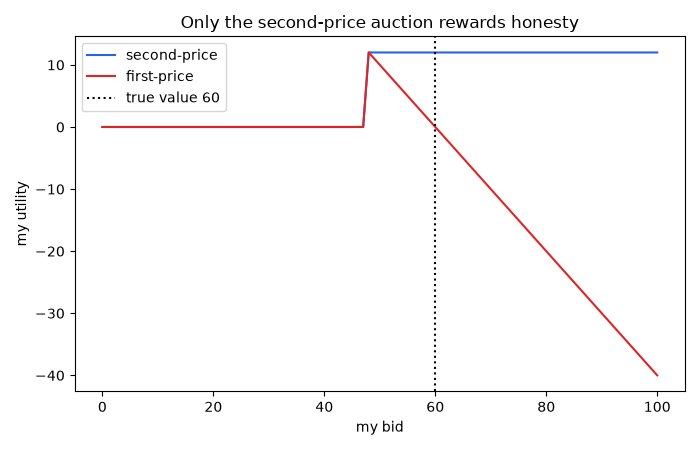
In a sealed-bid first-price auction, the winner pays its own bid, so every bidder shades its bid below its value, by an amount that depends on guesses about the others. Vickrey proposed charging the winner the second-highest bid instead. A bid then decides only whether one wins, never what one pays, and bidding one’s true value is a dominant strategy:
is maximized by \(b_i = v_i\) whatever the others bid. Blockchains use the idea where honest bidding matters: fee mechanisms, block-builder auctions, and on-chain auctions of names and collateral.
from random import Random

import matplotlib.pyplot as plt

import blockchainkit as bk
One bidder’s utility against its own bid#
VALUE = 60
others = {"rival0": 35, "rival1": 48, "rival2": 22}
bids = range(0, 101)
second = [bk.economics.second_price_auction(others | {"me": b}).utility("me", VALUE) for b in bids]
first = [bk.economics.first_price_auction(others | {"me": b}).utility("me", VALUE) for b in bids]
assert max(second) == second[VALUE]  # The true value is a best bid.
assert max(first) > first[VALUE] == 0  # Bidding the value earns nothing in a first-price auction.
print("best first-price bid:", first.index(max(first)), "earning", max(first))
best first-price bid: 48 earning 12.0
Truthfulness against every rival profile#
rng = Random(11)
worst_gain = 0
for _ in range(300):
    rivals = {f"r{i}": rng.randint(0, 100) for i in range(rng.randint(1, 5))}
    value = rng.randint(0, 100)
    truthful = bk.economics.second_price_auction(rivals | {"me": value}).utility("me", value)
    for deviation in range(0, 101, 5):
        result = bk.economics.second_price_auction(rivals | {"me": deviation})
        worst_gain = max(worst_gain, result.utility("me", value) - truthful)
print("largest gain from lying over 300 random auctions:", worst_gain)
assert worst_gain == 0

fig, ax = plt.subplots(figsize=(7, 4.5))
ax.plot(bids, second, color="#2563eb", label="second-price")
ax.plot(bids, first, color="#dc2626", label="first-price")
ax.axvline(VALUE, color="black", linestyle=":", label=f"true value {VALUE}")
ax.set(xlabel="my bid", ylabel="my utility", title="Only the second-price auction rewards honesty")
ax.legend()
fig.tight_layout()

plt.show()
largest gain from lying over 300 random auctions: 0
Exercise#
Two bidders could collude in a second-price auction: the lower one stays out. How much does that save the winner, and who pays for it? Repeat with three bidders where the two highest collude.
Total running time of the script: (0 minutes 0.085 seconds)
