
Note
Go to the end to download the full example code or to run this example in your browser via JupyterLite.
Myerson’s optimal auction and revenue equivalence (1981)#
Which auction earns the seller the most? Myerson replaced each bidder’s value \(v\) by its virtual value, the marginal revenue of selling to it,
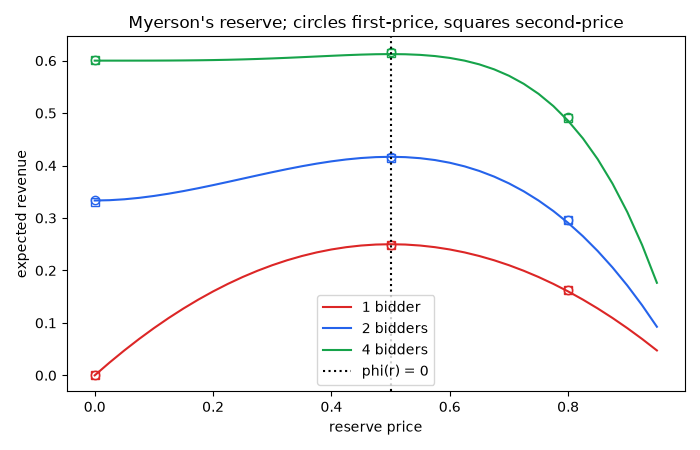
and showed that expected revenue equals the expected virtual value of the winner. The optimal auction therefore sells to the highest nonnegative virtual value: for identical bidders, a second-price auction with a reserve price \(\varphi^{-1}(0)\), which is \(1/2\) for values uniform on \([0, 1]\), however many bidders there are.
The same identity gives revenue equivalence: any two auctions that allocate alike earn the same on average. A first-price auction, in which bidders shade their bids, and a second-price one, in which they bid their values, raise exactly the same expected revenue.
import matplotlib.pyplot as plt
import numpy as np

import blockchainkit as bk
Revenue against the reserve#
reserves = np.linspace(0, 0.95, 39)
fig, ax = plt.subplots(figsize=(7, 4.5))
for n, color in ((1, "#dc2626"), (2, "#2563eb"), (4, "#16a34a")):
    revenue = [bk.economics.expected_revenue(n, reserve=r) for r in reserves]
    ax.plot(reserves, revenue, color=color, label=f"{n} bidder{'s' * (n > 1)}")
    best = reserves[int(np.argmax(revenue))]
    assert abs(best - bk.economics.optimal_reserve()) < 0.03
    for auction, marker in (("first-price", "o"), ("second-price", "s")):
        measured = [
            bk.economics.simulate_revenue(auction, n, rounds=4_000, reserve=r, seed=3)
            for r in (0.0, 0.5, 0.8)
        ]
        ax.plot((0.0, 0.5, 0.8), measured, marker, color=color, fillstyle="none")
ax.axvline(bk.economics.optimal_reserve(), color="black", linestyle=":", label="phi(r) = 0")
ax.set(xlabel="reserve price", ylabel="expected revenue")
ax.set_title("Myerson's reserve; circles first-price, squares second-price")
ax.legend()
fig.tight_layout()
Revenue equivalence#
for n in (2, 5):
    theory = bk.economics.expected_revenue(n, reserve=0.5)
    first = bk.economics.simulate_revenue("first-price", n, rounds=30_000, reserve=0.5, seed=8)
    second = bk.economics.simulate_revenue("second-price", n, rounds=30_000, reserve=0.5, seed=8)
    print(f"{n} bidders: theory {theory:.4f}, first-price {first:.4f}, second-price {second:.4f}")
    assert abs(first - theory) < 0.01 and abs(second - theory) < 0.01

plt.show()
2 bidders: theory 0.4167, first-price 0.4142, second-price 0.4132
5 bidders: theory 0.6719, first-price 0.6711, second-price 0.6708
Exercise#
The reserve helps most with one bidder. With a single bidder whose value is uniform on [0, 1], the seller just posts a price p. Show that its revenue is p (1 - p) and that the best price is Myerson’s reserve. A worked solution is in Exercises: economics.
Total running time of the script: (0 minutes 0.481 seconds)
