Note
Go to the end to download the full example code or to run this example in your browser via JupyterLite.
Announce, then fetch: Bitcoin’s inv/getdata relay (Nakamoto 2009)#
The simplest relay floods: every peer forwards a new block over each of its
links, so a peer with eight neighbors may receive it eight times. The first
Bitcoin client instead announces: it sends a small inv message
carrying the block’s hash, and sends the block only to peers that ask for it
with getdata. Each peer downloads each block once.
What to look for#
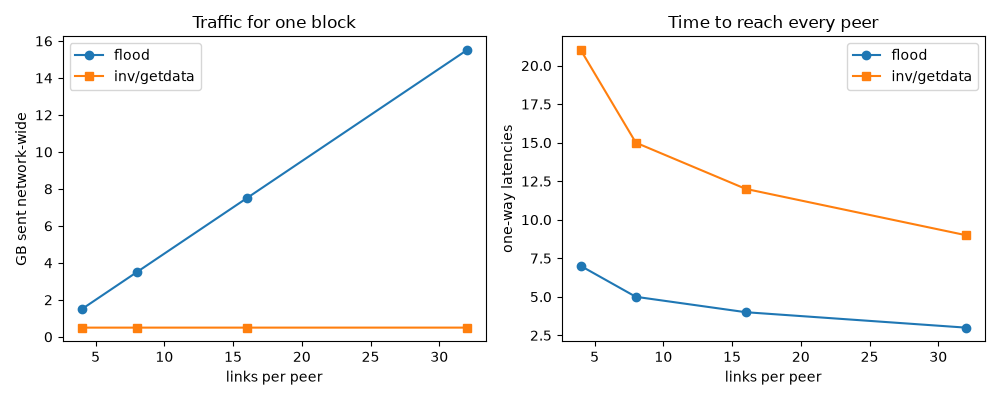
Announcing cuts the traffic by roughly the average degree, and the saving grows as peers keep more connections. The price is latency: each hop now needs three one-way messages (inv, getdata, block) instead of one, which is the delay that compact blocks later attacked.
The history behind this experiment: Breakthroughs in Peer-to-Peer Networking.
A 1 MB block on a random network of 500 peers#
import matplotlib.pyplot as plt

import blockchainkit as bk

size = 1_000_000
degrees = [4, 8, 16, 32]
flood, announce = [], []
for d in degrees:
    graph = bk.network.watts_strogatz(500, d, 1.0, seed=1)
    assert graph.is_connected()
    flood.append(bk.network.relay_cost(graph, size=size))
    announce.append(bk.network.relay_cost(graph, size=size, mode="announce"))
for d, f, a in zip(degrees, flood, announce, strict=True):
    print(f"degree {d:2d}: flood {f.bytes / 1e6:6.0f} MB, announce {a.bytes / 1e6:4.0f} MB")
assert all(a.bytes < f.bytes / (d / 2) for d, f, a in zip(degrees, flood, announce, strict=True))
assert all(a.completion == 3 * f.completion for f, a in zip(flood, announce, strict=True))
degree  4: flood   1501 MB, announce  499 MB
degree  8: flood   3501 MB, announce  499 MB
degree 16: flood   7501 MB, announce  499 MB
degree 32: flood  15501 MB, announce  500 MB
Check the count against the simulator#
Every message the simulator hands to a link is counted, including the duplicates that receivers discard.
graph = bk.network.watts_strogatz(500, 8, 1.0, seed=1)
network = bk.network.SimulatedNetwork.from_graph(graph)
network.broadcast("0", b"block")
network.run()
assert network.messages_sent == bk.network.relay_cost(graph, size=size).messages
print(network.messages_sent, "full-block copies sent to reach", len(network.deliveries), "peers")

fig, (left, right) = plt.subplots(1, 2, figsize=(10, 4))
left.plot(degrees, [f.bytes / 1e9 for f in flood], "o-", label="flood")
left.plot(degrees, [a.bytes / 1e9 for a in announce], "s-", label="inv/getdata")
left.set(xlabel="links per peer", ylabel="GB sent network-wide", title="Traffic for one block")
left.legend()
right.plot(degrees, [f.completion for f in flood], "o-", label="flood")
right.plot(degrees, [a.completion for a in announce], "s-", label="inv/getdata")
right.set(xlabel="links per peer", ylabel="one-way latencies", title="Time to reach every peer")
right.legend()
fig.tight_layout()
3501 full-block copies sent to reach 500 peers
Exercise#
Bitcoin relays transactions the same way. Transactions are about 250
bytes, while an inv costs 61 bytes. Does announcing still pay off, and
how would batching many hashes into one inv change the answer?
Total running time of the script: (0 minutes 0.921 seconds)
