
Note
Go to the end to download the full example code or to run this example in your browser via JupyterLite.
k-anonymity and anonymity sets: hiding among k (2002)#
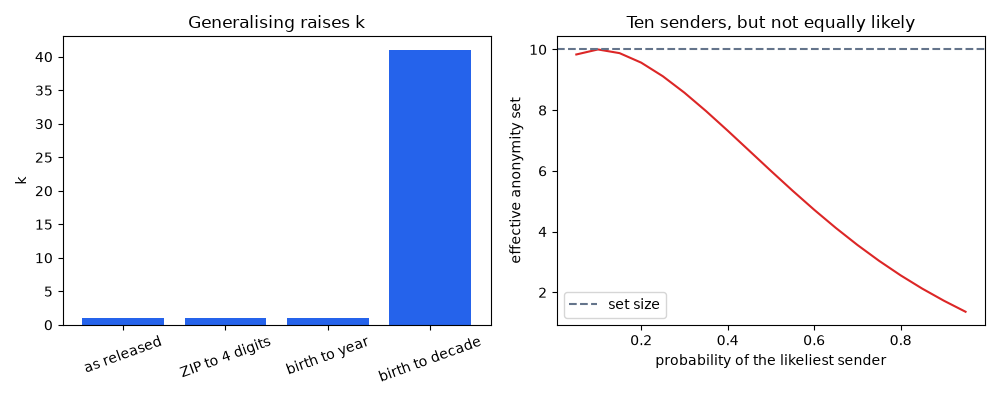
Latanya Sweeney showed that a ZIP code, a birth date and a sex single out most Americans. A table is k-anonymous if every combination of these quasi-identifiers appears at least \(k\) times, so each person hides among \(k\). Generalising values, a ZIP to its first three digits or a date to a year, merges rows until \(k\) is reached.
The same year, anonymity on networks was measured the same way: by the anonymity set of possible senders. An attacker who finds some senders likelier than others has less uncertainty than the set’s size suggests, so Serjantov and Danezis, and Díaz et al., counted
the number of equally likely senders that leave the same uncertainty.
from random import Random

import matplotlib.pyplot as plt

import blockchainkit as bk
Generalising a table#
rng = Random(1997)
rows = [
    {
        "zip": f"021{rng.randrange(30, 40)}",
        "born": f"19{rng.randrange(50, 90)}-{rng.randrange(1, 13):02d}",
        "sex": rng.choice("FM"),
    }
    for _ in range(400)
]
quasi = ["zip", "born", "sex"]
steps = {
    "as released": rows,
    "ZIP to 4 digits": [{**r, "zip": r["zip"][:4]} for r in rows],
    "birth to year": [{**r, "zip": r["zip"][:4], "born": r["born"][:4]} for r in rows],
    "birth to decade": [{**r, "zip": r["zip"][:3], "born": r["born"][:3]} for r in rows],
}
ks = {name: bk.privacy.k_anonymity(table, quasi) for name, table in steps.items()}
unique = sum(1 for n in bk.privacy.equivalence_classes(rows, quasi).values() if n == 1)
print(f"{unique} of {len(rows)} rows are unique as released; k by step: {ks}")
assert ks["as released"] == 1 and ks["birth to decade"] > 1
386 of 400 rows are unique as released; k by step: {'as released': 1, 'ZIP to 4 digits': 1, 'birth to year': 1, 'birth to decade': 41}
Size is not the whole story#
Ten possible senders, as the attacker’s suspicion of one grows.
suspicion = [i / 20 for i in range(1, 20)]
effective = [bk.privacy.effective_anonymity_set([p] + [(1 - p) / 9] * 9) for p in suspicion]
assert abs(effective[1] - 10) < 1e-9

fig, (ax1, ax2) = plt.subplots(1, 2, figsize=(10, 4))
ax1.bar(list(ks), list(ks.values()), color="#2563eb")
ax1.set(ylabel="k", title="Generalising raises k")
ax1.tick_params(axis="x", labelrotation=20)
ax2.plot(suspicion, effective, color="#dc2626")
ax2.axhline(10, color="#64748b", linestyle="--", label="set size")
ax2.set(xlabel="probability of the likeliest sender", ylabel="effective anonymity set")
ax2.set_title("Ten senders, but not equally likely")
ax2.legend()
fig.tight_layout()

plt.show()
Exercise#
A table is 5-anonymous, but in one class of five rows every patient has the same diagnosis. What does an attacker who knows a neighbour is in that class learn, and what property did Machanavajjhala et al. add? A worked solution is in Exercises: privacy.
Total running time of the script: (0 minutes 0.096 seconds)
