
Note
Go to the end to download the full example code or to run this example in your browser via JupyterLite.
Chaum’s mix-nets: untraceable mail (1981)#
David Chaum wanted to hide who writes to whom, even from someone watching every wire. A sender wraps its message in one layer of encryption per mix, innermost for the last. Each mix collects a batch, removes one layer from every message, and sends them on in a random order. The bytes change at every hop and so does the order, so an observer cannot match what goes in to what comes out.
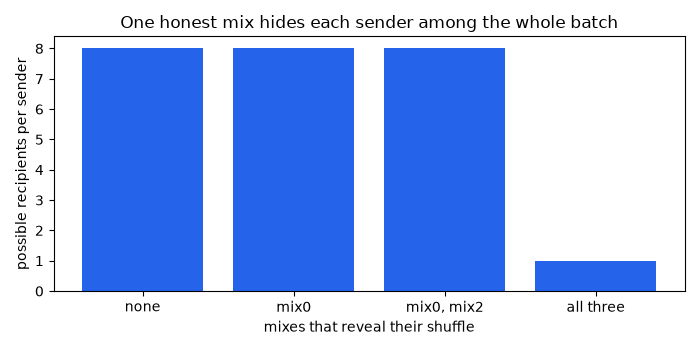
Following a message needs every mix’s shuffle. If the mixes are \(M_1, \dots, M_k\) and the observer learns the permutations of the corrupt ones, a sender stays hidden among the whole batch as soon as one mix is honest:
from random import Random

import matplotlib.pyplot as plt

import blockchainkit as bk
Wrapping and peeling#
Each mix learns only the next hop.
mix0 forwards  39 bytes to mix1
mix1 forwards  25 bytes to mix2
mix2 forwards  12 bytes to bob
A batch through the cascade#
Eight senders write to eight recipients at once.
rng = Random(2)
onions = [bk.privacy.wrap(f"note {i}".encode(), mixes, f"r{i}", rng) for i in range(8)]
run = bk.privacy.mix_cascade(onions, mixes, seed=3)
print("delivered:", [recipient for recipient, _ in run.delivered])
for sender in range(8):
    assert run.delivered[run.output_of(sender)][0] == f"r{sender}"

corrupt_sets = {
    "none": frozenset(),
    "mix0": frozenset({0}),
    "mix0, mix2": frozenset({0, 2}),
    "all three": frozenset({0, 1, 2}),
}
candidates = {
    name: sum(len(run.candidates(s, corrupt)) for s in range(8)) / 8
    for name, corrupt in corrupt_sets.items()
}
print(candidates)
assert candidates["mix0, mix2"] == 8 and candidates["all three"] == 1

fig, ax = plt.subplots(figsize=(7, 3.5))
ax.bar(list(candidates), list(candidates.values()), color="#2563eb")
ax.set(xlabel="mixes that reveal their shuffle", ylabel="possible recipients per sender")
ax.set_title("One honest mix hides each sender among the whole batch")
fig.tight_layout()

plt.show()
delivered: ['r4', 'r3', 'r6', 'r1', 'r2', 'r5', 'r0', 'r7']
{'none': 8.0, 'mix0': 8.0, 'mix0, mix2': 8.0, 'all three': 1.0}
Exercise#
The observer watches the cascade at a quiet hour, when only two messages pass. What is the chance of linking a sender now, and what did Chaum propose to keep batches large? A worked solution is in Exercises: privacy.
Total running time of the script: (0 minutes 0.058 seconds)
