
Note
Go to the end to download the full example code or to run this example in your browser via JupyterLite.
Onion routing in Tor: fast, but exposed end to end (2004)#
Tor wraps traffic in layers like a mix-net, through a circuit of three relays, but forwards each packet at once: no batching, no reordering. That makes browsing fast enough to use. The design paper states the price: an adversary that watches both ends of a circuit can match the packet timing going in to the timing coming out. Delays shift every packet alike, so the gaps between packets survive the trip.
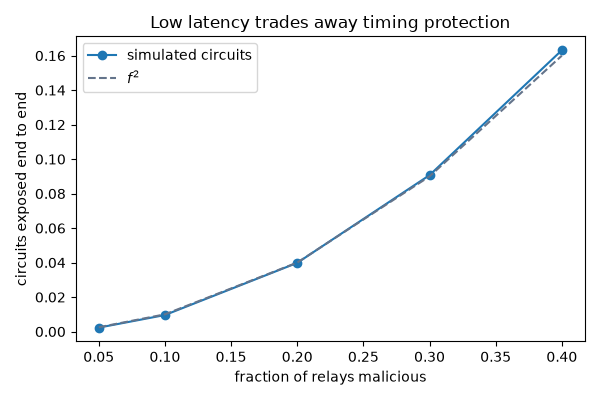
An adversary running a fraction \(f\) of the relays sees both ends of a random circuit with probability about
from random import Random

import matplotlib.pyplot as plt

import blockchainkit as bk
A three-hop circuit#
The guard knows the user, the exit knows the destination, nobody knows both.
guard sends to middle
middle sends to exit
exit sends to example.org
Timing correlation#
Fifty users browse at once; the adversary records packet times at entry and exit and matches flows by their gaps.
observed = bk.privacy.simulate_flows(50, 30, seed=3)
guesses = bk.privacy.match_flows(observed.entering, observed.leaving)
correct = sum(g == t for g, t in zip(guesses, observed.truth, strict=True))
print(f"flows matched correctly: {correct} of 50")
assert correct == 50
flows matched correctly: 50 of 50
How often both ends are watched#
fractions = [0.05, 0.1, 0.2, 0.3, 0.4]
rates = [
    bk.privacy.circuit_compromise_rate(100, range(int(f * 100)), 20_000, seed=1) for f in fractions
]
for f, rate in zip(fractions, rates, strict=True):
    assert abs(rate - f * f) < 0.02

fig, ax = plt.subplots(figsize=(6, 4))
ax.plot(fractions, rates, marker="o", label="simulated circuits")
ax.plot(fractions, [f * f for f in fractions], linestyle="--", color="#64748b", label="$f^2$")
ax.set(xlabel="fraction of relays malicious", ylabel="circuits exposed end to end")
ax.set_title("Low latency trades away timing protection")
ax.legend()
fig.tight_layout()

plt.show()
Exercise#
Tor clients keep the same entry guard for months. If 10% of relays are malicious, what is the chance a user’s guard is bad, and why is that better than choosing a fresh entry for every circuit? A worked solution is in Exercises: privacy.
Total running time of the script: (0 minutes 0.227 seconds)
