
Note
Go to the end to download the full example code or to run this example in your browser via JupyterLite.
Groth16: three group elements per proof (2016)#
Groth found the shortest pairing-based SNARK: a proof is three group elements \((A, B, C)\), and the verifier checks one equation,
where the setup encodes the circuit’s QAP at a secret point \(\tau\), blinded by secrets \(\alpha, \beta, \gamma, \delta\). The prover adds fresh random \(r, s\) to every proof, so two proofs of the same statement look unrelated: they reveal nothing but the public inputs. Proofs stay the same size however large the circuit, which is why Zcash (Sapling), Tornado Cash and many rollups use Groth16.
import matplotlib.pyplot as plt

import blockchainkit as bk

TRAPDOOR = bk.proofs.Groth16Trapdoor(tau=1001, alpha=22, beta=33, gamma=44, delta=55)
Prove x**3 + x + 5 = 35 without revealing x#
circuit = bk.proofs.Circuit()
out, x = circuit.public(35), circuit.private(3)
circuit.assert_equal(circuit.mul(circuit.mul(x, x), x) + x + 5, out)
key = bk.proofs.groth16_setup(circuit.r1cs(), TRAPDOOR)
first = bk.proofs.groth16_prove(key, circuit.witness(), seed=1)
second = bk.proofs.groth16_prove(key, circuit.witness(), seed=2)
vk = key.verifying_key
assert bk.proofs.groth16_verify(vk, [35], first) and bk.proofs.groth16_verify(vk, [35], second)
assert first != second  # Rerandomized: nothing links the two proofs.
assert not bk.proofs.groth16_verify(vk, [36], first)
print("proof A:", first.a)
proof A: (21341727789, 3407614924)
The proof does not grow with the circuit#
Prove knowledge of a cube root chain: y = x**(3**k) for growing k.
constraints, elements = [], []
for k in (1, 4, 16, 64, 256):
    chain = bk.proofs.Circuit()
    y = chain.public(pow(2, 3**k, bk.proofs.FIELD_PRIME))
    value = chain.private(2)
    for _ in range(k):
        value = chain.mul(chain.mul(value, value), value)
    chain.assert_equal(value, y)
    chain_key = bk.proofs.groth16_setup(chain.r1cs(), TRAPDOOR)
    proof = bk.proofs.groth16_prove(chain_key, chain.witness())
    assert bk.proofs.groth16_verify(chain_key.verifying_key, chain.public_inputs(), proof)
    constraints.append(chain.r1cs().num_constraints)
    elements.append(3)
print("constraints:", constraints, "-> always 3 group elements")

fig, ax = plt.subplots(figsize=(7, 4.5))
ax.loglog(constraints, constraints, "o-", color="#dc2626", label="witness size (field elements)")
ax.loglog(constraints, elements, "o-", color="#2563eb", label="Groth16 proof (group elements)")
ax.set(xlabel="constraints", ylabel="elements", title="Groth16 proofs have constant size")
ax.legend()
fig.tight_layout()

plt.show()
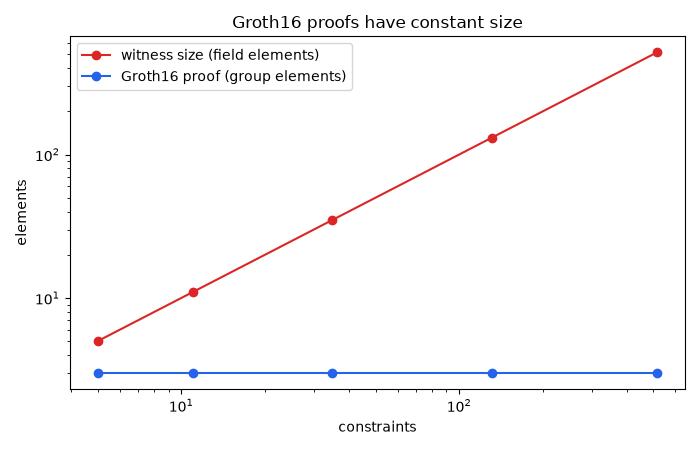
constraints: [5, 11, 35, 131, 515] -> always 3 group elements
Exercise#
The verifier’s work is three pairings plus one point multiplication per public input. Add 10 public inputs to the cube-chain circuit and check that proofs still verify; which part of the verifying key grew?
Total running time of the script: (0 minutes 0.384 seconds)
