Note
Go to the end to download the full example code or to run this example in your browser via JupyterLite.
Ethereum: a replicated computer metered by gas (Buterin 2014)#
Ethereum turned a blockchain into a shared computer: every node runs every contract call and must reach the same state. Since no one can predict whether an arbitrary program halts, each call carries a gas budget; every instruction spends some, and running out aborts the call and undoes its effects. Words are 256 bits, wide enough for hashes and keys. This small stack machine uses unit instruction costs, not Ethereum’s prices.
What to look for#
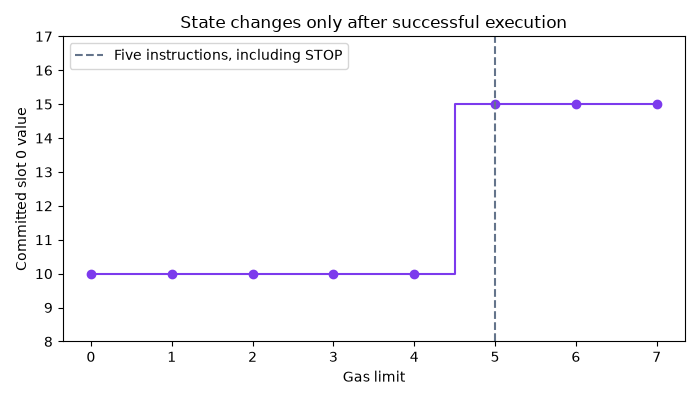
Compare successful execution with an exhausted gas budget. Success returns new storage; failure preserves the original storage. An infinite loop stops when its budget runs out, so every call terminates.
Read cells in order. An assert that produces no output has passed.
The final exercise asks you to change an input and explain the result.
The history behind this experiment: Breakthroughs in Replicated Execution. See Exercises: execution for a worked solution to the exercise.
import matplotlib.pyplot as plt

import blockchainkit as bk
from blockchainkit.vm.visualizers import plot_execution_trace

# Increment persistent slot zero by five.
program = [("LOAD", 0), ("PUSH", 5), ("ADD", None), ("STORE", 0), ("STOP", None)]
initial = {0: 10}
result = bk.vm.execute(program, storage=initial)
assert result.storage[0] == 15
assert bk.vm.execute(program, storage=initial) == result
assert initial == {0: 10}
print("Storage after success:", dict(result.storage), "; gas used:", result.gas_used)
Storage after success: {0: 15} ; gas used: 5
Failed executions do not modify the caller’s state#
try:
    bk.vm.execute(program, storage=initial, gas_limit=3)
except bk.vm.VMError as error:
    print("Execution rejected:", error)
else:
    raise AssertionError("expected out-of-gas failure")
assert initial == {0: 10}
try:
    bk.vm.execute([("JMP", 0)], gas_limit=20)
except bk.vm.VMError:
    print("An infinite loop was stopped by its gas budget.")
Execution rejected: out of gas
An infinite loop was stopped by its gas budget.
limits = list(range(8))
committed = []
for limit in limits:
    try:
        execution = bk.vm.execute(program, storage=initial, gas_limit=limit)
        committed.append(execution.storage[0])
    except bk.vm.VMError:
        committed.append(initial[0])
fig, ax = plt.subplots(figsize=(7, 4))
ax.step(limits, committed, where="mid", marker="o", color="#7c3aed")
ax.axvline(5, linestyle="--", color="#64748b", label="Five instructions, including STOP")
ax.set(
    xlabel="Gas limit",
    ylabel="Committed slot 0 value",
    title="State changes only after successful execution",
    ylim=(8, 17),
)
ax.legend()
fig.tight_layout()
Exercise#
Implement a branch that stores one value when two numbers are equal and another value otherwise. Check both branches, stack underflow, and 256-bit wraparound. The VM is an independent component; it is not embedded in the transfer-only ledger’s transaction format.
Trace the stack after each instruction#
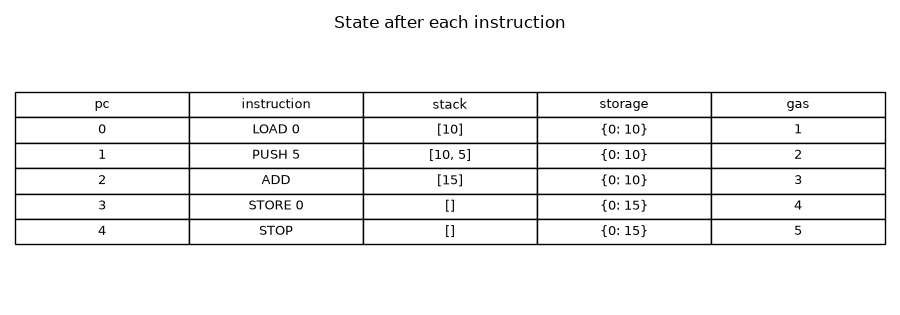
trace=True records the machine state after every executed instruction.
Storage in the trace is the working copy: it is committed only if the whole
program succeeds. The trace follows jumps too, so it works for loops.
traced = bk.vm.execute(program, storage=initial, trace=True)
assert traced.trace[-1].storage == dict(result.storage)
assert initial == {0: 10}
ax = plot_execution_trace(traced.trace)
ax.figure.tight_layout()
Total running time of the script: (0 minutes 0.251 seconds)
