
Note
Go to the end to download the full example code or to run this example in your browser via JupyterLite.
Bech32 addresses (BIP173, 2017)#
Pieter Wuille and Gregory Maxwell designed Bech32 for segregated-witness addresses. It uses one case and 32 characters chosen to avoid look-alikes, and a 6-character checksum that is a BCH code over GF(32): the string, read as a polynomial, must satisfy
Out of 159,605 candidate codes, the one chosen detects every error in up to 4 characters for strings of up to 89 characters. Base58Check’s hash detects most errors, but promises nothing about any of them. Here every pattern of one and two substitutions in an address is tried, and a sample of three and four.
import random
from itertools import combinations

import matplotlib.pyplot as plt

import blockchainkit as bk
The address of a key#
key = bk.crypto.public_key(1)
address = bk.wallets.p2wpkh_address(key)
print("private key 1 ->", address)
program = bk.wallets.segwit_decode("bc", address)
print("witness version", program.version, "program", program.program.hex())
assert address == "bc1qw508d6qejxtdg4y5r3zarvary0c5xw7kv8f3t4"
assert program.program == bk.wallets.base58check_decode(bk.wallets.p2pkh_address(key))[1]
private key 1 -> bc1qw508d6qejxtdg4y5r3zarvary0c5xw7kv8f3t4
witness version 0 program 751e76e8199196d454941c45d1b3a323f1433bd6
Errors in up to four characters#
def detected(positions, rng):
    chars = list(address)
    for i in positions:
        chars[i] = rng.choice([c for c in bk.wallets.CHARSET if c != chars[i]])
    try:
        bk.wallets.bech32_decode("".join(chars))
    except ValueError:
        return True
    return False


rng = random.Random(173)
data_positions = range(3, len(address))
rates = []
for k in (1, 2, 3, 4):
    patterns = list(combinations(data_positions, k))
    if len(patterns) > 3_000:
        patterns = rng.sample(patterns, 3_000)
    hits = sum(detected(p, rng) for p in patterns)
    rates.append(hits / len(patterns))
    print(f"{k} characters wrong: {hits} of {len(patterns)} detected")
assert rates == [1.0, 1.0, 1.0, 1.0]

fig, ax = plt.subplots(figsize=(6, 4))
ax.bar([1, 2, 3, 4], rates, color="#2563eb")
ax.set(xlabel="characters substituted", ylabel="share detected", ylim=(0, 1.05))
ax.set_title("Bech32 detects every error in up to 4 characters")
fig.tight_layout()
plt.show()
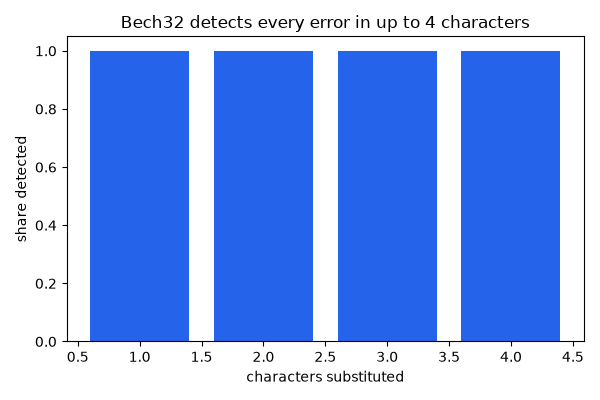
1 characters wrong: 39 of 39 detected
2 characters wrong: 741 of 741 detected
3 characters wrong: 3000 of 3000 detected
4 characters wrong: 3000 of 3000 detected
Exercise#
Upper-case the address. Is it still valid? Mix the case. Is it still valid? A worked solution is in Exercises: wallets.
Total running time of the script: (0 minutes 0.214 seconds)
