Examples#
This gallery walks through every public feature of mathematicskit.combinatorics:
permutation/combination counting and generation, Pascal’s triangle,
integer partitions, the inclusion-exclusion principle, and Stirling/
Catalan/Bell numbers.
See also the narrative tutorial:
Each script in this gallery is self-contained and can be run directly with
python examples/combinatorics/<section>/<script>.py.
Sections#
counting – permutation/combination counting and sequence generation, and multinomial coefficients.
pascals_triangle – the binomial-coefficient recurrence.
partitions – the partition function, enumeration, and Young diagrams.
inclusion_exclusion – the inclusion-exclusion principle and derangements.
special_numbers – Stirling numbers, Catalan numbers, and Bell numbers.
Counting#
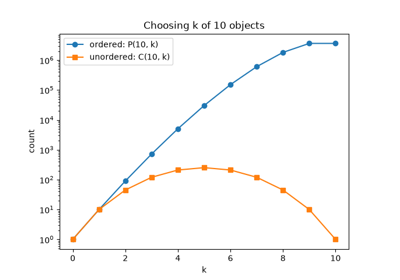
Permutation/combination counting and generation, and multinomial coefficients.

Combinatorial designs#
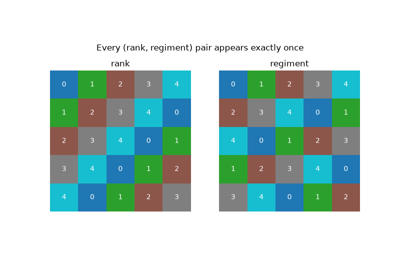
Latin squares and orthogonal pairs.
Extremal combinatorics#
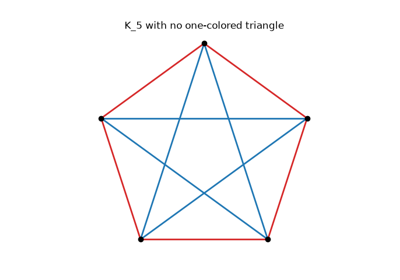
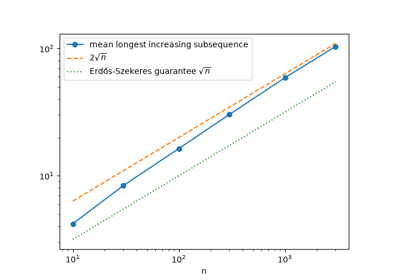
Ramsey’s theorem and the Erdős-Szekeres theorem: order that must appear in any large enough structure.
Inclusion-exclusion#
The inclusion-exclusion principle and derangements.

The hat-check problem: derangements via inclusion-exclusion
Matchings#
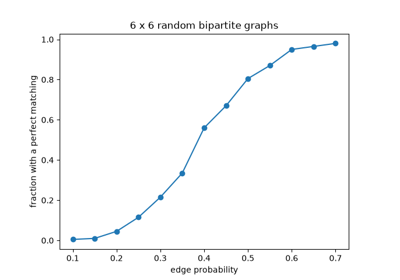
Hall’s marriage theorem and bipartite matchings.
Necklaces#
Pólya enumeration: counting colorings up to symmetry.
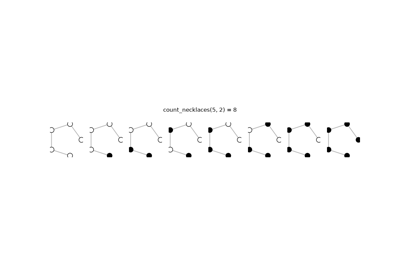
Pólya’s enumeration theorem: necklaces and bracelets
Integer partitions#
The partition function, enumeration, and Young diagrams.
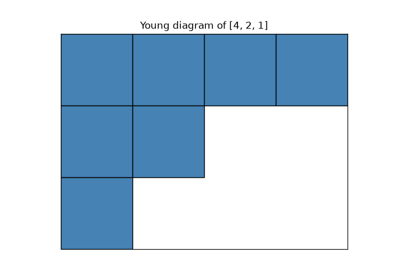
Integer partitions, the partition function, and Young diagrams
Pascal’s triangle#
The binomial-coefficient recurrence, built by hand.
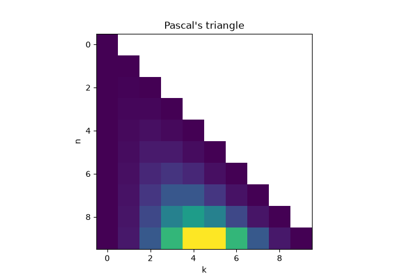
Pascal’s triangle vs. scipy-computed binomial coefficients
Integer sequences#
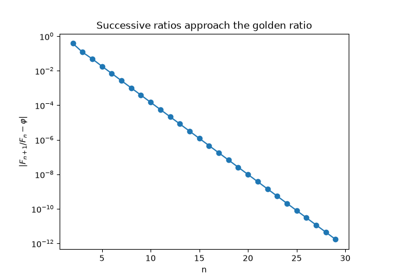
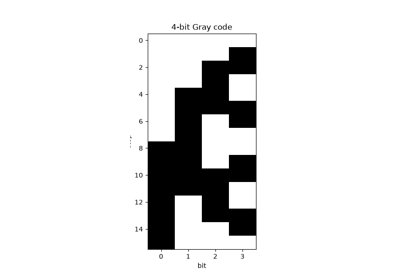
Fibonacci numbers, Bernoulli numbers and sums of powers, and Gray codes.

Special numbers#
Stirling numbers, Bell numbers, and Catalan numbers.
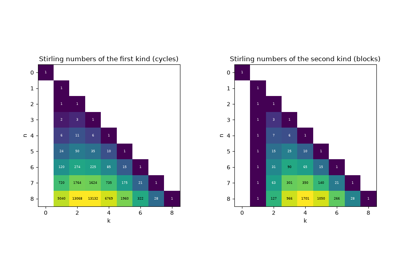
Stirling’s numbers: cycles, set partitions, and Bell numbers
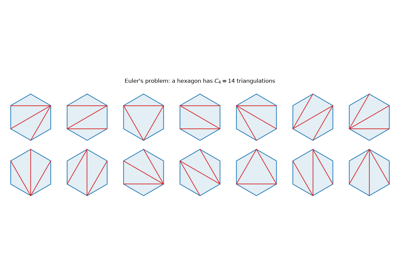
Catalan numbers: Euler’s polygon triangulations and Catalan’s brackets
Labeled trees#
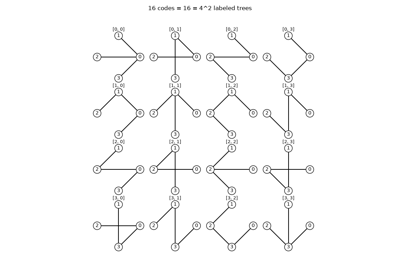
Cayley’s formula and Prüfer codes.