
Note
Go to the end to download the full example code.
Liebig’s combustion analysis: an empirical formula from CO2 and H2O masses#
Justus von Liebig’s Kaliapparat made organic elemental analysis
routine. The sample is burned in oxygen over hot copper oxide, the water
is caught in calcium chloride, the CO2 in potash bulbs, and both are
weighed. Carbon and hydrogen follow from those two masses, oxygen by
difference. Below, a 10.00 mg sample of ascorbic acid (vitamin C) is
“burned”. Its mass percentages go to
empirical_formula(), which converts to
moles, divides by the smallest, and searches for the smallest multiplier
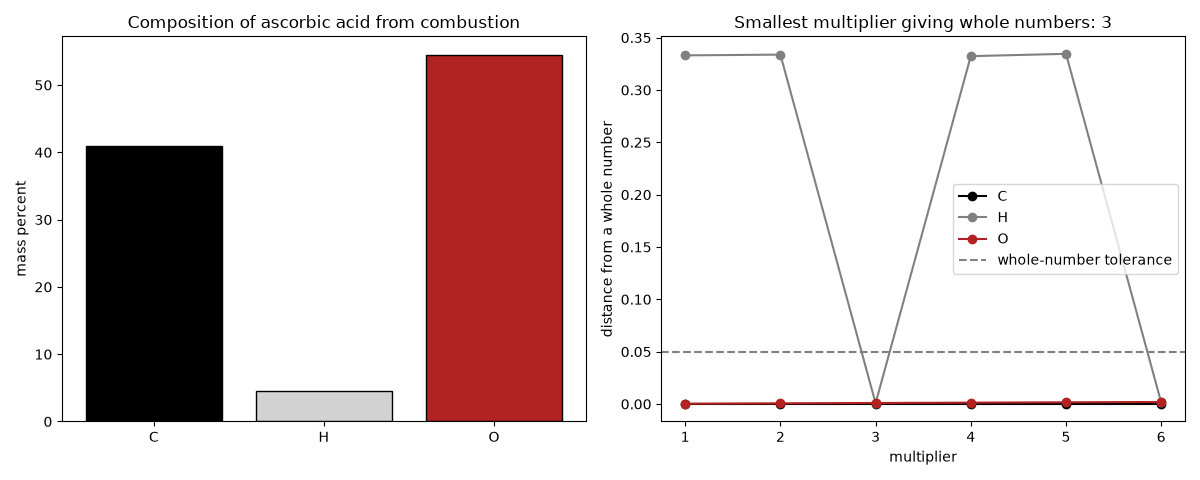
that gives whole numbers. Here that gives C3H4O3, and a molar mass of
about 176 g/mol then fixes the molecular formula as C6H8O6. The right
panel shows why the multiplier search is needed: the raw mole ratios are
1 : 1.33 : 1, which become whole only after multiplying by 3.
weighed: 14.99 mg CO2, 4.09 mg H2O
%C = 40.91, %H = 4.58, %O (by difference) = 54.51
empirical formula C3H4O3; molar mass 176 g/mol -> 2 x C3H4O3
import matplotlib.pyplot as plt
import numpy as np

from chemistrykit.periodic_table import get_element, molar_mass
from chemistrykit.stoichiometry import empirical_formula, mass_percent

sample_mg = 10.00
true = mass_percent("C6H8O6")
m_CO2 = sample_mg * true["C"] / 100 * molar_mass("CO2") / get_element("C").atomic_mass
m_H2O = sample_mg * true["H"] / 100 * molar_mass("H2O") / (2 * get_element("H").atomic_mass)
m_CO2, m_H2O = round(m_CO2, 2), round(m_H2O, 2)  # a microbalance reads to 0.01 mg
print(f"weighed: {m_CO2:.2f} mg CO2, {m_H2O:.2f} mg H2O")

pct_C = 100 * m_CO2 * get_element("C").atomic_mass / molar_mass("CO2") / sample_mg
pct_H = 100 * m_H2O * 2 * get_element("H").atomic_mass / molar_mass("H2O") / sample_mg
pct_O = 100.0 - pct_C - pct_H
measured = {"C": pct_C, "H": pct_H, "O": pct_O}
formula = empirical_formula(measured)
unit = "".join(f"{e}{n}" for e, n in formula.items())
n_units = round(176.0 / molar_mass(formula))
print(f"%C = {pct_C:.2f}, %H = {pct_H:.2f}, %O (by difference) = {pct_O:.2f}")
print(f"empirical formula {unit}; molar mass 176 g/mol -> {n_units} x {unit}")

moles = np.array([measured[e] / get_element(e).atomic_mass for e in "CHO"])
ratios = moles / moles.min()

fig, axes = plt.subplots(1, 2, figsize=(12, 4.8))
axes[0].bar(["C", "H", "O"], [pct_C, pct_H, pct_O], color=["black", "lightgray", "firebrick"], edgecolor="black")
axes[0].set_ylabel("mass percent")
axes[0].set_title("Composition of ascorbic acid from combustion")

m = np.arange(1, 7)
for ratio, e, color in zip(ratios, "CHO", ["black", "gray", "firebrick"], strict=True):
    scaled = ratio * m
    axes[1].plot(m, np.abs(scaled - np.round(scaled)), "o-", color=color, label=e)
axes[1].axhline(0.05, color="gray", linestyle="--", label="whole-number tolerance")
axes[1].set_xlabel("multiplier")
axes[1].set_ylabel("distance from a whole number")
axes[1].set_title("Smallest multiplier giving whole numbers: 3")
axes[1].legend()
fig.tight_layout()

plt.show()
Total running time of the script: (0 minutes 0.062 seconds)