
Sections#
equations_of_state – the ideal gas law, van der Waals continuity of liquid and gas, Redlich-Kwong, Peng-Robinson vapor pressures, and Lewis fugacity.
phase_equilibria – the Clausius-Clapeyron vapor-pressure curve, Antoine’s equation, and the Gibbs phase rule.
equilibrium – the law of mass action, Gibbs-energy minimization, the van’t Hoff plot, and Le Chatelier’s principle.
thermochemistry – Hess’s law and Nernst’s heat theorem.
mixtures – Raoult’s-law P-x-y diagrams, Henry’s law, van’t Hoff’s osmotic pressure, and the Margules, Wilson, NRTL and UNIQUAC activity-coefficient models (azeotropes and liquid-liquid splitting).
Equations of state#
The ideal gas law, van der Waals, Redlich-Kwong, and Peng-Robinson equations of state, and Lewis fugacities computed from them.
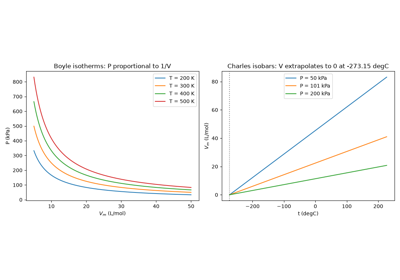
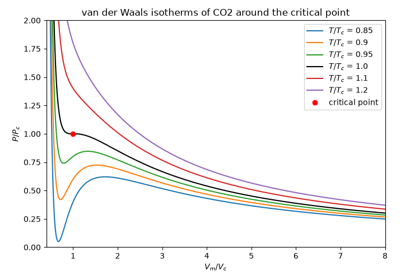
Andrews and van der Waals: continuity of the liquid and gas states
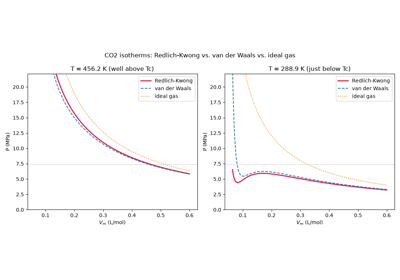
Redlich-Kwong isotherms of CO2 against van der Waals and the ideal gas
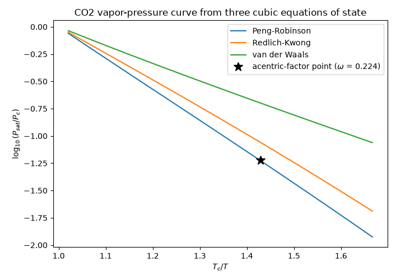
Peng-Robinson: vapor pressures from the acentric factor
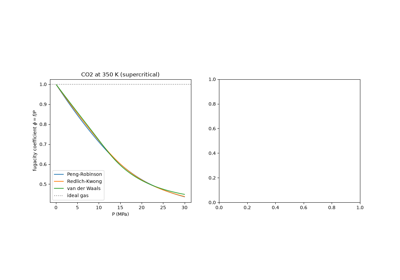
Lewis fugacity: the effective pressure of a real gas
Reaction equilibrium#
The law of mass action, Gibbs-energy minimization, the van’t Hoff plot, and Le Chatelier’s principle.
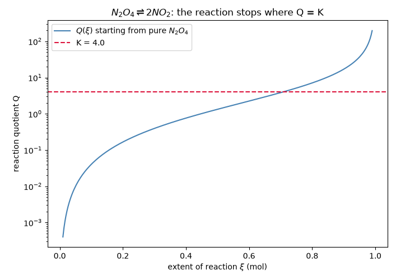
Guldberg and Waage’s law of mass action: Q = K at equilibrium
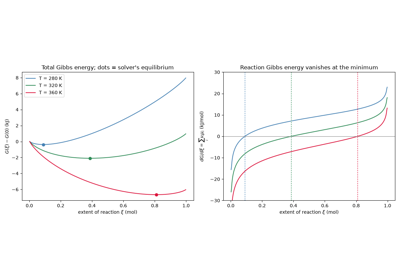
Gibbs’s equilibrium criterion: minimum total Gibbs energy
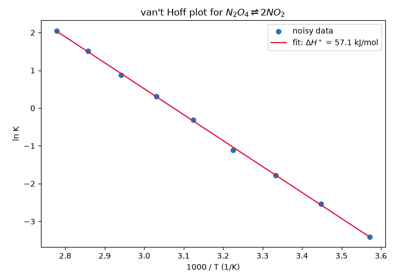
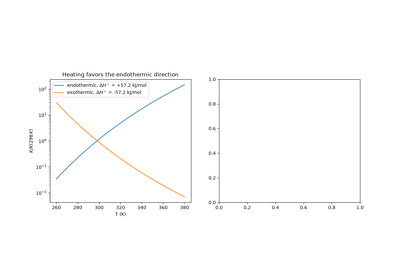
Le Chatelier’s principle: equilibrium shifts that oppose a disturbance
Mixtures and colligative properties#
Raoult’s-law P-x-y diagrams, Henry’s law for dilute solutes, van’t Hoff’s osmotic pressure and the colligative properties, and the Margules, Wilson, NRTL and UNIQUAC activity-coefficient models for non-ideal solutions: the ethanol-water azeotrope, liquid-liquid phase splitting, and the combinatorial/residual decomposition.
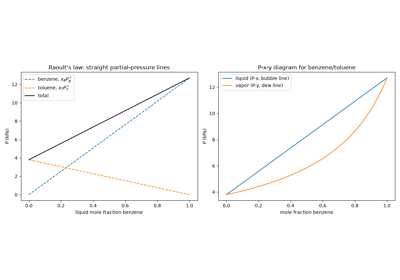
Raoult’s law and the P-x-y diagram of an ideal solution
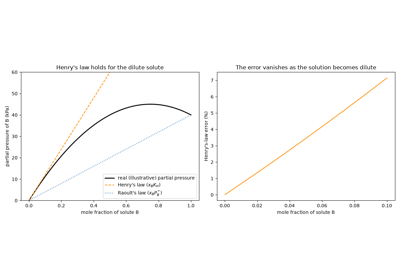
Henry’s law: the dilute-solute limit of a real solution
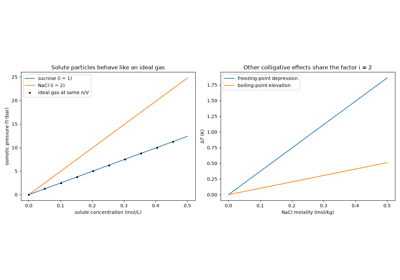
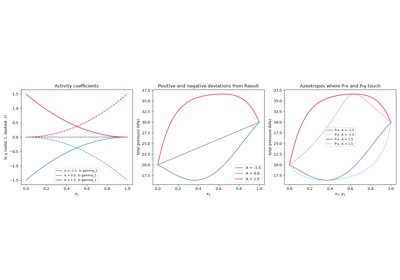
Margules activity coefficients: deviations from Raoult’s law
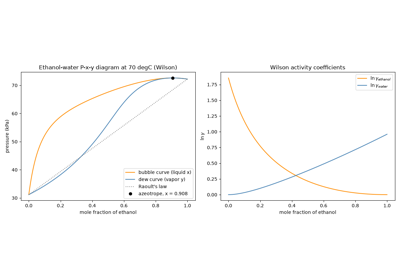
Wilson’s local-composition model: the ethanol-water azeotrope
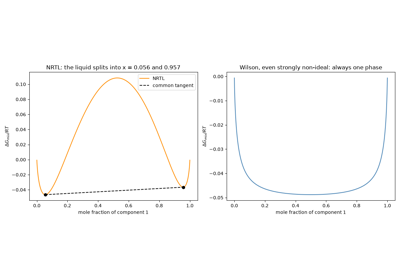
NRTL: a non-ideal liquid that splits into two phases
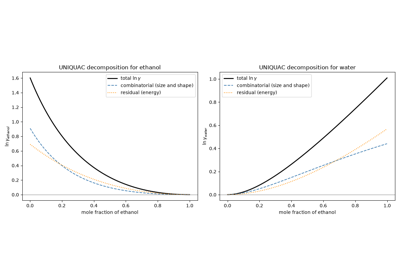
UNIQUAC: separating molecular size from molecular energy
Phase equilibria#
The Clausius-Clapeyron liquid-vapor phase boundary, Antoine’s three-constant vapor-pressure equation, and the Gibbs phase rule.
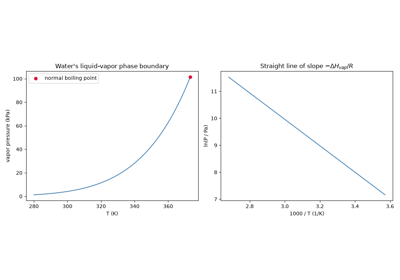
The Clausius-Clapeyron vapor-pressure curve of water
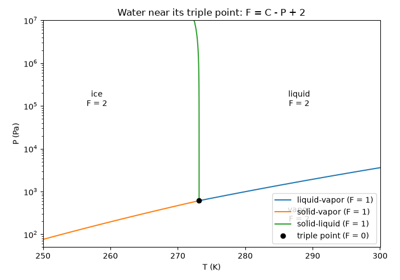
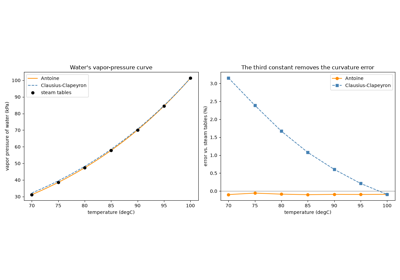
Antoine’s equation: vapor pressure beyond Clausius-Clapeyron
Thermochemistry#
Hess’s law of constant heat summation and Nernst’s heat theorem: reaction enthalpies built from steps or formation enthalpies, and the behavior of reaction entropies and free energies as the temperature approaches absolute zero.
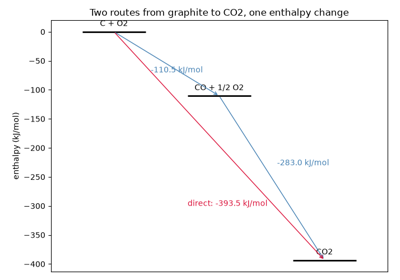
Hess’s law: reaction enthalpy does not depend on the path
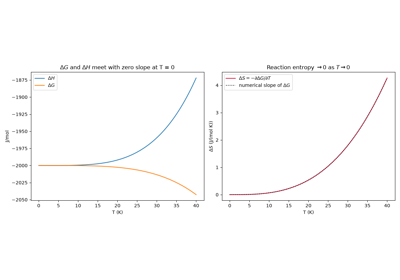
Nernst’s heat theorem: reaction entropy vanishes at absolute zero