
Note
Go to the end to download the full example code.
UNIQUAC: separating molecular size from molecular energy#
Abrams and Prausnitz’s UNIQUAC model
(UNIQUACSolution) writes
\(\ln\gamma_i\) as the sum of two physically distinct parts. The
combinatorial part depends only on each molecule’s van der Waals
volume \(r\) and surface area \(q\), and arises because big and
small molecules pack differently. The residual part depends on the
interaction energies. Below, for ethanol-water with tabulated
\(r, q\) values, the two parts are plotted separately: the size
mismatch alone contributes a small negative (Flory-Huggins-like) term,
while the energetic part drives the large positive deviations.
import matplotlib.pyplot as plt
import numpy as np

from chemistrykit.thermo import UNIQUACSolution

r = dict(ethanol=2.1055, water=0.92)
q = dict(ethanol=1.972, water=1.40)
full = UNIQUACSolution(r["ethanol"], r["water"], q["ethanol"], q["water"], tau12=0.70, tau21=0.95, P1_star=72.2, P2_star=31.2)
size_only = UNIQUACSolution(r["ethanol"], r["water"], q["ethanol"], q["water"], tau12=1.0, tau21=1.0, P1_star=72.2, P2_star=31.2)

x = np.linspace(0.001, 0.999, 400)
g1, g2 = full.activity_coefficients(x)
c1, c2 = size_only.activity_coefficients(x)

fig, axes = plt.subplots(1, 2, figsize=(12, 4.8))
for ax, total, comb, name in ((axes[0], g1, c1, "ethanol"), (axes[1], g2, c2, "water")):
    ax.plot(x, np.log(total), color="black", linewidth=2, label=r"total $\ln\gamma$")
    ax.plot(x, np.log(comb), "--", color="steelblue", label="combinatorial (size and shape)")
    ax.plot(x, np.log(total) - np.log(comb), ":", color="darkorange", label="residual (energy)")
    ax.axhline(0.0, color="gray", linewidth=0.8)
    ax.set_xlabel("mole fraction of ethanol")
    ax.set_ylabel(rf"$\ln\gamma_{{{name}}}$")
    ax.set_title(f"UNIQUAC decomposition for {name}")
    ax.legend()
fig.tight_layout()
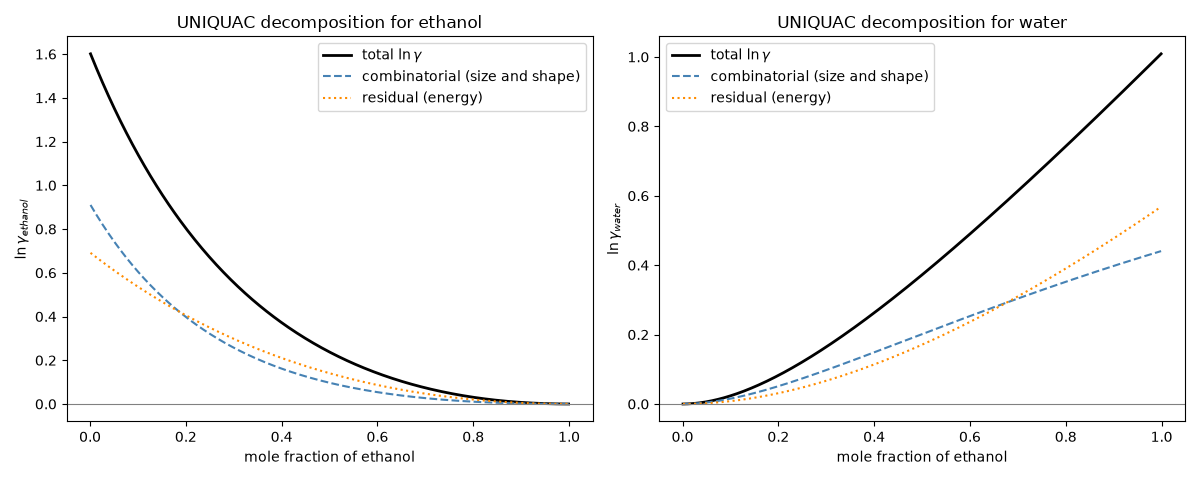
With all \(\tau=1\) only the combinatorial part is left, and it vanishes too when the molecules are the same size:
same = UNIQUACSolution(1.5, 1.5, 1.2, 1.2, 1.0, 1.0, 1.0, 1.0)
print("same-size, athermal gamma:", [round(float(g), 12) for g in same.activity_coefficients(0.3)])
x_az, P_az = full.azeotrope()
print(f"full model azeotrope: x_ethanol = {x_az:.3f} at {P_az:.1f} kPa")

plt.show()
same-size, athermal gamma: [1.0, 1.0]
full model azeotrope: x_ethanol = 0.881 at 73.0 kPa
Total running time of the script: (0 minutes 0.086 seconds)