
Examples#
This gallery walks through every public feature of chemistrykit.spectro:
the Beer-Lambert absorbance law and its stray-light deviation from
linearity; rigid-rotor rotational spectra with isotope shifts; harmonic
vs. Morse-potential vibrational band positions, plus a genuine triatomic
normal-mode calculation; Franck-Condon vibronic progressions for
electronic spectra; NMR from Larmor frequencies and chemical shifts to
J-coupling multiplets, second-order AB/ABX spectra, the Karplus
relation, and Fourier-transform NMR;
atomic line spectra (Fraunhofer, Kirchhoff-Bunsen, Balmer-Rydberg); and
spectral lineshapes.
Each script in this gallery is self-contained and can be run directly with
python examples/spectro/<section>/<script>.py. Every script also
carries an RST module docstring as its title/description and uses # %%
markers to split narrative text from code, which is exactly what
Sphinx-Gallery renders into the pages below – the script is the source of
truth for what you see, not a copy of it.
Sections#
beer_lambert – the Beer-Lambert absorbance law and its stray-light deviation from linearity at high concentration.
atomic – Fraunhofer’s dark solar lines, Kirchhoff and Bunsen’s flame emission/absorption spectra, and the hydrogen series from the Balmer-Rydberg formula.
rotational – rigid-rotor rotational spectra, relative line intensities, and microwave isotope shifts.
vibrational – harmonic vs. Morse IR band positions and anharmonicity constants, Wilson GF-matrix normal modes for CO2 and H2O, Raman/IR mutual exclusion, and a linear molecule’s degenerate bend.
electronic – Franck-Condon vibronic progressions in a UV-Vis absorption band.
nmr – Larmor frequencies and chemical shifts, first-order J-coupling multiplets, second-order AB/ABX spectra, the Karplus relation, and Fourier-transform NMR.
lineshapes – Gaussian, Lorentzian, and Voigt line profiles.
Atomic line spectra#
Discrete atomic lines as chemical fingerprints: Fraunhofer’s dark solar lines, Kirchhoff and Bunsen’s flame emission and absorption spectra, and the Balmer-Rydberg formula for the hydrogen series.
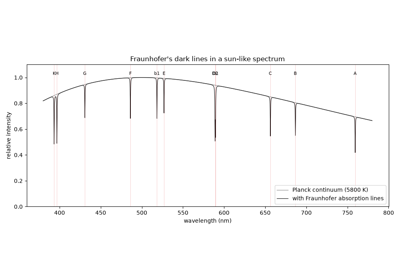
Fraunhofer’s dark lines: sharp absorption lines at fixed wavelengths in the solar spectrum
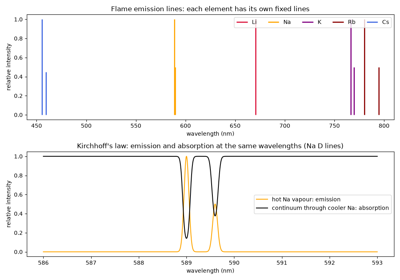
Kirchhoff and Bunsen’s flame spectra: bright emission lines and matching dark absorption lines
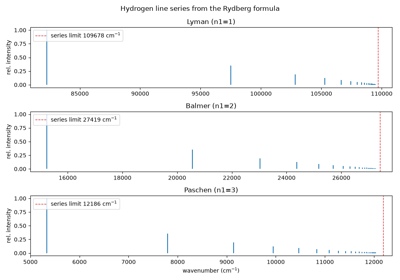
The hydrogen spectrum: Balmer’s formula, the Rydberg series, and Bohr’s energy levels
Beer-Lambert law#
The Beer-Lambert absorbance law, and its stray-light deviation from linearity at high concentration.
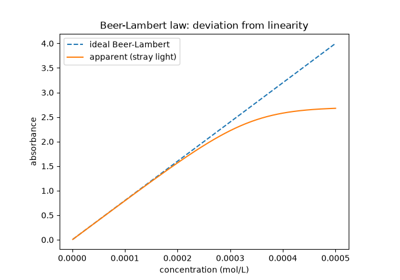
Beer-Lambert absorbance, and its deviation from linearity at high concentration
Electronic spectra#
Franck-Condon vibronic progressions for a UV-Vis electronic absorption band.
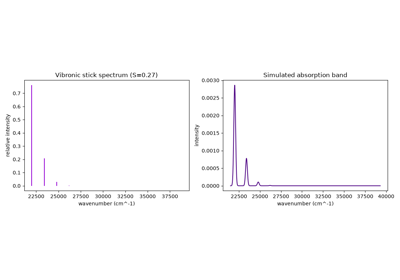
Franck-Condon vibronic progressions in a UV-Vis absorption band
Spectral lineshapes#
The Gaussian, Lorentzian, and Voigt lineshapes, and the two physically distinct broadening mechanisms (Doppler/inhomogeneous vs. lifetime-collisional/homogeneous) that produce them.
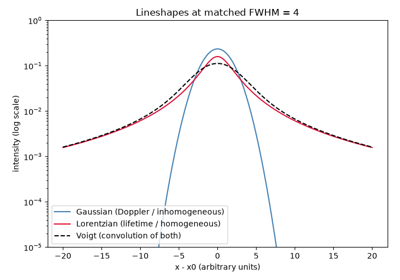
Gaussian, Lorentzian, and Voigt lineshapes: two broadening mechanisms and their convolution
NMR spectroscopy#
Nuclear magnetic resonance: Larmor frequencies and the chemical shift, first-order spin-spin coupling multiplets (the n+1 rule and a doublet of triplets), the Karplus dihedral-angle dependence of vicinal couplings, Fourier-transform NMR from a free-induction decay, and exact second-order (AB and ABX) spectra.
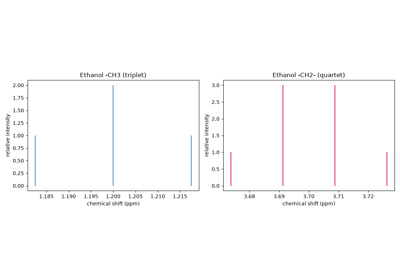
Spin-spin (J) coupling and the n+1 rule: ethanol’s triplet/quartet and a doublet of triplets
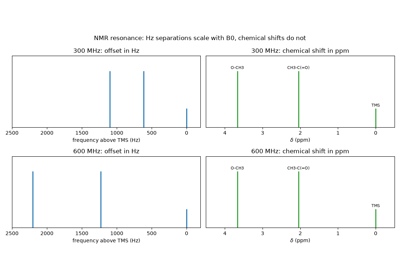
Nuclear magnetic resonance: Larmor frequencies and the field-independent chemical shift
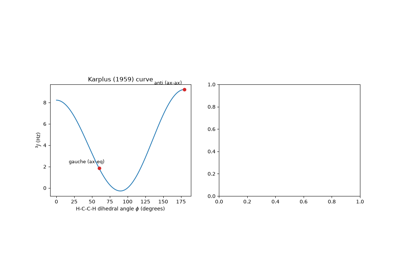
The Karplus relation: vicinal 3J(H,H) coupling as a function of dihedral angle
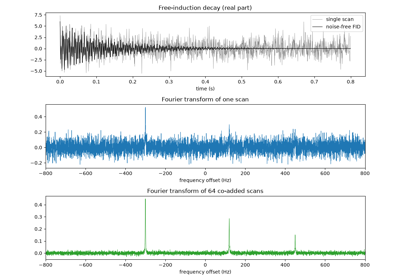
Fourier-transform NMR: from a free-induction decay to a spectrum
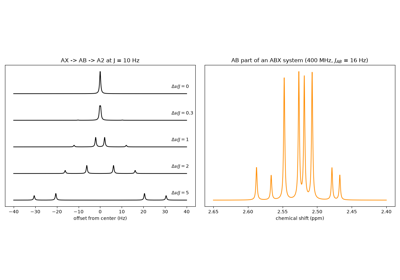
Second-order NMR: from AX to AB, and the ABX system
Rotational spectra#
Rigid-rotor rotational spectra built on chemistrykit.quantum’s rigid
rotor: quantized levels, evenly spaced transition wavenumbers and
Boltzmann line intensities, and microwave isotope shifts of CO
isotopologues.
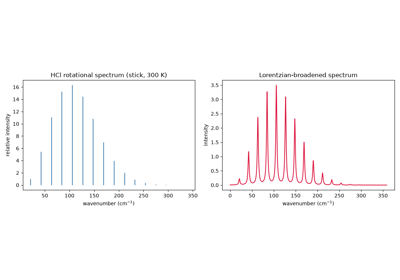
Dennison’s quantized rigid rotor: HCl rotational lines spaced by 2B, with Boltzmann intensities
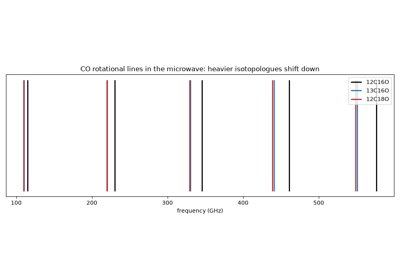
Microwave spectroscopy and the isotope shift: CO isotopologues’ J=1-0 lines in GHz
Vibrational spectra#
Harmonic vs. Morse-potential IR band positions and anharmonicity constants; Wilson GF-matrix normal modes for CO2 and H2O; the Raman/IR mutual exclusion rule for CO2; and the doubly degenerate bend of a linear triatomic.
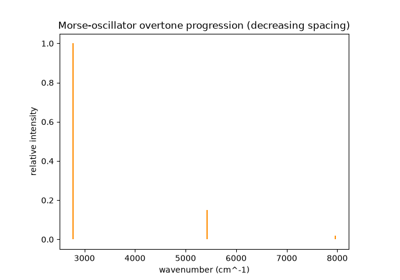
Harmonic vs. Morse IR band positions, and recovering anharmonicity from overtones
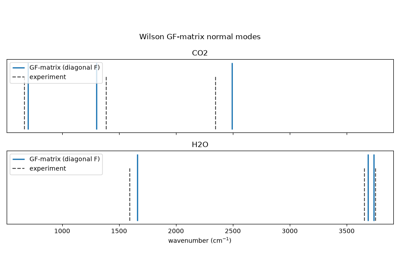
Wilson’s GF-matrix method: CO2 and H2O normal-mode frequencies from the G and F matrices
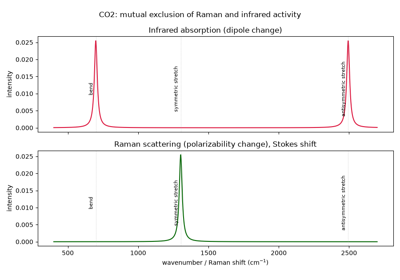
Raman scattering vs. infrared absorption: the mutual exclusion rule for CO2
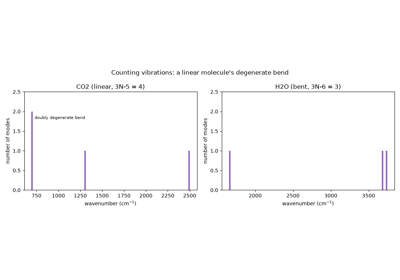
Herzberg’s linear-molecule rules: CO2’s doubly degenerate bend and 3N-5 vibrations