Note
Go to the end to download the full example code.
Raman scattering vs. infrared absorption: the mutual exclusion rule for CO2#
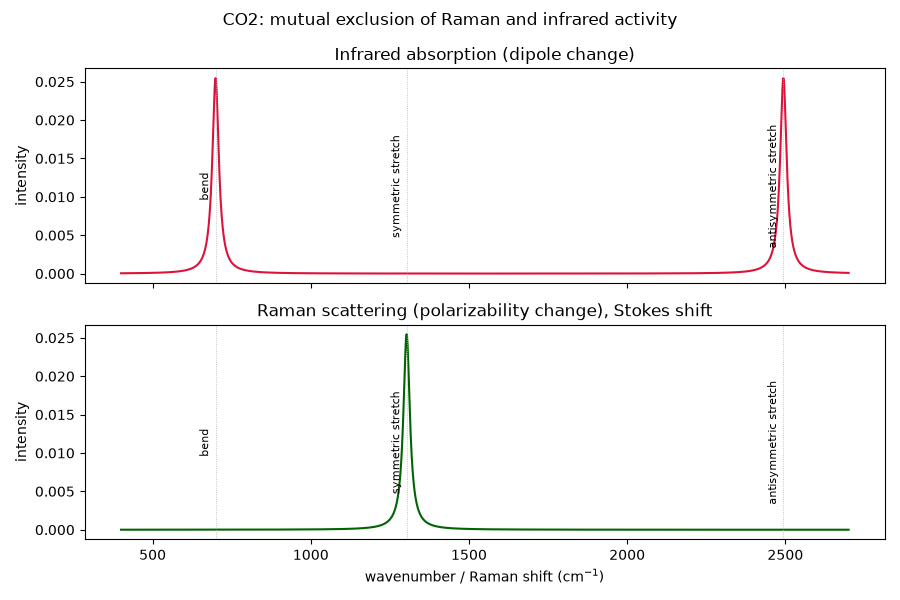
Raman and Krishnan (1928) found that a small fraction of scattered light is shifted in frequency by a molecule’s vibrational wavenumbers. A mode is Raman-active if it changes the molecule’s polarizability. It is infrared-active if it changes the dipole moment. For a centrosymmetric molecule such as CO2, no mode is active in both spectra.
This example takes CO2’s normal modes from
TriatomicNormalModes
and evaluates each mode’s dipole and polarizability derivatives with two
simple models. The dipole comes from fixed partial charges (O
\(-q\), C \(+2q\)). The polarizability comes from bond
polarizabilities that grow with bond length. The result is an infrared
spectrum and a Raman (Stokes-shift) spectrum with no lines in common.
import matplotlib.pyplot as plt
import numpy as np
import scipy.constants as sc

from chemistrykit.spectro.core.base_system import Spectrum
from chemistrykit.spectro.systems.vibrational import TriatomicNormalModes
from chemistrykit.spectro.visualizers.spectro_plots import plot_broadened_spectrum

bond_length = 116.3e-12
co2 = TriatomicNormalModes.linear(
    mass_terminal=15.999 * sc.atomic_mass,
    mass_central=12.011 * sc.atomic_mass,
    bond_length=bond_length,
    k_r=1600.0,
    k_theta=0.85e-18,
)
result = co2.solve()
L = result.internal_coordinate_vectors  # columns: modes; rows: (r1, r2, bend)
names = ["bend", "symmetric stretch", "antisymmetric stretch"]
Dipole derivative: with charges -q, +2q, -q, stretching the two bonds changes the axial dipole by q(dr1 - dr2). The linearized bend coordinate S=(x0-2x1+x2)/r changes the transverse dipole by -q r S. Polarizability derivative: the isotropic sum of bond polarizabilities changes by alpha’(dr1 + dr2), while bending changes it only at second order.
q, alpha_prime = 1.0, 1.0  # arbitrary units: only zero vs. nonzero matters
ir_activity = (q * (L[0] - L[1])) ** 2 + (q * bond_length * L[2]) ** 2
raman_activity = (alpha_prime * (L[0] + L[1])) ** 2
ir_activity /= ir_activity.max()
raman_activity /= raman_activity.max()

for name, nu, ir, ra in zip(names, result.wavenumbers, ir_activity, raman_activity, strict=True):
    print(f"{name:>22s}: {nu:7.1f} cm^-1  IR {'active' if ir > 1e-6 else 'silent':>6s}  Raman {'active' if ra > 1e-6 else 'silent':>6s}")
                 bend:   699.0 cm^-1  IR active  Raman silent
    symmetric stretch:  1302.8 cm^-1  IR silent  Raman active
antisymmetric stretch:  2493.8 cm^-1  IR active  Raman silent
No mode appears in both spectra: the symmetric stretch is seen only in Raman, and the bend and antisymmetric stretch only in the infrared.
ir = Spectrum(positions=result.wavenumbers, intensities=np.where(ir_activity > 1e-6, ir_activity, 0.0))
raman = Spectrum(positions=result.wavenumbers, intensities=np.where(raman_activity > 1e-6, raman_activity, 0.0))
x = np.linspace(400.0, 2700.0, 3000)

fig, (ax1, ax2) = plt.subplots(2, 1, figsize=(9, 6), sharex=True)
plot_broadened_spectrum(ir, x, ax=ax1, shape="lorentzian", fwhm=25.0, color="crimson")
ax1.set_title("Infrared absorption (dipole change)")
plot_broadened_spectrum(raman, x, ax=ax2, shape="lorentzian", fwhm=25.0, color="darkgreen")
ax2.set_title("Raman scattering (polarizability change), Stokes shift")
ax2.set_xlabel(r"wavenumber / Raman shift (cm$^{-1}$)")
for ax in (ax1, ax2):
    for nu, name in zip(result.wavenumbers, names, strict=True):
        ax.axvline(nu, color="0.7", lw=0.6, ls=":")
        ax.text(nu - 15.0, 0.45, name, transform=ax.get_xaxis_transform(), rotation=90, fontsize=8, ha="right", va="center")
fig.suptitle("CO2: mutual exclusion of Raman and infrared activity")
fig.tight_layout()
plt.show()
Total running time of the script: (0 minutes 0.066 seconds)