
Examples#
This gallery walks through every public feature of
chemistrykit.electrochem: the Nernst equation for standard and
concentration cells (with activity-coefficient corrections), a curated
standard-reduction-potential table with redox-couple balancing,
Butler-Volmer electrode kinetics and Tafel-plot linearization, Faraday’s
laws of electrolysis and the galvanic-vs-electrolytic distinction, a
simplified constant-current battery discharge model with Peukert’s-law
rate dependence, fuel-cell thermodynamics, Kohlrausch’s conductivity
laws, and diffusion-limited electroanalytical currents.
Each script in this gallery is self-contained and can be run directly
with python examples/electrochem/<section>/<script>.py. Every script
also carries an RST module docstring as its title/description and uses
# %% markers to split narrative text from code, which is exactly what
Sphinx-Gallery renders into the pages below – the script is the source
of truth for what you see, not a copy of it.
Sections#
nernst – the Nernst equation for standard cells and concentration cells, plus Debye-Huckel activity-coefficient-corrected reaction quotients.
standard_potentials – the curated standard-reduction-potential table, redox-couple electron balancing, and cell-potential combination.
butler_volmer – Butler-Volmer electrode kinetics and its high-overpotential Tafel-plot linearization, checked for convergence.
electrolysis – Faraday’s laws of electrolysis, and galvanic vs. electrolytic cell operation.
battery – Volta’s pile, a simplified constant-current battery discharge model, and Peukert’s-law capacity-vs-rate dependence.
fuel_cell – Grove’s hydrogen-oxygen gas battery and its thermodynamic voltage and efficiency limits.
conductivity – Kohlrausch’s laws of electrolytic conductivity.
voltammetry – the Cottrell equation, polarography and the Ilkovič equation, and the Randles-Ševčík peak current.
Battery discharge#
Volta’s pile of series-stacked two-metal cells, a simplified constant-current battery discharge model and Peukert’s-law capacity-vs-rate dependence.
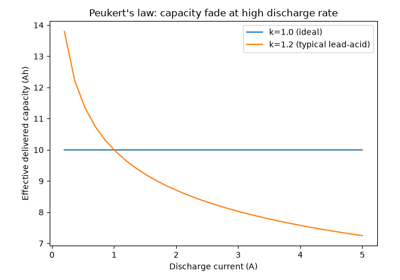
Peukert’s law: battery capacity falls at high discharge rates
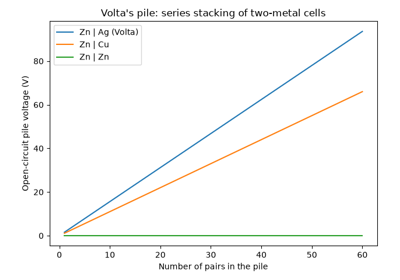
Volta’s pile: stacking zinc-silver cells in series
Butler-Volmer kinetics#
Butler-Volmer electrode kinetics and its high-overpotential Tafel-plot linearization.
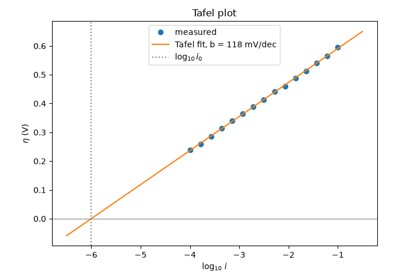
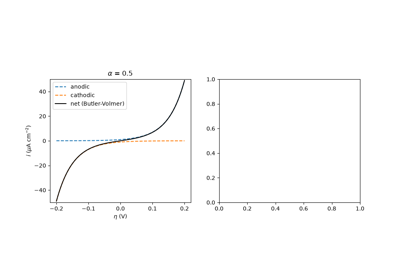
The Butler-Volmer equation: anodic and cathodic partial currents
Electrolytic conductivity#
Kohlrausch’s law of independent migration of ions and his square-root law for molar conductivity.
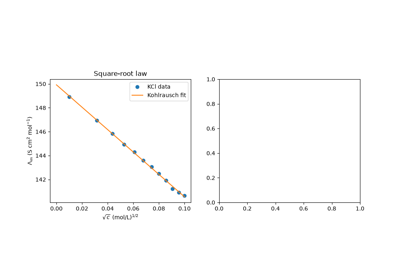
Kohlrausch’s laws: independent migration and the square-root law
Electrolysis#
Faraday’s laws of electrolysis, Nicholson and Carlisle’s electrolysis of water, and Davy’s electrolytic isolation of the alkali metals.
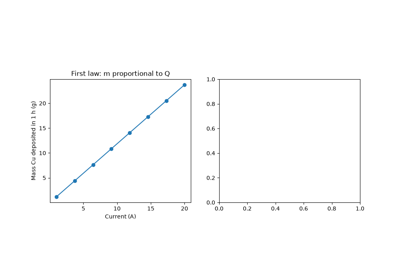
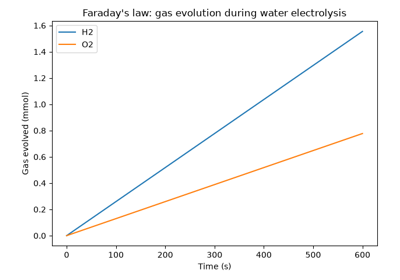
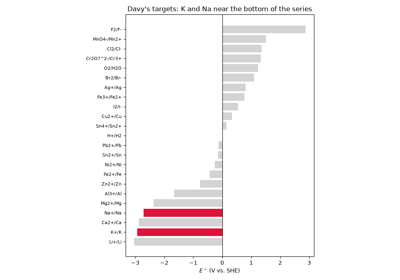
Davy’s electrolytic isolation of potassium and sodium
Fuel cells#
Grove’s gas battery and the thermodynamic voltage and efficiency limits of the hydrogen-oxygen fuel cell.
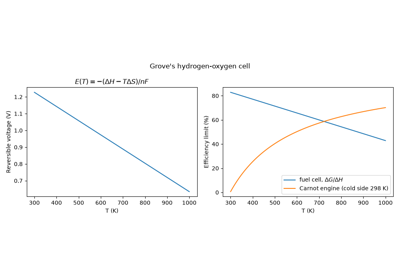
Grove’s gas battery: the hydrogen-oxygen fuel cell
The Nernst equation#
Standard and concentration cells via the Nernst equation, and Debye-Huckel activity-coefficient-corrected reaction quotients.
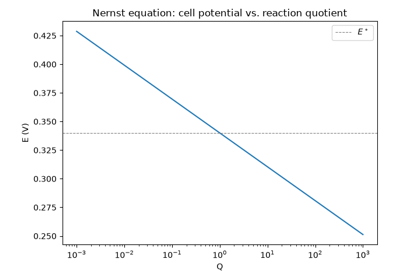
The Nernst equation: cell potential versus concentration
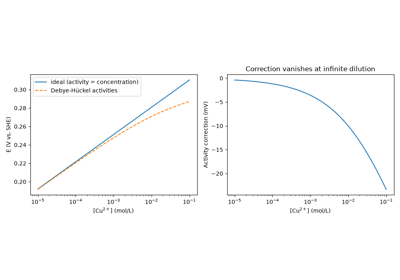
Debye-Hückel activity corrections to the Nernst equation
Standard reduction potentials#
The Daniell cell from tabulated standard reduction potentials, and the 1953 Stockholm sign convention behind the table.
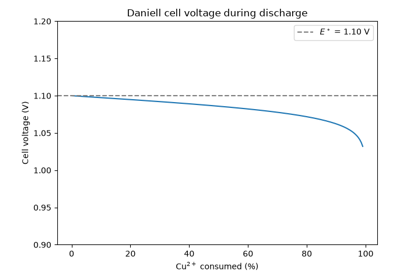
The Daniell cell: a steady 1.10 V from zinc and copper

The 1953 Stockholm convention: electrode potentials are reduction potentials
Electroanalytical currents#
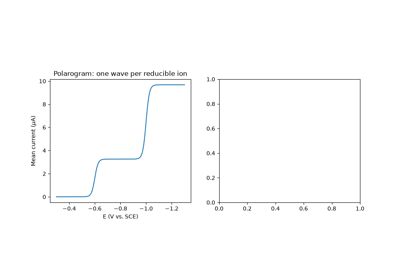
Diffusion-limited currents: the Cottrell equation, Heyrovský’s polarography and the Ilkovič equation, and the Randles-Ševčík peak current of cyclic voltammetry.
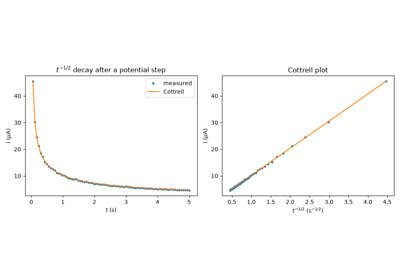
The Cottrell equation: current decay after a potential step
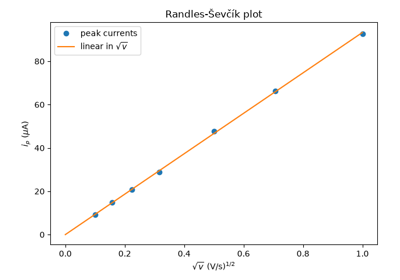
The Randles-Ševčík equation: peak current in cyclic voltammetry