Examples#
This gallery walks through every public feature of
chemistrykit.statmech: translational/rotational/vibrational partition
functions and the thermodynamic functions derived from them; the
Maxwell-Boltzmann speed distribution; the lattice-gas adsorption model;
quantum statistics and its classical limit; the Debye solid; exact
Ising-model results; and the second virial coefficient.
Each script in this gallery is self-contained and can be run directly with
python examples/statmech/<section>/<script>.py. Every script also
carries an RST module docstring as its title/description and uses # %%
markers to split narrative text from code, which is exactly what
Sphinx-Gallery renders into the pages below – the script is the source
of truth for what you see, not a copy of it.
Sections#
partition_functions – equipartition, the Einstein vibrational heat capacity, Gibbs’s canonical partition function, and the Sackur-Tetrode translational entropy.
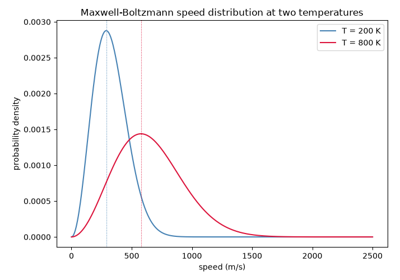
maxwell_boltzmann – the Maxwell-Boltzmann speed distribution, its characteristic speeds, and a Stern-type molecular-beam check.
lattice_gas – the lattice-gas derivation of the Langmuir adsorption isotherm, and \(S=k_B\ln W\) by counting arrangements.
quantum_statistics – the thermal de Broglie wavelength, and the Maxwell-Boltzmann limit of Bose-Einstein and Fermi-Dirac statistics.
solids – Debye’s \(T^3\) law for the heat capacity of a solid.
ising – Ising’s 1D chain, Kramers-Wannier duality, and Onsager’s exact 2D solution.
virial – Mayer’s second virial coefficient from a pair potential.
Ising model#
Exact results for the nearest-neighbor Ising (lattice-gas) model: Ising’s one-dimensional chain, Kramers-Wannier duality, and Onsager’s two-dimensional solution.
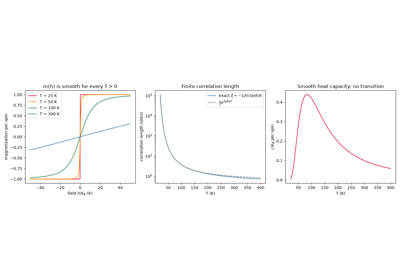
Ising’s one-dimensional chain: no phase transition
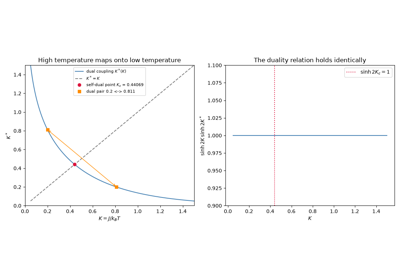
Kramers-Wannier duality and the exact Ising critical temperature
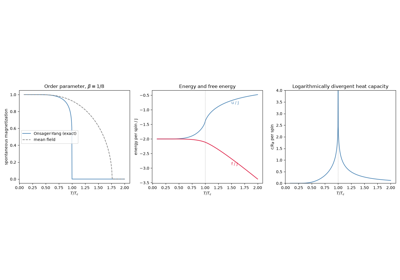
Onsager’s exact solution of the two-dimensional Ising model
Lattice-gas adsorption#
The lattice-gas derivation of the Langmuir adsorption isotherm, and Boltzmann’s \(S=k_B\ln W\) counted directly on a lattice.
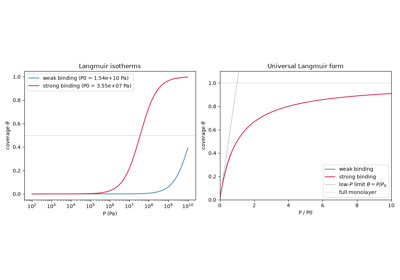
Langmuir’s adsorption isotherm from a lattice-gas model
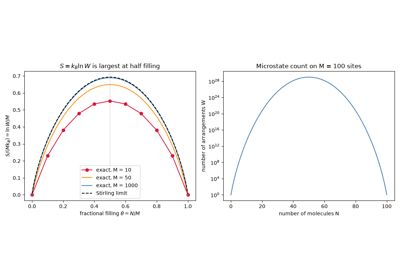
Boltzmann’s S = k ln W by counting lattice arrangements
Maxwell-Boltzmann speed distribution#
The Maxwell-Boltzmann speed distribution and its characteristic speeds, and a Stern-type molecular-beam sampling check of its shape.
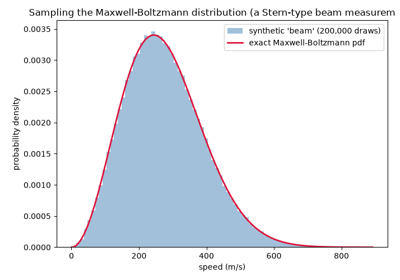
Verifying the speed distribution: Stern’s molecular-beam experiment
Partition functions#
The equipartition theorem, Einstein’s vibrational heat capacity, Gibbs’s canonical-ensemble route from a partition function to every thermodynamic function, and the Sackur-Tetrode translational entropy.
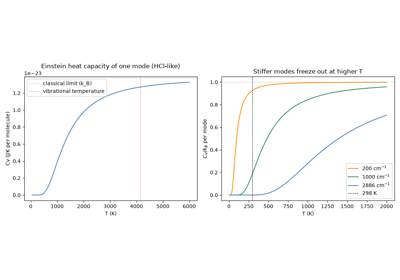
Einstein’s quantum theory of the vibrational heat capacity
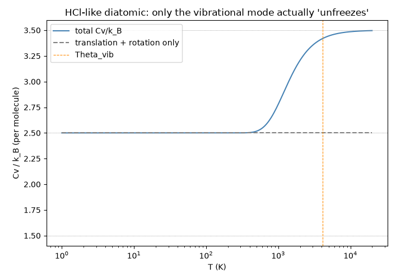
The equipartition theorem, and why only one mode actually “freezes out”
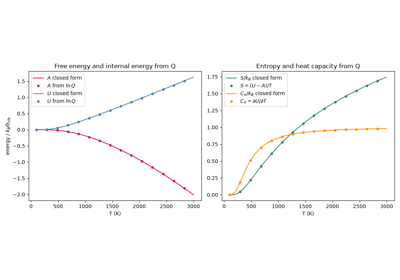
Gibbs’s canonical ensemble: all thermodynamics from one partition function
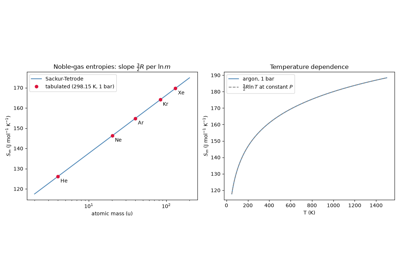
Quantum statistics and the classical limit#
The thermal de Broglie wavelength, and how Bose-Einstein and Fermi-Dirac statistics reduce to classical Maxwell-Boltzmann counting for ordinary molecular gases.
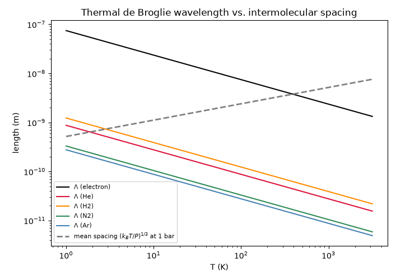
De Broglie’s matter waves: the thermal wavelength of a gas
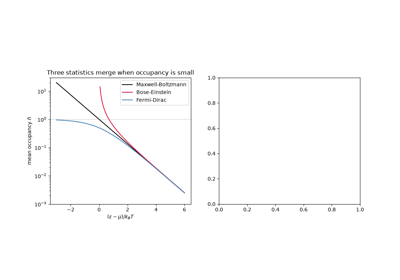
Bose-Einstein and Fermi-Dirac statistics reduce to Maxwell-Boltzmann
Heat capacity of solids#
Debye’s continuum model of lattice vibrations and its low-temperature \(T^3\) law.
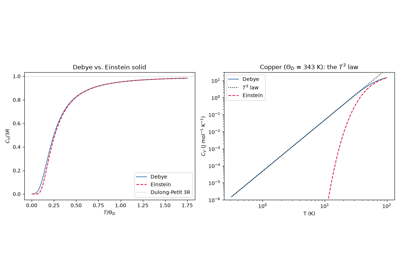
Debye’s T-cubed law for the heat capacity of a solid
Virial coefficients#
The second virial coefficient of an imperfect gas computed from its intermolecular pair potential.
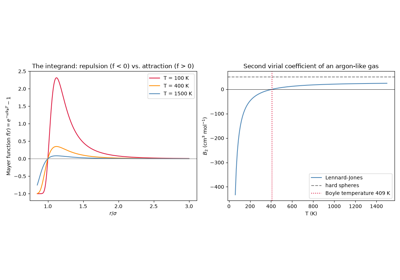
Mayer’s cluster expansion: the second virial coefficient