
Note
Go to the end to download the full example code.
The equipartition theorem, and why only one mode actually “freezes out”#
James Clerk Maxwell (1860) and, in fully general form, Ludwig Boltzmann
(1871) showed that every classical quadratic degree of freedom of a
system in thermal equilibrium contributes exactly \(\frac12k_B\) to
its heat capacity – the equipartition theorem. A rigid diatomic molecule
therefore “should” carry \(\frac32k_B\) (translation) + \(k_B\)
(2 rotational degrees of freedom) + \(k_B\) (1 vibrational mode,
kinetic + potential) = \(\frac72k_B\) at every temperature – a
prediction 19th-century equipartition theory could not explain deviations
from (Maxwell himself flagged the puzzle sharply in 1879). Only
VibrationalPartitionFunctionHarmonic is an
exact quantum treatment in this package, so it alone shows the real
resolution Einstein gave in 1907: a mode’s contribution only “switches on”
once \(k_BT\) exceeds its own quantum spacing.
RotationalPartitionFunctionLinear, by
contrast, implements only the classical high-temperature limit (as its own
docstring flags), so it contributes its full \(k_B\) at every
temperature here – a deliberate approximation, harmless in practice
because real rotational spacings are tiny compared to vibrational ones (as
the numbers below confirm), but worth seeing explicitly rather than
assuming.
import matplotlib.pyplot as plt
import numpy as np

from chemistrykit.statmech import IdealGasMolecule, VibrationalPartitionFunctionHarmonic

K_B = 1.380649e-23

# HCl-like molecule: moment of inertia and vibrational wavenumber matched
# to plot_01_vibrational_heat_capacity.py.
vib_mode = VibrationalPartitionFunctionHarmonic.from_wavenumber(2886.0)
hcl = IdealGasMolecule(
    mass=6.15e-26,
    volume=1.0e-3,
    moment_of_inertia=1.45e-46,
    vibrational_frequencies=[vib_mode.frequency],
)
theta_rot = hcl.rotational.rotational_temperature
theta_vib = vib_mode.vibrational_temperature
print(f"Rotational temperature Theta_rot = {theta_rot:.2f} K")
print(f"Vibrational temperature Theta_vib = {theta_vib:.1f} K")
print(f"Theta_vib / Theta_rot = {theta_vib / theta_rot:.0f}x higher -- why rotation looks 'always classical' here")
Rotational temperature Theta_rot = 2.78 K
Vibrational temperature Theta_vib = 4152.3 K
Theta_vib / Theta_rot = 1495x higher -- why rotation looks 'always classical' here
T = np.logspace(0.0, 4.3, 400)
Cv_total = np.array([hcl.heat_capacity_v(t, N=1.0) for t in T]) / K_B
Cv_rot = np.array([hcl.rotational.heat_capacity_v(t, N=1.0) for t in T]) / K_B
Cv_vib = np.array([hcl.vibrational_modes[0].heat_capacity_v(t, N=1.0) for t in T]) / K_B

fig, ax = plt.subplots(figsize=(7, 5))
ax.semilogx(T, Cv_total, color="steelblue", label="total Cv/k_B")
ax.semilogx(T, 1.5 + Cv_rot, color="gray", linestyle="--", label="translation + rotation only")
for value in (1.5, 2.5, 3.5):
    ax.axhline(value, linestyle=":", linewidth=0.6, color="gray")
ax.axvline(theta_vib, color="darkorange", linestyle="--", linewidth=0.8, label="Theta_vib")
ax.set_xlabel("T (K)")
ax.set_ylabel("Cv / k_B (per molecule)")
ax.set_title("HCl-like diatomic: only the vibrational mode actually 'unfreezes'")
ax.legend()
fig.tight_layout()
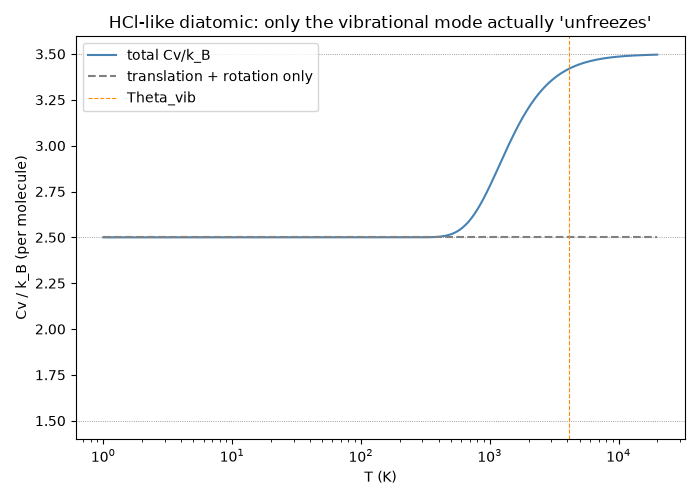
The classical rotational contribution never moves (it is pinned at exactly 1.0 k_B, its high-temperature limit, at every T shown), while the exact quantum vibrational contribution climbs from essentially zero to its own classical limit only once T approaches Theta_vib – the single genuine step in the total curve, and the mode Einstein’s 1907 theory was built to explain:
for T_check, label in [(10.0, "T << Theta_vib"), (300.0, "T ~ room temperature"), (5000.0, "T ~ Theta_vib")]:
    Cv = hcl.heat_capacity_v(T_check, N=1.0) / K_B
    Cv_v = hcl.vibrational_modes[0].heat_capacity_v(T_check, N=1.0) / K_B
    print(f"{label:20s} (T={T_check:>7.1f} K): Cv_total/k_B = {Cv:.3f}  (Cv_vib/k_B = {Cv_v:.4f})")

plt.show()
T << Theta_vib       (T=   10.0 K): Cv_total/k_B = 2.500  (Cv_vib/k_B = 0.0000)
T ~ room temperature (T=  300.0 K): Cv_total/k_B = 2.500  (Cv_vib/k_B = 0.0002)
T ~ Theta_vib        (T= 5000.0 K): Cv_total/k_B = 3.444  (Cv_vib/k_B = 0.9445)
Total running time of the script: (0 minutes 0.072 seconds)