
Examples#
This gallery walks through every public feature of
chemistrykit.crystal: the 7 crystal systems and general unit-cell
volume; hard-sphere packing (packing fraction, coordination number) for
the SC/BCC/FCC/HCP lattices; ionic-crystal lattice energy via the
Born-Lande and Kapustinskii equations, backed by a genuinely converging
(Evjen-method) numerical Madelung constant; Bragg’s law and powder-XRD
peak positions with structure factors and systematic absences, Laue
interference, and Scherrer crystallite sizes; Schottky/Frenkel
point-defect equilibrium; Miller indices, interfacial angles, and the 14
Bravais lattices; and Pauling’s radius-ratio rule and Goldschmidt’s
perovskite tolerance factor.
Each script in this gallery is self-contained and can be run directly
with python examples/crystal/<section>/<script>.py. Every script
also carries an RST module docstring as its title/description and uses
# %% markers to split narrative text from code, which is exactly what
Sphinx-Gallery renders into the pages below – the script is the source
of truth for what you see, not a copy of it.
Sections#
crystal_systems – classifying a unit cell into one of the 7 crystal systems, the general lattice-parameter volume formula, Steno’s interfacial angles, Miller indices from face intercepts, and the 14 Bravais lattices.
packing – atomic packing factor, coordination number, and atoms per cell for SC, BCC, FCC, and ideal HCP.
lattice_energy – the Born-Lande and Kapustinskii equations, and Shannon’s effective ionic radii.
madelung – Madelung’s lattice sum shell by shell, and the NaCl Madelung constant from a genuinely converging (Evjen-method) lattice summation, contrasted with a naive truncated sum that does not converge.
xrd – Bragg’s law, cubic d-spacings, and simulated powder-XRD patterns with systematic absences for SC/BCC/FCC, Laue interference, and Scherrer crystallite sizes.
defects – Frenkel and Schottky point-defect concentration vs. temperature.
crystal_chemistry – Pauling’s radius-ratio rule and Goldschmidt’s perovskite tolerance factor.
Crystal chemistry#
Rules of thumb from ionic radii: Pauling’s radius-ratio rule for coordination numbers and Goldschmidt’s tolerance factor for perovskites.
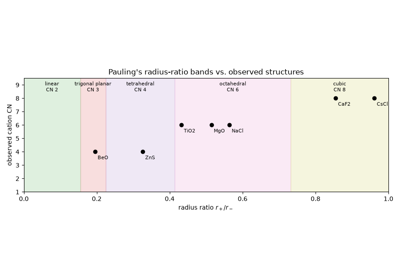
Pauling’s radius-ratio rule: predicting coordination numbers
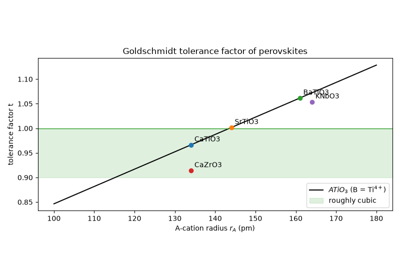
Goldschmidt’s tolerance factor: which perovskites are cubic
Crystal systems#
Classifying a unit cell into one of the 7 crystal systems from its lattice parameters and the general unit-cell-volume formula; Steno’s constant interfacial angles; Miller indices from Hauy’s rational face intercepts; and the 14 Bravais lattices.

Weiss’s crystal systems: classifying a unit cell by its axes
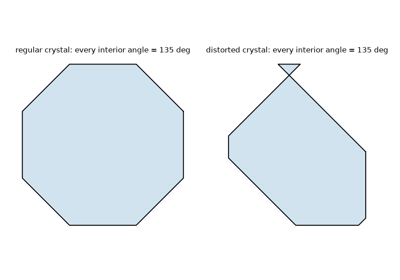
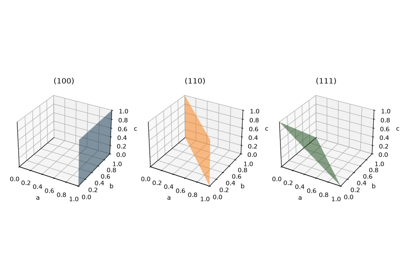
Hauy’s law of rational indices: Miller indices from face intercepts
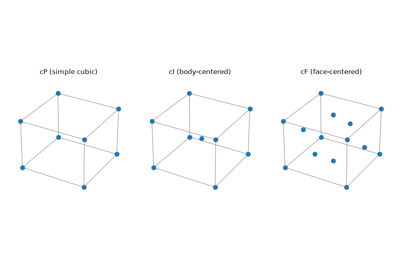
Bravais lattices: the 14 lattices and the three cubic centerings
Point defects#
Frenkel and Schottky point-defect concentrations vs. temperature, from Boltzmann-factor equilibrium.
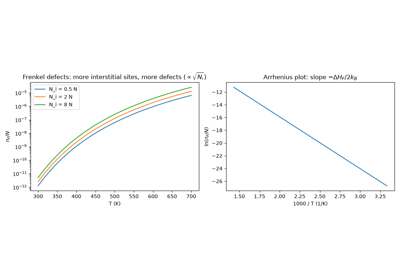
Frenkel defects: vacancy-interstitial pairs in silver chloride
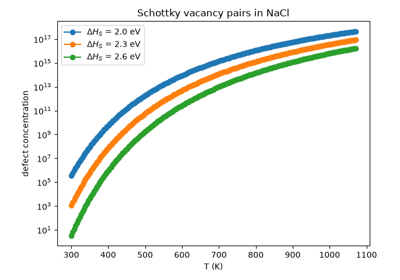
Schottky defects: paired cation and anion vacancies in rock salt
Lattice energy#
The Born-Lande and Kapustinskii equations for ionic-crystal lattice energy, and the Shannon ionic radii the Kapustinskii equation uses.
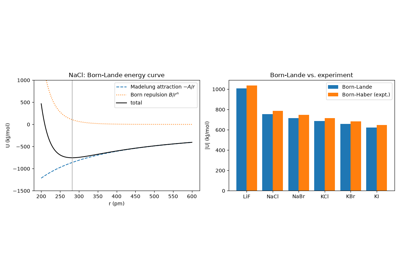
Born-Lande equation: lattice energies of the alkali halides
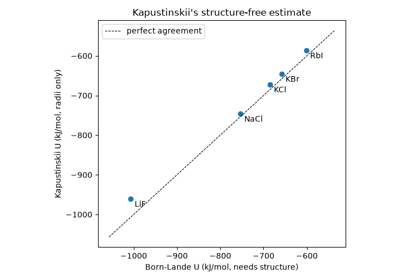
Kapustinskii equation: lattice energy without a crystal structure
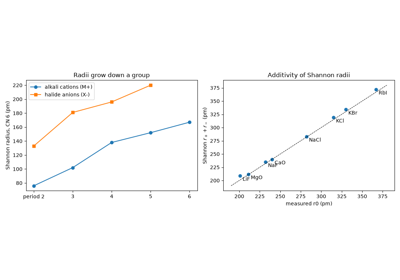
Shannon’s effective ionic radii: additivity and periodic trends
Madelung constant#
Madelung’s electrostatic lattice sum for NaCl, shell by shell, and Evjen’s genuinely converging summation of it, contrasted with a naive truncated sum that does not converge.
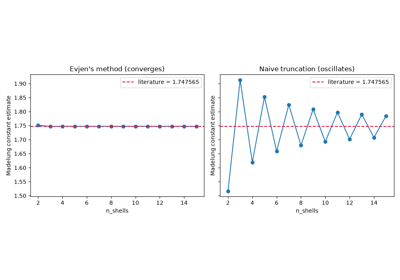
Evjen’s method: converging the NaCl Madelung constant
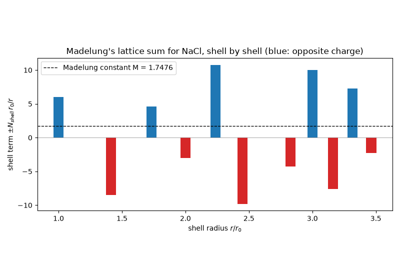
Madelung’s lattice sum: the electrostatic energy of rock salt
Hard-sphere packing#
Atomic packing factor, coordination number, and atoms per cell for the simple cubic, body-centered cubic, face-centered cubic, and ideal hexagonal close-packed lattices.
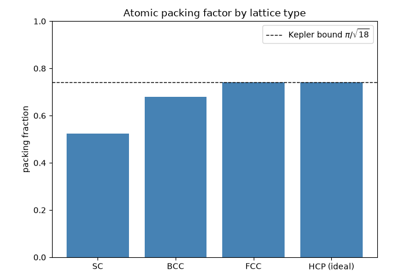
Kepler’s conjecture: packing efficiency of SC, BCC, FCC, and HCP
Powder XRD#
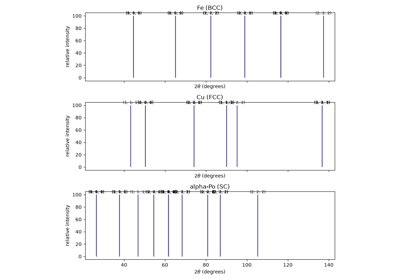
Laue interference from a periodic array, Bragg’s law and simulated powder-XRD patterns with structure factors and systematic absences for SC, BCC, and FCC, and Scherrer crystallite sizes from line broadening.
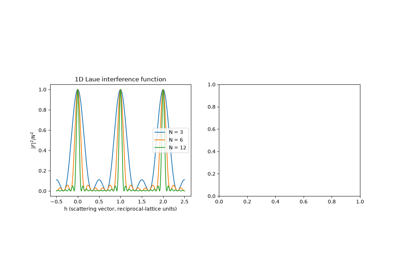
Laue’s interference: sharp diffraction spots from a periodic array
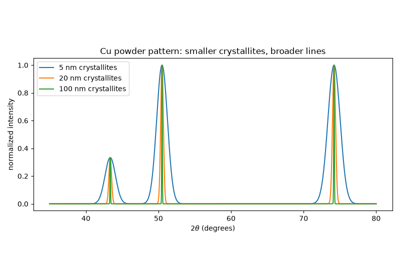
Scherrer equation: crystallite size from peak broadening