
Note
Go to the end to download the full example code.
Schottky defects: paired cation and anion vacancies in rock salt#
Wagner and Schottky (1930) identified the second point-defect mechanism
of ionic crystals: a cation and an anion leave the bulk together,
keeping the crystal neutral and leaving a vacancy pair behind. The
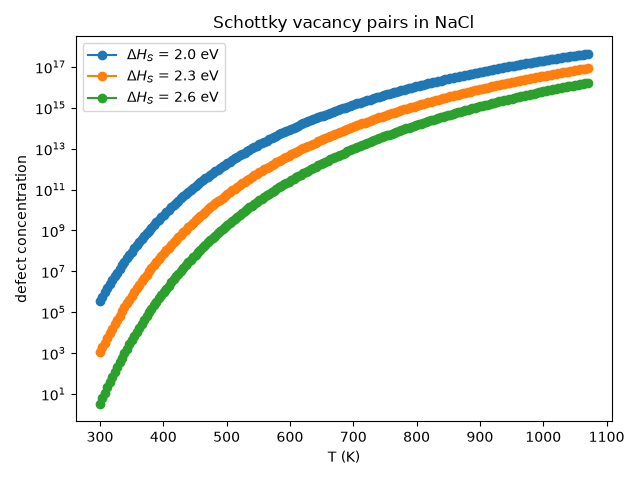
equilibrium number is \(n_S=N\exp(-\Delta H_S/2k_BT)\)
(schottky_defect_concentration()).
In NaCl, the classic Schottky-dominated solid, \(\Delta H_S\approx2.3\) eV.
import matplotlib.pyplot as plt
import numpy as np

from chemistrykit.constants import ELEMENTARY_CHARGE
from chemistrykit.crystal.systems.defects import schottky_defect_concentration
from chemistrykit.crystal.visualizers.crystal_plots import plot_defect_concentration_vs_temperature

N = 2.24e22  # NaCl formula units per cm^3
T = np.linspace(300.0, 1070.0, 200)  # NaCl melts at 1074 K

for dh_eV in (2.0, 2.3, 2.6):
    n_melt = schottky_defect_concentration(N, dh_eV * ELEMENTARY_CHARGE, 1070.0)
    print(f"Delta H_S = {dh_eV:.1f} eV: vacancy-pair fraction just below melting = {n_melt / N:.2e}")
Delta H_S = 2.0 eV: vacancy-pair fraction just below melting = 1.95e-05
Delta H_S = 2.3 eV: vacancy-pair fraction just below melting = 3.83e-06
Delta H_S = 2.6 eV: vacancy-pair fraction just below melting = 7.53e-07
Each Schottky defect is one Na+ vacancy plus one Cl- vacancy, so the crystal stays stoichiometric – the ratio of the two vacancy counts is 1 at every temperature – while the total grows by many orders of magnitude from room temperature to the melting point:
n_S(300 K) = 1.07e+03 per cm^3, n_S(1070 K) = 8.58e+16 per cm^3, ratio 8.0e+13
Total running time of the script: (0 minutes 0.055 seconds)