
Examples#
This gallery walks through every public feature of
chemistrykit.surface: Langmuir, Freundlich, and BET adsorption
isotherms with their standard linearizations for fitting parameters from
data; Langmuir-Hinshelwood single- and dual-site surface-reaction
kinetics; and a turnover-frequency/rate-enhancement catalysis model
built on chemistrykit.kinetics’s Arrhenius equation; the Gibbs
adsorption equation; Polanyi/Dubinin-Radushkevich and Temkin isotherms;
Eley-Rideal kinetics; and temperature-programmed desorption.
Each script in this gallery is self-contained and can be run directly
with python examples/surface/<section>/<script>.py. Every script
also carries an RST module docstring as its title/description and uses
# %% markers to split narrative text from code, which is exactly what
Sphinx-Gallery renders into the pages below – the script is the source
of truth for what you see, not a copy of it.
Sections#
langmuir – the Langmuir monolayer isotherm, its exact half-saturation point, and its linearization for fitting.
freundlich – the empirical Freundlich power-law isotherm and its linearization.
bet – the BET multilayer isotherm, and its numerical reduction to Langmuir in the appropriate limit.
langmuir_hinshelwood – single- and dual-site surface-reaction kinetics built on the Langmuir coverage.
catalysis – one example per catalysis milestone: Doebereiner and Berzelius, Arrhenius and Ostwald, Sabatier’s hydrogenation, Constable’s compensation effect, Balandin’s volcano curve, and Boudart’s turnover frequency.
gibbs_adsorption – surface excess from surface tension via the Gibbs adsorption equation.
dubinin – Polanyi’s adsorption potential and the Dubinin-Radushkevich characteristic curve.
temkin – the logarithmic Temkin isotherm from a spread of site energies.
eley_rideal – Eley-Rideal kinetics contrasted with dual-site Langmuir-Hinshelwood kinetics.
tpd – temperature-programmed desorption and Redhead’s analysis.
BET isotherm#
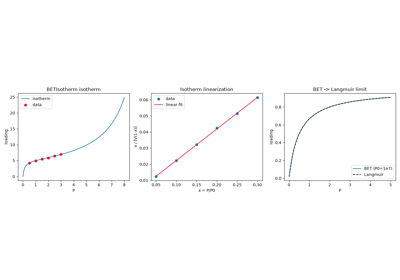
The BET multilayer adsorption isotherm, its linearization for fitting (Vm, C), and its numerical reduction to the Langmuir isotherm when multilayer condensation is suppressed (P0 much larger than the working pressure range).
Catalysis#
One example per milestone in the history of catalysis: Doebereiner’s platinum and Berzelius’s naming of catalysis, Arrhenius and Ostwald’s kinetic definition of a catalyst, Sabatier’s catalytic hydrogenation, Constable’s compensation effect, Balandin’s volcano curve, and Boudart’s turnover frequency.
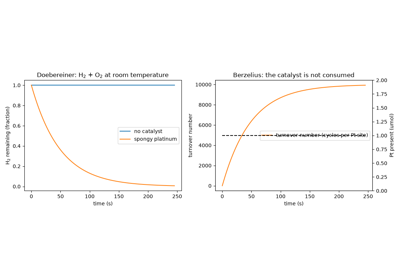
Doebereiner’s platinum and Berzelius’s catalysis: a catalyst that is not consumed
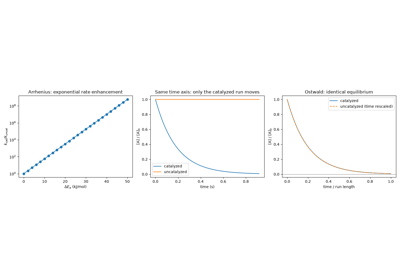
Arrhenius and Ostwald: a catalyst speeds a reaction but leaves its equilibrium alone
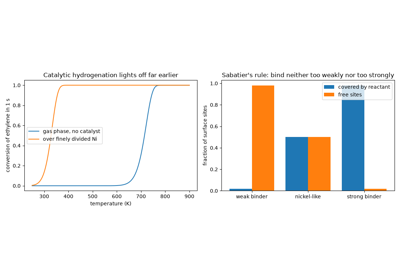
Sabatier and Senderens: catalytic hydrogenation over finely divided nickel
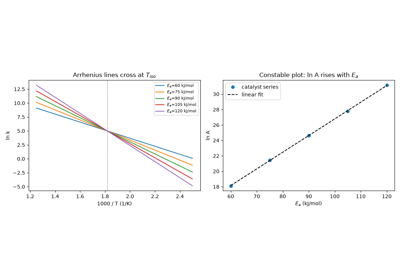
Constable’s compensation effect across a catalyst series
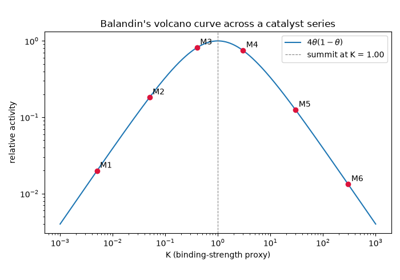
Balandin’s volcano curve: catalytic activity peaks at intermediate binding
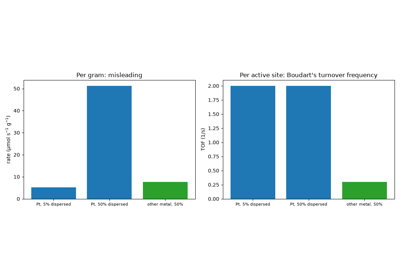
Boudart’s turnover frequency: comparing catalysts per active site
Polanyi potential and Dubinin-Radushkevich#
Polanyi’s adsorption potential, the temperature-independent characteristic curve, and the Dubinin-Radushkevich micropore-filling isotherm with its linearization.
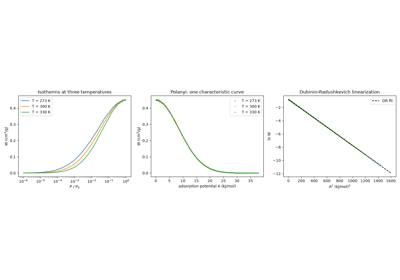
Polanyi’s potential theory and the Dubinin-Radushkevich characteristic curve
Eley-Rideal kinetics#
The Eley-Rideal mechanism, in which a gas-phase molecule reacts directly with an adsorbed one, and how its rate law differs from the dual-site Langmuir-Hinshelwood mechanism.
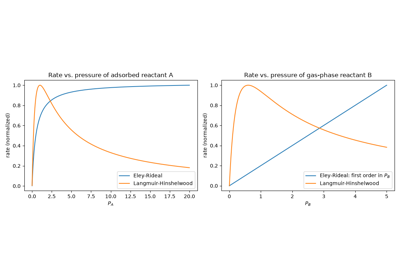
The Eley-Rideal mechanism: a gas molecule strikes an adsorbed one
Freundlich isotherm#
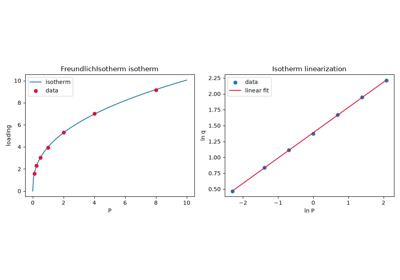
The empirical Freundlich power-law adsorption isotherm, and fitting (Kf, n) from data via the standard log q vs. log P linearization.
Gibbs adsorption equation#
Measuring how much solute is adsorbed at a liquid surface from surface tension alone, via the Gibbs adsorption equation and the Szyszkowski equation.
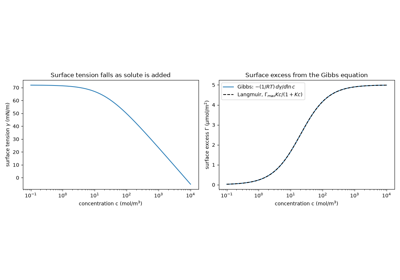
The Gibbs adsorption equation: surface excess from surface tension
Langmuir isotherm#
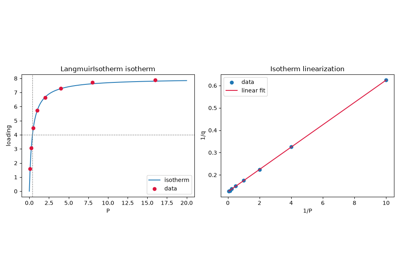
The Langmuir monolayer adsorption isotherm: its exact half-saturation point at P=1/K, and fitting (K, qmax) from data via the standard 1/q-vs-1/P linearization.
Langmuir-Hinshelwood kinetics#
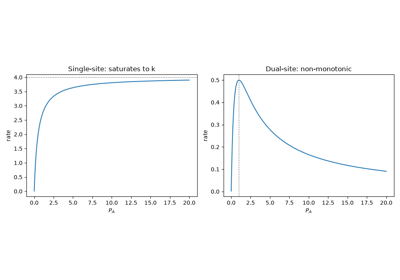
Single-site surface-reaction kinetics (rate as a function of Langmuir coverage) and dual-site (competitive, bimolecular) kinetics, including the non-monotonic rate-vs-pressure behavior of the dual-site mechanism.
Temkin isotherm#
The Temkin isotherm: a logarithmic isotherm arising from a heat of adsorption that falls with coverage, and its fit from data.
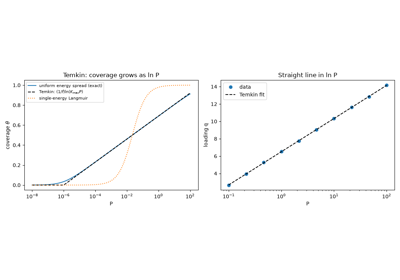
The Temkin isotherm: a heat of adsorption that falls with coverage
Temperature-programmed desorption#
Simulated TPD spectra from the Polanyi-Wigner equation, and Redhead’s formula for turning a peak temperature into a desorption energy.
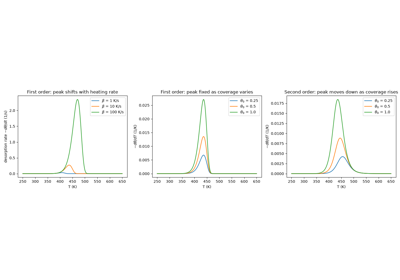
Redhead’s analysis of temperature-programmed desorption