Note
Go to the end to download the full example code.
Musher’s hypervalent molecules: main-group centres beyond the octet#
James Musher (1969) grouped molecules such as \(\mathrm{PCl_5}\), \(\mathrm{SF_6}\), \(\mathrm{ClF_3}\) and the xenon fluorides into one class: hypervalent molecules, whose central main-group atom appears to hold more than the eight electrons of Lewis’s octet. Counting the Lewis electrons around the central atom (two per bond plus two per lone pair) gives 10 or 12 for all of them.
Whatever the bonding explanation (d-orbital participation, or the
three-centre four-electron bond favoured today), VSEPR domain counting
predicts their shapes. This example builds six hypervalent molecules
with
build_vsepr_molecule(),
counts the electrons around each central atom, and confirms each shape’s
symmetry with
determine_point_group().
import matplotlib.pyplot as plt

from chemistrykit.structure.systems.point_group import determine_point_group
from chemistrykit.structure.systems.vsepr import VSEPRGeometry, build_vsepr_molecule
from chemistrykit.structure.visualizers.structure_plots import plot_molecule_3d

# name: (steric number, lone pairs, central atom, ligand, bond length in A, expected point group)
hypervalent = {
    "PCl5": (5, 0, "P", "Cl", 2.07, "D3h"),
    "SF4": (5, 1, "S", "F", 1.60, "C2v"),
    "ClF3": (5, 2, "Cl", "F", 1.65, "C2v"),
    "XeF2": (5, 3, "Xe", "F", 1.98, "D_inf_h"),
    "SF6": (6, 0, "S", "F", 1.56, "Oh"),
    "XeF4": (6, 2, "Xe", "F", 1.95, "D4h"),
}

molecules = {}
for name, (sn, lp, central, ligand, length, expected) in hypervalent.items():
    molecule = build_vsepr_molecule(sn, lp, bond_length=length, central_symbol=central, ligand_symbol=ligand)
    molecules[name] = molecule
    n_bonds = sn - lp
    electrons = 2 * n_bonds + 2 * lp  # single bonds: one shared pair each
    group = determine_point_group(molecule).group_name
    shape = VSEPRGeometry(sn, lp).shape_name
    print(f"{name:5s}: {electrons:2d} electrons around {central:2s} (octet exceeded by {electrons - 8}), AX{n_bonds}E{lp} {shape}, point group {group}")
    assert electrons > 8
    assert group == expected, (name, group)
PCl5 : 10 electrons around P  (octet exceeded by 2), AX5E0 trigonal bipyramidal, point group D3h
SF4  : 10 electrons around S  (octet exceeded by 2), AX4E1 seesaw, point group C2v
ClF3 : 10 electrons around Cl (octet exceeded by 2), AX3E2 T-shaped, point group C2v
XeF2 : 10 electrons around Xe (octet exceeded by 2), AX2E3 linear, point group D_inf_h
SF6  : 12 electrons around S  (octet exceeded by 4), AX6E0 octahedral, point group Oh
XeF4 : 12 electrons around Xe (octet exceeded by 4), AX4E2 square planar, point group D4h
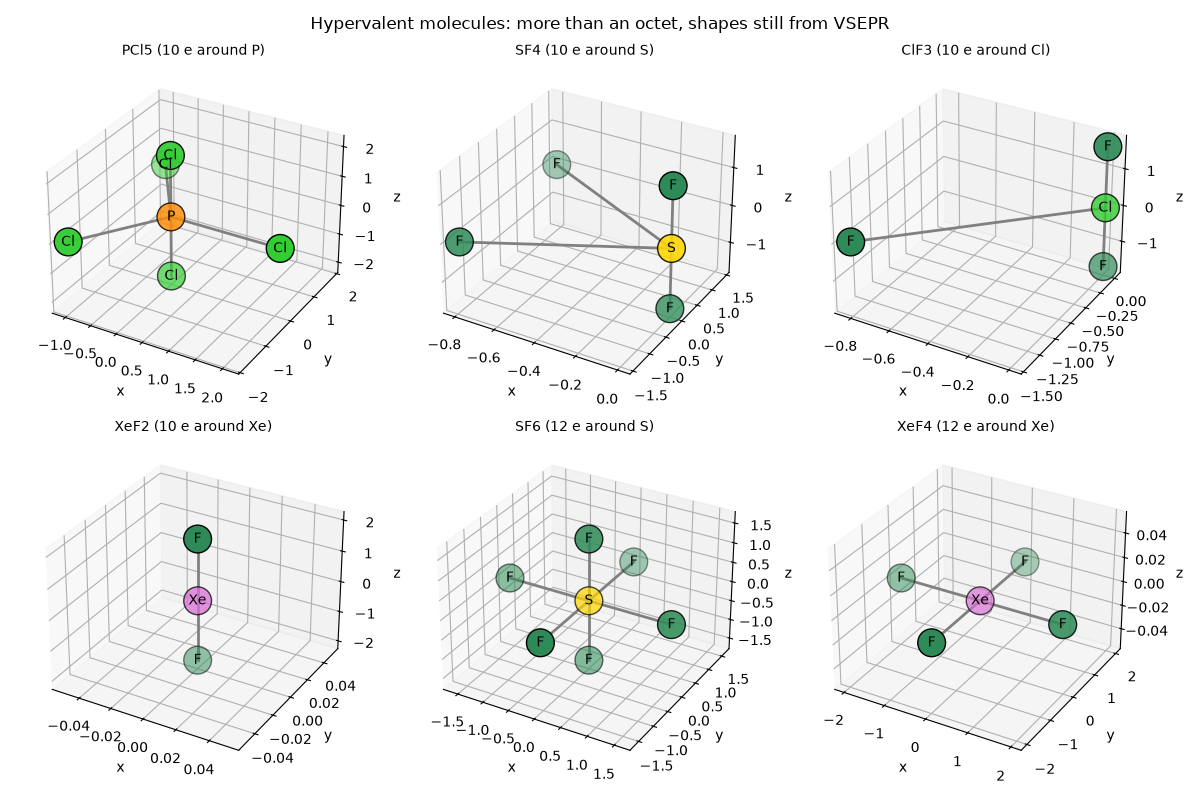
The six shapes, all derived from the five- and six-domain polyhedra:
fig = plt.figure(figsize=(12, 8))
for i, (name, molecule) in enumerate(molecules.items(), start=1):
    ax = fig.add_subplot(2, 3, i, projection="3d")
    plot_molecule_3d(molecule, ax=ax)
    ax.set_title(f"{name} ({2 * (hypervalent[name][0])} e around {hypervalent[name][2]})", fontsize=10)
fig.suptitle("Hypervalent molecules: more than an octet, shapes still from VSEPR")
fig.tight_layout()
plt.show()
Total running time of the script: (0 minutes 0.211 seconds)