Note
Go to the end to download the full example code.
Sabatier and Senderens: catalytic hydrogenation over finely divided nickel#
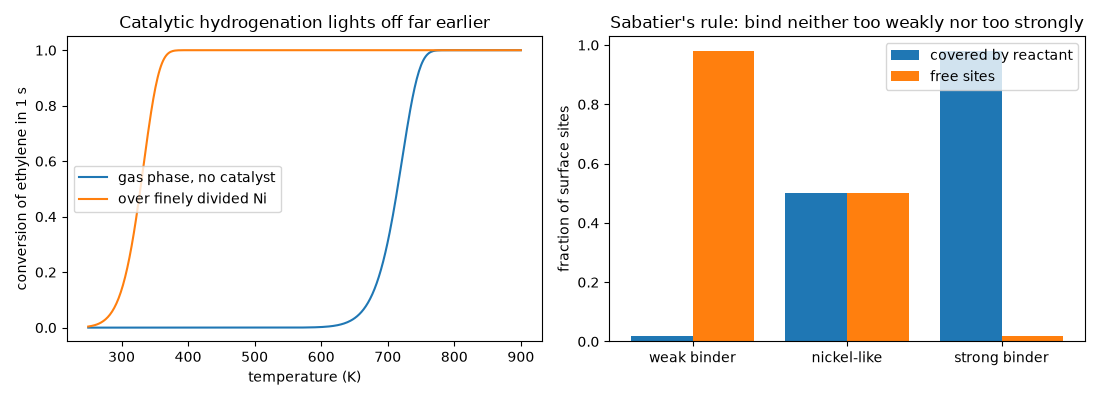
Sabatier and Senderens showed from 1897 that finely divided nickel
hydrogenates ethylene (\(C_2H_4 + H_2 \to C_2H_6\)) at temperatures
where the gas-phase reaction does not run at all. This example uses
illustrative Arrhenius parameters and
compare_catalyzed_rate() to
compute the conversion reached in a one-second contact time as the
temperature rises. Over nickel the reaction lights off hundreds of
kelvin earlier. A second panel shows Sabatier’s rule of thumb from
screening many metals: a metal that binds the reactant too weakly holds
almost none of it on the surface, and one that binds it too strongly
leaves no free sites. Only a moderate binder has both.
import matplotlib.pyplot as plt
import numpy as np

from chemistrykit.surface.systems.catalysis import compare_catalyzed_rate
from chemistrykit.surface.systems.langmuir import langmuir_coverage

tau = 1.0  # contact time, s
T = np.linspace(250.0, 900.0, 400)
comparisons = [compare_catalyzed_rate(Ea_uncatalyzed=180e3, Ea_catalyzed=45e3, T=Ti, A_uncatalyzed=1e13, A_catalyzed=1e7) for Ti in T]
X_uncat = 1.0 - np.exp(-np.array([c.k_uncatalyzed for c in comparisons]) * tau)
X_ni = 1.0 - np.exp(-np.array([c.k_catalyzed for c in comparisons]) * tau)

T_half_ni = T[np.searchsorted(X_ni, 0.5)]
T_half_gas = T[np.searchsorted(X_uncat, 0.5)]
print(f"50% conversion over Ni at   ~{T_half_ni:.0f} K")
print(f"50% conversion in gas phase ~{T_half_gas:.0f} K")
print(f"Nickel lowers the working temperature by ~{T_half_gas - T_half_ni:.0f} K")
50% conversion over Ni at   ~330 K
50% conversion in gas phase ~716 K
Nickel lowers the working temperature by ~386 K
Sabatier’s rule: surface coverage of the reactant (Langmuir) for three hypothetical metals at the same pressure.
weak binder    reactant coverage 0.020, free sites 0.980
nickel-like    reactant coverage 0.500, free sites 0.500
strong binder  reactant coverage 0.980, free sites 0.020
fig, axes = plt.subplots(1, 2, figsize=(11, 4))
axes[0].plot(T, X_uncat, label="gas phase, no catalyst")
axes[0].plot(T, X_ni, label="over finely divided Ni")
axes[0].set_xlabel("temperature (K)")
axes[0].set_ylabel("conversion of ethylene in 1 s")
axes[0].set_title("Catalytic hydrogenation lights off far earlier")
axes[0].legend()

names = list(metals)
x = np.arange(len(names))
axes[1].bar(x - 0.2, [theta[n] for n in names], width=0.4, label="covered by reactant")
axes[1].bar(x + 0.2, [1 - theta[n] for n in names], width=0.4, label="free sites")
axes[1].set_xticks(x, names)
axes[1].set_ylabel("fraction of surface sites")
axes[1].set_title("Sabatier's rule: bind neither too weakly nor too strongly")
axes[1].legend()
plt.tight_layout()
plt.show()
Total running time of the script: (0 minutes 0.072 seconds)