
Note
Go to the end to download the full example code.
Doebereiner’s platinum and Berzelius’s catalysis: a catalyst that is not consumed#
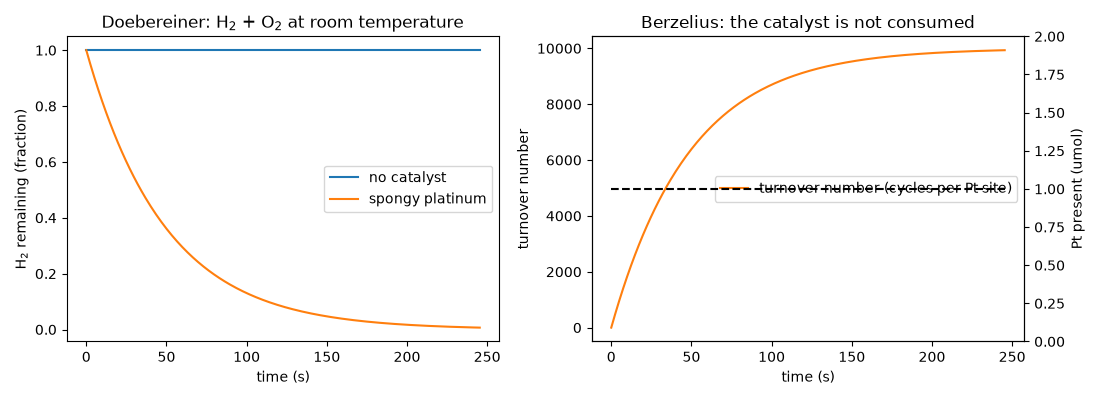
In 1823 Doebereiner found that spongy platinum ignites a jet of hydrogen
in air at room temperature and comes out of the reaction unchanged; in
1835 Berzelius named the phenomenon catalysis. This example makes both
halves of that observation quantitative with illustrative (not measured)
parameters for \(2H_2 + O_2 \to 2H_2O\). Lowering the activation
energy on platinum
(compare_catalyzed_rate())
turns a reaction that is frozen at room temperature into a fast one, and
the turnover_number() keeps
growing while the amount of platinum stays exactly the same. The
catalyst is used again and again, never used up.
import matplotlib.pyplot as plt
import numpy as np

from chemistrykit.surface.systems.catalysis import compare_catalyzed_rate, turnover_number

T = 293.15  # room temperature, K
comparison = compare_catalyzed_rate(Ea_uncatalyzed=170e3, Ea_catalyzed=60e3, T=T, A_uncatalyzed=1e11, A_catalyzed=1e9)
print(f"Uncatalyzed k at {T} K: {comparison.k_uncatalyzed:.3e} 1/s")
print(f"On platinum:            {comparison.k_catalyzed:.3e} 1/s")
print(f"Rate enhancement:       {comparison.rate_enhancement:.3e}")
Uncatalyzed k at 293.15 K: 5.120e-20 1/s
On platinum:            2.038e-02 1/s
Rate enhancement:       3.980e+17
A batch of hydrogen (first order in H2 for simplicity) over a fixed amount of platinum. The platinum is not a reactant: its amount stays constant, while the number of H2 molecules each Pt site has converted (the turnover number) keeps rising.
n_H2_0 = 1.0e-2  # mol
n_Pt = 1.0e-6  # mol of surface Pt sites
t = np.linspace(0.0, 5.0 / comparison.k_catalyzed, 300)
n_H2_cat = n_H2_0 * np.exp(-comparison.k_catalyzed * t)
n_H2_uncat = n_H2_0 * np.exp(-comparison.k_uncatalyzed * t)
ton = np.array([turnover_number(n_H2_0 - n, n_Pt) for n in n_H2_cat])
print(f"\nTurnover number when the H2 is used up: {ton[-1]:.0f} cycles per Pt site")
print(f"Platinum left afterwards: {n_Pt:.1e} mol (unchanged)")
Turnover number when the H2 is used up: 9933 cycles per Pt site
Platinum left afterwards: 1.0e-06 mol (unchanged)
fig, axes = plt.subplots(1, 2, figsize=(11, 4))
axes[0].plot(t, n_H2_uncat / n_H2_0, label="no catalyst")
axes[0].plot(t, n_H2_cat / n_H2_0, label="spongy platinum")
axes[0].set_xlabel("time (s)")
axes[0].set_ylabel("H$_2$ remaining (fraction)")
axes[0].set_title("Doebereiner: H$_2$ + O$_2$ at room temperature")
axes[0].legend()

axes[1].plot(t, ton, color="C1", label="turnover number (cycles per Pt site)")
axes[1].set_xlabel("time (s)")
axes[1].set_ylabel("turnover number")
ax2 = axes[1].twinx()
ax2.plot(t, np.full_like(t, n_Pt * 1e6), "k--", label="Pt present (umol)")
ax2.set_ylabel("Pt present (umol)")
ax2.set_ylim(0, 2)
axes[1].set_title("Berzelius: the catalyst is not consumed")
axes[1].legend(loc="center right")
plt.tight_layout()
plt.show()
Total running time of the script: (0 minutes 0.083 seconds)