Note
Go to the end to download the full example code.
SHAKE: rigid bonds let a bending molecule take larger time steps#
Ryckaert, Ciccotti, and Berendsen’s SHAKE algorithm (1977) replaces stiff
bond springs by exact length constraints, restored after every Verlet
position update by iterative corrections along the old bond vectors
(shake()). A water-like
triatomic is simulated twice: with stiff harmonic O-H springs
(HarmonicMolecule),
and with the two bonds held rigid by SHAKE
(ShakeMolecule), keeping
the same flexible angle-bending term. Both runs use the same time step, chosen comfortably for the slow
bending motion but too long for the fast bond stretch.
import matplotlib.pyplot as plt
import numpy as np

from chemistrykit.md.systems.constraints import ShakeMolecule
from chemistrykit.md.systems.pair_potentials import HarmonicMolecule

theta0, r0 = np.deg2rad(104.5), 1.0
masses = [1.0, 16.0, 1.0]
k_bond, k_angle = 3000.0, 50.0
positions = np.array([[np.sin(theta0 / 2), np.cos(theta0 / 2), 0.0], [0.0, 0.0, 0.0], [-np.sin(theta0 / 2), np.cos(theta0 / 2), 0.0]])
velocities = np.zeros_like(positions)
velocities[0] = [np.cos(theta0 / 2), -np.sin(theta0 / 2), 0.0]  # tangential kicks that open the angle
velocities[2] = [-np.cos(theta0 / 2), -np.sin(theta0 / 2), 0.0]
velocities -= np.average(velocities, axis=0, weights=masses)

angles = [(0, 1, 2, k_angle, theta0)]
flexible = HarmonicMolecule(positions, velocities, masses, bonds=[(0, 1, k_bond, r0), (1, 2, k_bond, r0)], angles=angles)
rigid = ShakeMolecule(positions, velocities, masses, constraints=[(0, 1, r0), (1, 2, r0)], angles=angles)

dt, n_steps = 0.04, 250


def angle_deg(p):
    v1, v2 = p[0] - p[1], p[2] - p[1]
    return np.degrees(np.arccos(v1 @ v2 / np.linalg.norm(v1) / np.linalg.norm(v2)))


records = {"flexible (stiff springs)": flexible, "rigid bonds (SHAKE)": rigid}
traces = {name: {"bond": [], "angle": [], "energy": []} for name in records}
alive = {name: True for name in records}
for _ in range(n_steps + 1):
    for name, mol in records.items():
        p = mol.positions
        bond = np.linalg.norm(p[0] - p[1])
        alive[name] = alive[name] and abs(bond - r0) < 0.5  # stop following a run once it has blown up
        tr = traces[name]
        tr["bond"].append(bond if alive[name] else np.nan)
        tr["angle"].append(angle_deg(p) if alive[name] else np.nan)
        tr["energy"].append(mol.kinetic_energy() + mol.potential_energy() if alive[name] else np.nan)
        if alive[name]:
            mol.step(dt)

t = np.arange(n_steps + 1) * dt
fig, axes = plt.subplots(1, 3, figsize=(14, 4.2))
for name, color in zip(records, ["firebrick", "steelblue"], strict=True):
    tr = traces[name]
    axes[0].plot(t, tr["bond"], color=color, label=name)
    axes[1].plot(t, tr["angle"], color=color, label=name)
    axes[2].plot(t, np.array(tr["energy"]) - tr["energy"][0], color=color, label=name)
axes[0].set_ylabel("O-H bond length")
axes[0].set_ylim(0.4, 1.6)
axes[1].set_ylabel("H-O-H angle (degrees)")
axes[2].set_ylabel("change in total energy")
axes[2].set_yscale("symlog", linthresh=1e-3)
axes[2].set_ylim(-10, 10)
for ax, title in zip(axes, ["Bond length", "Bond angle", "Energy conservation"], strict=True):
    ax.set_xlabel("t")
    ax.set_title(title)
axes[0].legend()
fig.tight_layout()
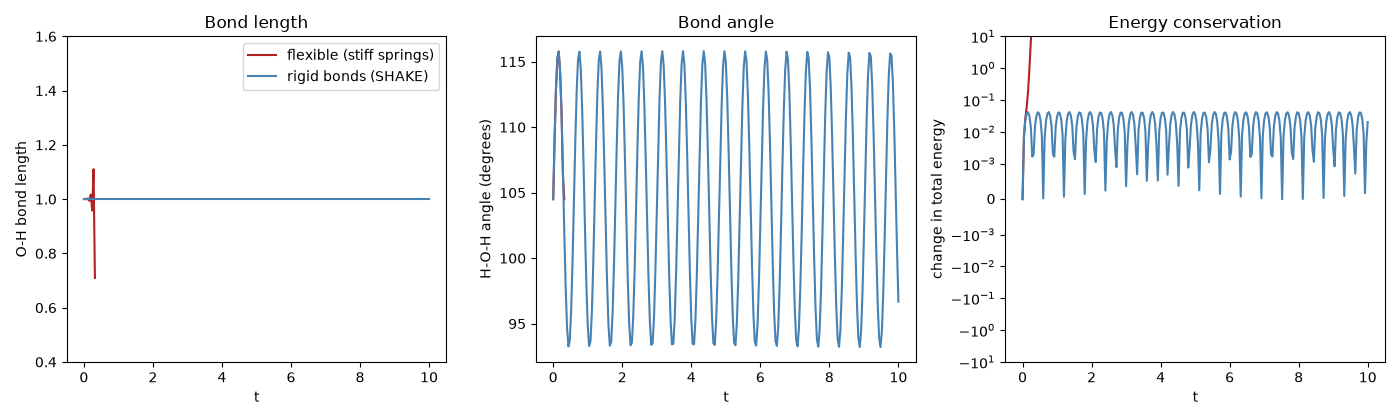
The stiff O-H springs vibrate far faster than the bend: Verlet is only stable for \(\omega\Delta t < 2\), and at this time step the flexible bonds exceed that limit, so their energy runs away within a few steps. With SHAKE the bond lengths stay fixed to the solver tolerance, only the slow bend is left to integrate, and the energy only fluctuates within a few percent, with no drift:
rigid_bonds = np.array(traces["rigid bonds (SHAKE)"]["bond"])
bond_period = 2 * np.pi / np.sqrt(k_bond * (1 / 1.0 + 1 / 16.0))
print(f"stiff-bond vibration period {bond_period:.3f}: omega * dt = {2 * np.pi / bond_period * dt:.2f} (> 2)")
print(f"flexible run blew up after {np.argmax(np.isnan(traces['flexible (stiff springs)']['bond']))} steps")
print(f"SHAKE bond-length deviation: {np.max(np.abs(rigid_bonds - r0)):.1e}")
energy = np.array(traces["rigid bonds (SHAKE)"]["energy"])
print(f"SHAKE run: largest energy change {np.max(np.abs(energy - energy[0])):.1e} (total energy {energy[0]:.3f})")

plt.show()
stiff-bond vibration period 0.111: omega * dt = 2.26 (> 2)
flexible run blew up after 9 steps
SHAKE bond-length deviation: 4.7e-11
SHAKE run: largest energy change 4.2e-02 (total energy 0.931)
Total running time of the script: (0 minutes 0.315 seconds)