Note
Go to the end to download the full example code.
Kasha’s rule: emission comes from the lowest excited state#
Kasha (1950) stated that emission comes almost entirely from the lowest
excited state of a given multiplicity (\(S_1\) for fluorescence),
because internal conversion from higher states such as \(S_2\) takes
picoseconds or less, much faster than emission. With
kasha_emission_yields(), a molecule excited
to \(S_2\) sends only a tiny fraction of its emission from
\(S_2\); the exception is a molecule like azulene, whose large
\(S_2\)-\(S_1\) gap slows internal conversion enough for
\(S_2\) emission to compete.
import matplotlib.pyplot as plt
import numpy as np

from chemistrykit.photochem import kasha_emission_yields

kf2, kf1, knr1 = 1.0e8, 1.0e8, 1.0e8  # 1/s
k_ic21 = np.logspace(7, 14, 200)  # S2 -> S1 internal conversion rate, 1/s
phi2, phi1 = np.array([kasha_emission_yields(kf2, k, kf1, knr1) for k in k_ic21]).T

fig, ax = plt.subplots()
ax.semilogx(k_ic21, phi1 / (phi1 + phi2), label=r"share of emission from $S_1$")
ax.semilogx(k_ic21, phi2 / (phi1 + phi2), label=r"share of emission from $S_2$")
ax.axvspan(1e12, 1e14, color="0.9", label="typical $S_2\\to S_1$ internal conversion")
ax.set_xlabel(r"$k_{ic}(S_2\to S_1)$ (s$^{-1}$)")
ax.set_ylabel("Fraction of emitted photons")
ax.set_title("Kasha's rule: fast internal conversion funnels emission to $S_1$")
ax.legend(loc="center left")
fig.tight_layout()
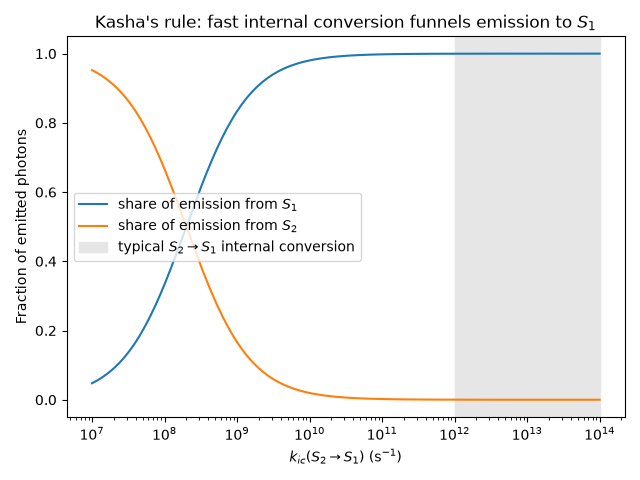
typical dye                   : Phi(S2 emission) = 1.00e-05, Phi(S1 emission) = 0.500
azulene-like (slow S2 -> S1)  : Phi(S2 emission) = 9.09e-02, Phi(S1 emission) = 0.455
Total running time of the script: (0 minutes 0.078 seconds)